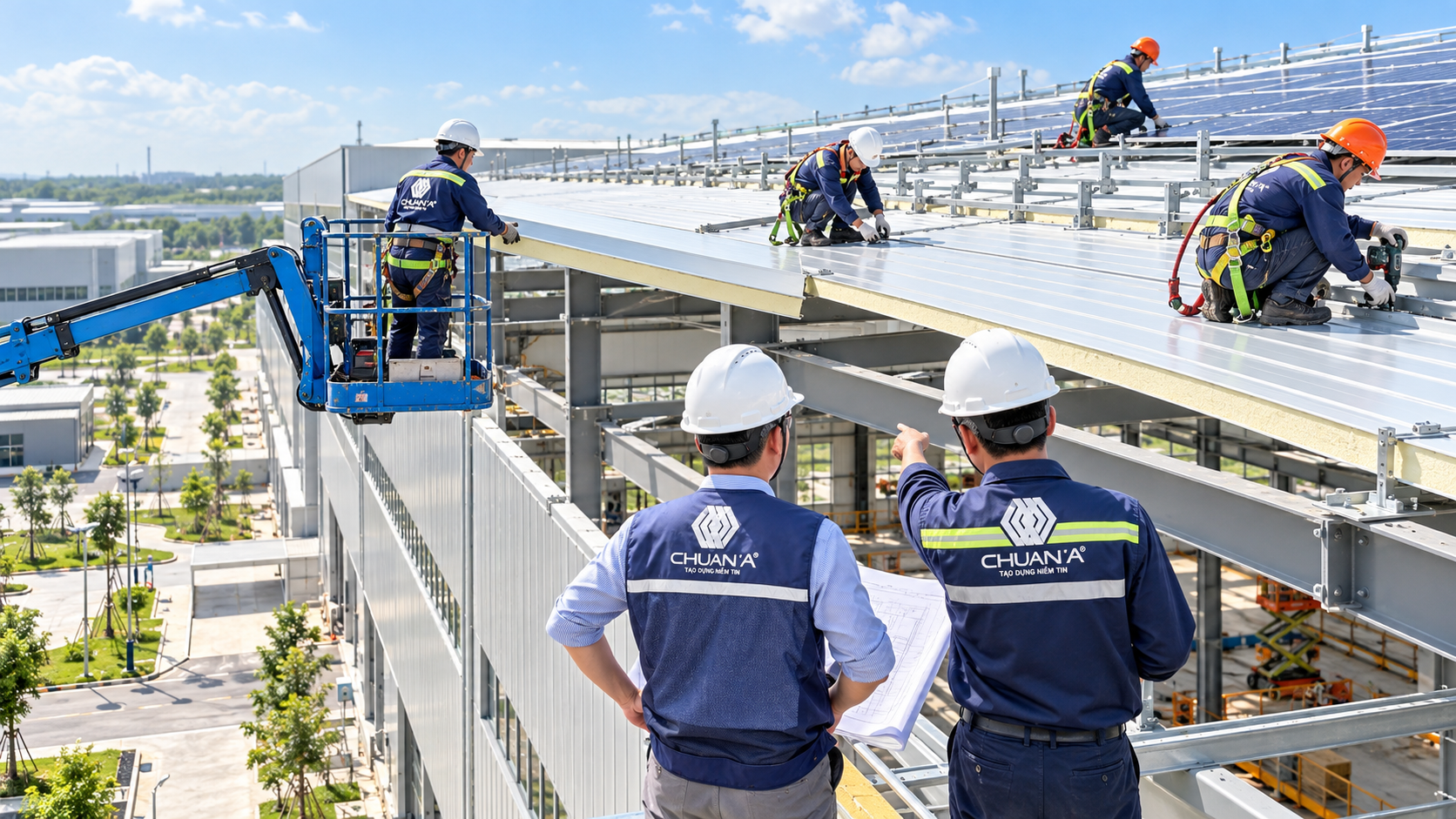
Green factory construction is becoming an important consideration for businesses investing in modern industrial facilities. Instead of focusing only on initial construction costs, sustainable factory development evaluates energy consumption, material efficiency, water use, maintenance, and long-term operating performance. Appropriate solutions can help improve working conditions, reduce unnecessary resource consumption, and support sustainable business development.
Green factory construction involves designing, building, and operating industrial facilities with an emphasis on energy efficiency, resource conservation, and environmental performance.
A building with extensive landscaping is not necessarily a high-performance green factory. Its performance should be evaluated through relevant engineering criteria and actual operating conditions.
Design decisions should consider heat transfer through roofs and walls, lighting requirements, ventilation demand, and equipment efficiency.
Construction materials, water, and other resources should be selected and managed according to the facility's operational needs.
Industrial facilities require suitable ventilation, lighting, thermal conditions, and safety arrangements for their manufacturing activities..png)
Appropriate roofing systems, building envelopes, and thermal insulation can help reduce heat gain.
Material selection should account for climate conditions, structural loads, fire safety, moisture exposure, and maintenance requirements.
Skylights and carefully planned daylight openings can reduce artificial lighting demand during suitable daytime conditions.
However, daylight design must also address glare, solar heat gain, and the requirements of production areas.
Natural and mechanical ventilation should be designed around internal heat sources, indoor air quality, and required airflow.
Factories with considerable process heat may need localized extraction systems.
LED lighting, appropriately sized motors, control systems, and energy monitoring can support more efficient electricity use.
Rooftop solar power may also be considered where structural capacity, electrical connections, fire safety, and applicable regulations permit.
Engineers review building area, production processes, electrical loads, water demand, environmental conditions, and operating objectives.
Architectural, structural, and MEP systems should be coordinated to achieve suitable layouts, roofing, lighting, ventilation, and building service installations.
Materials should be evaluated according to technical suitability, durability, safety, maintainability, and environmental information where reliable data is available.
Construction management should address material use, waste, dust, noise, water management, and occupational safety.
Insulation, structural components, and building services must be installed according to approved designs.
Completed installations should be inspected for required performance and technical compliance.
Operation and maintenance documentation should support long-term building efficiency..png)
Water-saving fixtures, leak detection, and suitable water reuse systems can be considered where treatment and operational requirements are satisfied.
Material segregation, organized storage, and appropriate waste transportation help reduce unnecessary waste during construction.
Green areas, paved surfaces, and drainage systems should be planned according to site conditions, internal transportation, and environmental requirements..png)
Construction costs depend on building size, structural systems, material specifications, energy-efficient equipment, and the owner's environmental objectives.
Certain solutions may require higher initial investment but can reduce energy consumption, water demand, or maintenance expenses over time.
Investors should evaluate life-cycle costs, including construction, operation, maintenance, equipment replacement, and long-term performance.
Environmental improvements should be supported by engineering calculations and actual operating measurements rather than assumed savings.
Chuan A provides consulting, design, and construction services for industrial facilities, emphasizing functionality, safety, and long-term operating efficiency.
Businesses can explore Chuan A's factory design and construction services and its guidance on factory design standards.
For project-specific consultation, investors should prepare information about factory size, manufacturing activities, energy needs, and environmental objectives.
CÔNG TY CP ĐẦU TƯ XÂY DỰNG CÔNG TRÌNH CHUẨN A
Address: Amata Industrial Park Service Center, Long Binh Ward, Dong Nai Province, Vietnam.
Hotline: 0907 494 549
Email: info@chuana.com.vn
Website: https://chuana.com.vn/