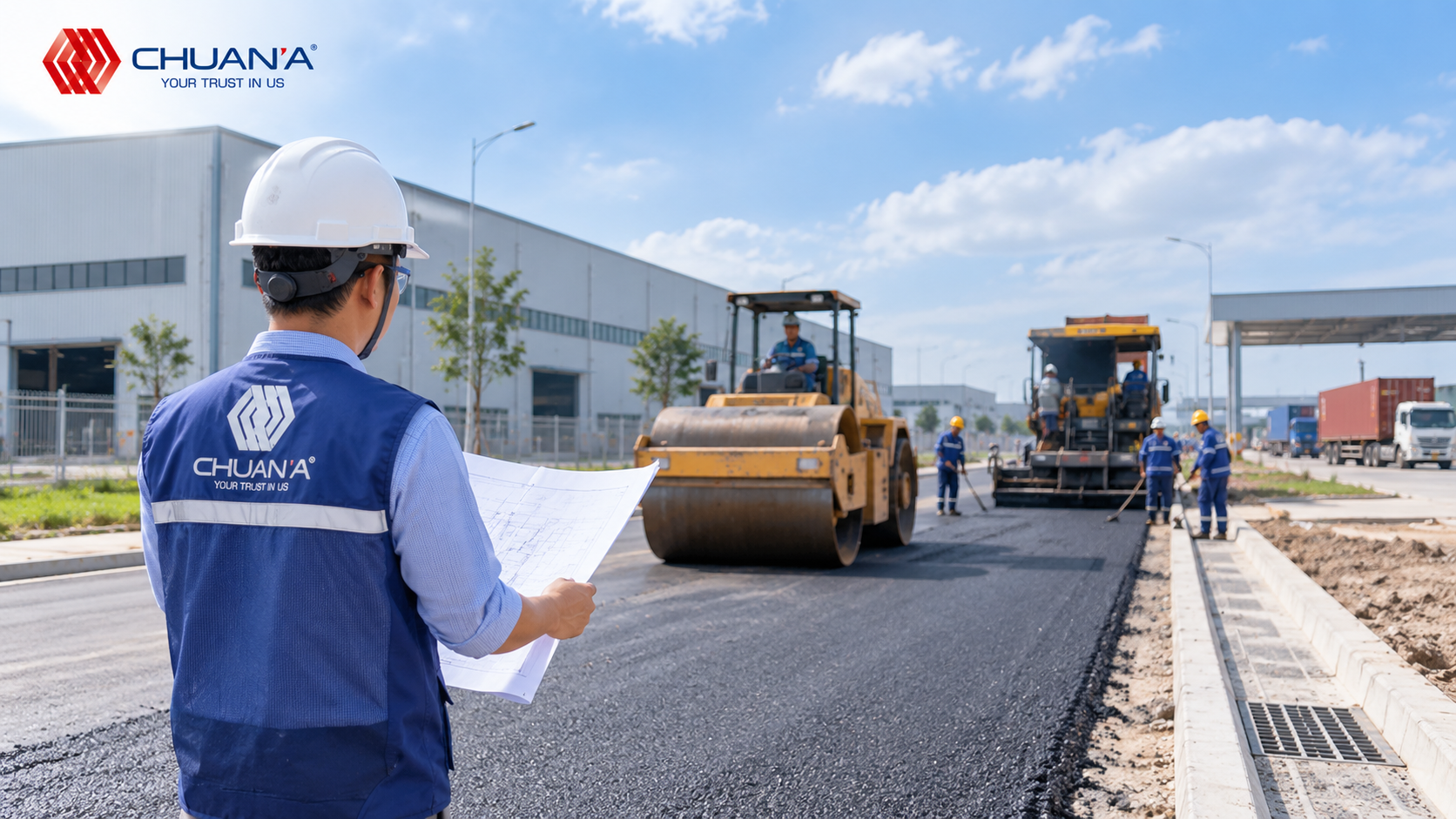
A modern factory may have an efficient production line and well-designed buildings, but poor internal roads can still create significant operational problems.
Factory roads connect the entrance gate, production buildings, warehouses, loading areas, truck yards and container operations.
For this reason, selecting a factory internal road contractor in Dong Nai involves much more than choosing a pavement material.
A reliable solution should consider ground conditions, vehicle types, traffic frequency, pavement structure, drainage, logistics flow and future maintenance.
Chuan A's published experience includes internal roads, drainage and industrial infrastructure, while one of its projects at Amata Industrial Park included site grading, internal roads, drainage and supporting lighting infrastructure.
A factory internal road is part of the transportation infrastructure within an industrial facility.
It may serve:
A complete internal traffic system may include:
The objective is to support the overall operational flow of the facility.
Industrial logistics depends on continuous movement.
Poor road infrastructure can create several problems.
Insufficient road width or unsuitable turning arrangements can slow truck and container operations.
Road elevation and drainage must be coordinated.
Replacing only the pavement surface may not solve a drainage problem caused by elevation or settlement.
Some locations receive more demanding traffic conditions, including:
Traffic conditions should therefore be considered during engineering.
Potholes, uneven surfaces and standing water may affect trucks, forklifts and pedestrians.
A road assessment should be considered when:
Repeated surface repairs may not solve a problem caused by the foundation or drainage system.(1).png)
There is no universal answer.
Both systems can be appropriate depending on project conditions.
Concrete is commonly used for industrial areas.
The design and construction process should consider:
A strong surface cannot compensate for an unsuitable foundation.
Asphalt is also widely used for road applications.
The system may involve:
The final choice should reflect engineering requirements, vehicle loading, construction conditions and maintenance strategy rather than unit price alone.
The pavement surface is the visible component, but long-term performance depends heavily on the layers below it.
These may include:
Problems associated with inadequate support may include:
Existing ground conditions should therefore be reviewed before finalizing the pavement solution.
For a new internal road, site preparation may include:
Chuan A's published Amata parking project includes site grading, foundation preparation, internal road construction and supporting drainage infrastructure.(1).png)
Road and drainage systems are directly connected.
Stormwater must move from the pavement into an appropriate collection network.
This may include:
Engineering considerations include:
Adding drainage inlets alone may not solve the problem if the road elevations are incorrect.
Container operations create different requirements from passenger-vehicle traffic.
The layout should identify:
Corners and intersections need to suit the expected vehicle type.
Areas where vehicles stop, turn or brake may experience different operating conditions from straight travel lanes.
Unnecessary interaction between large vehicles and pedestrians should be minimized.
Possible measures include:
An industrial yard should be designed according to its actual use.
The project should identify whether:
The solution can then coordinate:
Collect basic information about:
Review:
Depending on the project, the scope may involve:
Define:
Possible work includes:
The road foundation is constructed according to the approved project design.
Depending on design requirements, the pavement may use:
Complete relevant items such as:
Completed works should be checked according to the project documentation and agreed acceptance scope.(1).png)
Road renovation in an operating facility requires careful logistics planning.
Production may still need:
Alternative routes can be established where possible.
The road can be divided into phases so one area is completed before another is closed.
Some activities may be scheduled during:
Construction planning should preserve required access to critical facility areas.
Not every damaged road requires complete reconstruction.
The goal should be to correct the cause rather than repeatedly repairing the visible symptom.
Good concrete or asphalt cannot compensate for inadequate underlying support.
A passenger-car road and a container route do not operate under the same conditions.
Pavement elevation and stormwater collection should be designed together.
Road areas may contain:
Existing utilities should be identified before excavation.
A durable road can still create inefficient logistics if vehicle movement is poorly arranged.
Project cost can vary significantly depending on:
For this reason, a site survey and defined BOQ provide a more reliable basis for quotation than a generic price per square meter.
Manufacturers can prepare:
This information helps contractors prepare a more focused survey and proposal.
Industrial infrastructure is interconnected.
A road modification may affect:
An integrated approach can reduce conflicts and help maintain consistent site elevations.
Chuan A's website identifies internal roads, drainage and industrial infrastructure among its construction experience.
Its published Amata Industrial Park parking project included site preparation, internal roads, drainage and supporting infrastructure, providing direct relevance to factory road and yard projects in Dong Nai.
This supports an integrated approach where pavement, foundation and drainage are considered as one infrastructure system.
It depends on project conditions, vehicle requirements, foundation, schedule and maintenance strategy.
Not necessarily.
The cause should first be identified, including pavement elevation, drainage, settlement and collection points.
In many projects, yes.
Phased construction and temporary traffic management can help maintain facility access.
Yes, particularly for rehabilitation projects.
Yes.
Vehicle type, frequency and operating conditions are important design inputs.
The two systems should be coordinated because pavement slopes and elevations directly influence stormwater drainage.
An accurate quotation requires the actual condition of the facility. An on-site survey establishes work scope, construction methods and priority levels for each item.
CHUAN A CONSTRUCTION INVESTMENT CORPORATION
Address: Amata Industrial Park Service Centre, Long Binh Ward, Dong Nai Province, Vietnam.
Hotline: 0907 494 549
Email: info@chuana.com.vn
Website:https://chuana.com.vn/
Contact Chuan A to arrange a survey and receive a factory maintenance quotation in Dong Nai.