Internal roads are an essential part of industrial park infrastructure. They connect factories, warehouses, logistics areas, administrative buildings, and technical facilities. More importantly, they support the daily movement of raw materials, finished products, heavy vehicles, and personnel throughout an industrial site.
Industrial park internal road construction requires careful consideration of site conditions, traffic loads, pavement design, drainage, and actual operating requirements. A properly planned road network can improve traffic circulation, support logistics operations, and reduce the risk of premature pavement deterioration.
Internal roads are transportation routes located within an industrial park. They provide access between the main entrance, factories, warehouses, service areas, utility facilities, and other functional zones.
Unlike ordinary access roads, industrial park roads may accommodate a wide range of vehicles, including trucks, container trailers, specialized vehicles, forklifts, and employee transportation.
Depending on the site's layout and operational needs, the internal road network may include:
Main access roads: Connect the industrial park entrance with major functional areas.
Secondary roads: Provide access to individual factories, warehouses, and production facilities.
Utility access roads: Support maintenance and access to electrical, water supply, drainage, and other technical systems.
Intersections and turning areas: Allow vehicles to enter, exit, turn, and maneuver safely.
Pedestrian and two-wheel vehicle routes: Help separate pedestrian movement from industrial traffic.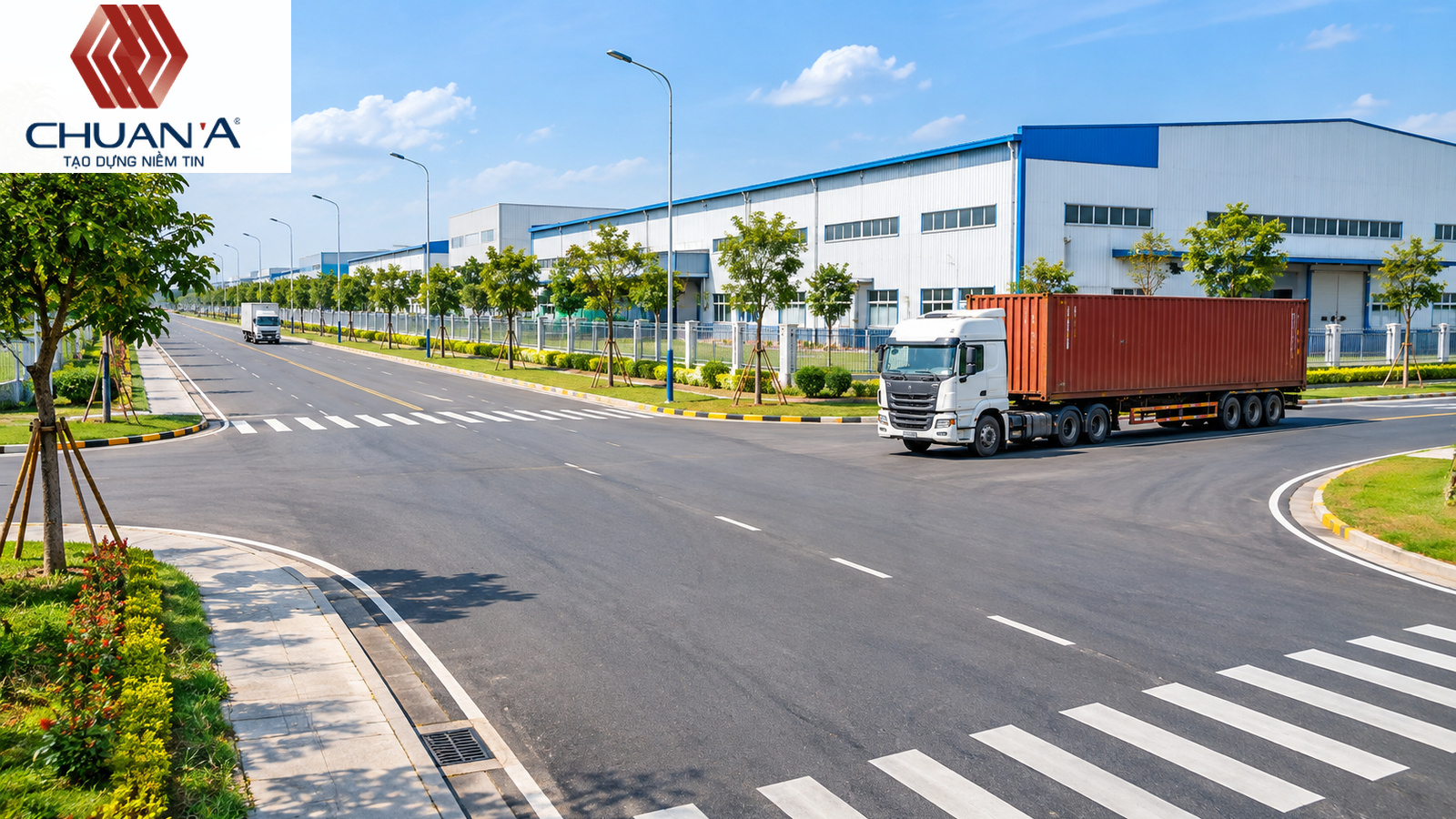
Before construction begins, the project team should assess the existing terrain, soil conditions, ground elevations, groundwater conditions, and drainage characteristics.
These investigations provide the information needed to select suitable ground improvement methods, determine pavement structures, and establish construction solutions.
Where weak soil, high groundwater levels, or complex terrain are present, the ground treatment strategy must be carefully evaluated. Inadequate investigation may contribute to differential settlement, pavement cracking, and long-term maintenance problems.
Industrial roads frequently serve heavy transportation activities. Their design should therefore consider vehicle types, axle loads, traffic volume, and expected operating frequency.
Road sections used regularly by heavy trucks and container trailers may require stronger pavement structures and more careful subgrade evaluation. Different road sections do not necessarily need identical pavement designs because their traffic conditions and operational demands may vary.
Standing water and water infiltration can affect pavement performance and accelerate deterioration.
Road design should therefore be coordinated with the stormwater drainage system, including pavement slopes, drainage channels, inlets, manholes, and underground pipes. Road elevations must also be coordinated with surrounding facilities to reduce localized flooding.
An effective industrial road network requires more than durable pavement. It also needs a clear traffic management plan.
Important considerations include lane widths, turning radii, intersections, traffic signs, pavement markings, parking areas, and pedestrian routes. Special attention should be given to locations with frequent heavy vehicle movements or significant pedestrian activity.
The appropriate pavement structure depends on design loads, soil conditions, traffic requirements, project specifications, and investment considerations.
Asphalt pavement is widely used in transportation infrastructure. Its structure typically includes an asphalt surface layer supported by base and subbase layers designed for the expected traffic conditions.
Its advantages include a relatively smooth riding surface and the ability to carry out localized repairs when necessary. However, pavement performance depends on structural design, material quality, construction methods, and drainage conditions.
Cement concrete pavement may be considered for areas exposed to heavy loads, frequent transportation activities, or specific operational requirements.
When properly designed and constructed, this pavement type can provide good load-bearing performance. Quality control should cover concrete materials, placement, curing, joint construction, and connections with adjacent structures.
Subgrade preparation and pavement base layers provide structural support and distribute vehicle loads. Their materials, thicknesses, and construction methods must follow the approved design documents and actual site conditions.
There is no single pavement solution suitable for every industrial park. The final selection should be based on geotechnical investigation, traffic loading, operational requirements, and project specifications.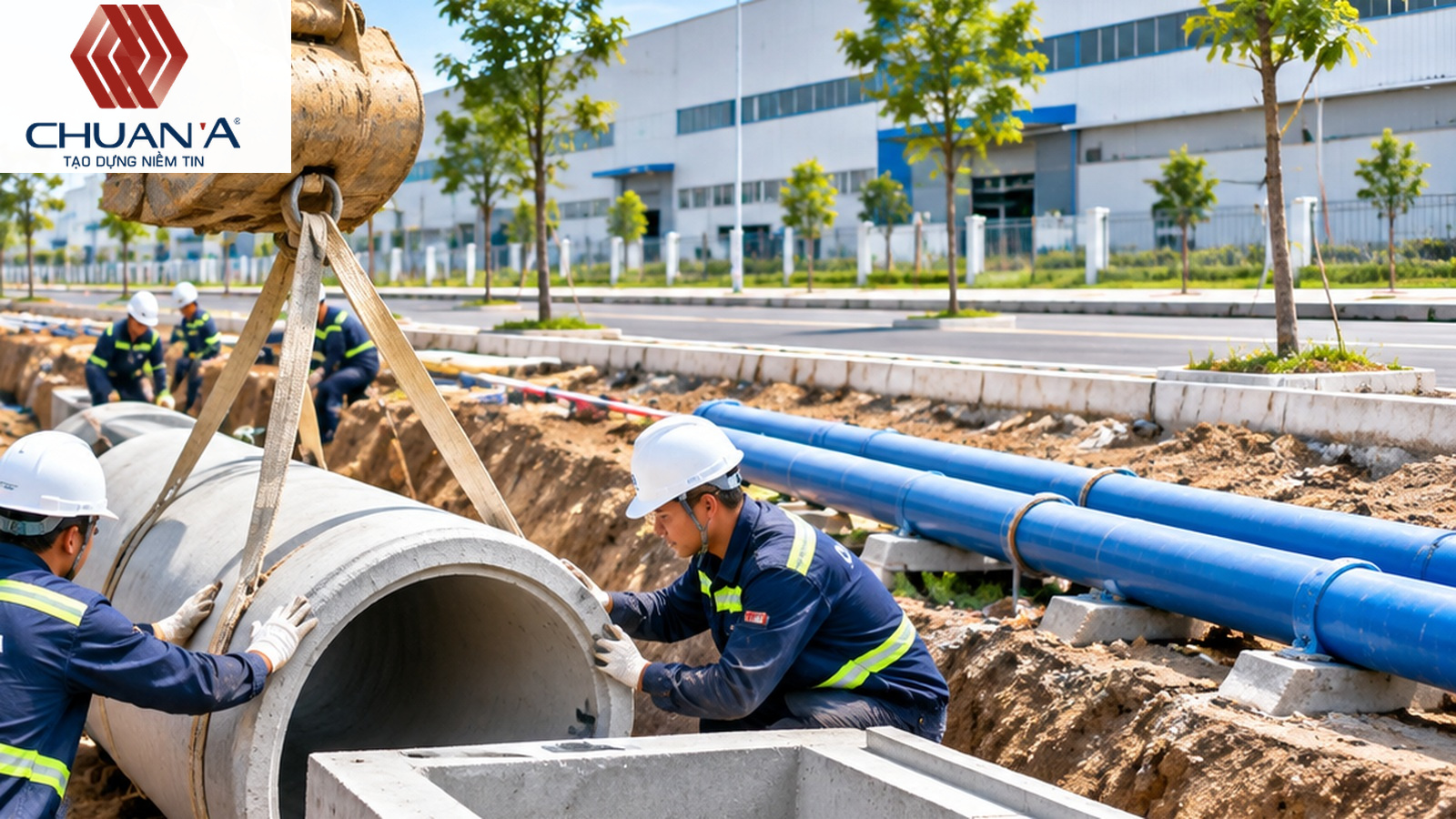
The construction team reviews the design documents, inspects existing conditions, identifies the construction boundaries, and checks existing infrastructure. Underground utilities, pipelines, and cables should be identified before excavation or heavy equipment operations begin.
The road centerline, pavement boundaries, design elevations, and control points are established according to the technical drawings. Accurate setting-out helps maintain the required road geometry throughout construction.
Excavation, embankment, and ground improvement are carried out according to the design requirements. Fill materials should be checked for quality and moisture conditions. Compaction must follow the specified construction procedures and appropriate testing requirements.
Drainage channels, manholes, cross drains, and longitudinal pipes are installed according to the approved drawings. Elevations, slopes, connections, and drainage performance should be checked before completing the related pavement layers.
Depending on the selected pavement design, the construction team installs the base, bonding, and surface layers. Each stage requires quality control for material properties, layer thickness, elevation, surface evenness, and applicable acceptance criteria.
After pavement construction, the remaining work may include shoulders, curbs, pavement markings, traffic signs, and supporting facilities. The site should be cleaned, inspected, and accepted before the road is opened for operation.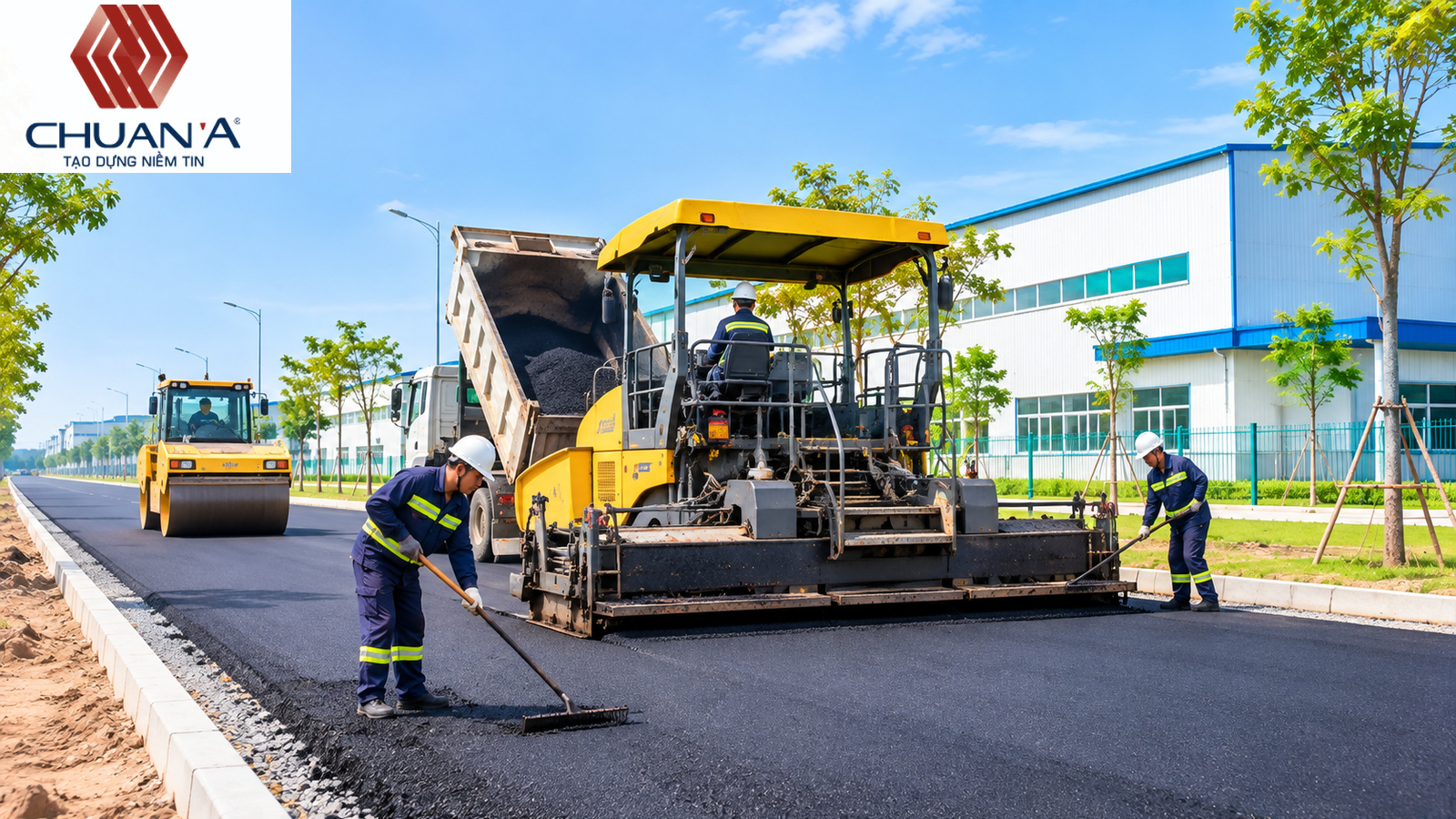
The performance of an industrial internal road depends not only on material selection but also on construction methods and technical supervision.
Key quality control activities include:
Incoming material inspection: Verify material sources, characteristics, and quality documentation.
Subgrade and base compaction testing: Conduct inspections and tests according to project specifications.
Elevation and slope control: Maintain road geometry and proper drainage.
Stage-by-stage acceptance: Inspect completed work before proceeding to subsequent pavement layers.
Workplace safety: Provide barriers, warning signs, traffic control, and safe equipment operation.
Protection of existing utilities: Prevent damage to underground cables, pipelines, and operating facilities.
Coordination among contractors, infrastructure managers, and industrial park tenants is also important to minimize disruptions to traffic and manufacturing activities.
Poor coordination between investigation, design, and construction can result in several problems:
Unstable subgrade: May cause settlement, cracking, and pavement deformation.
Inadequate drainage: Can lead to standing water, localized flooding, and damage to pavement layers.
Incorrect traffic load assumptions: May increase the risk of premature deterioration on heavy-vehicle routes.
Insufficient construction control: Can result in inaccurate elevations, inconsistent layer thicknesses, or poor surface quality.
Uncoordinated underground utilities: May require future pavement cutting to repair or install pipelines and cables.
Coordinating road planning with water supply, drainage, electrical, telecommunications, and fire protection systems during the design stage can help reduce these risks.
In industrial construction projects, internal roads should be considered part of an integrated infrastructure network rather than an isolated construction item.
With experience in civil construction, industrial construction, and infrastructure, CHUAN A CONSTRUCTION INVESTMENT JOINT STOCK COMPANY focuses on coordinating site conditions, building structures, technical infrastructure, and practical operating requirements during project implementation.
Each construction solution should be evaluated according to the design documents, existing site conditions, technical requirements, and the actual project scope. Quality control, schedule management, and construction safety remain important considerations throughout the process.
Businesses planning new construction, renovation, or completion of industrial facilities can contact Chuẩn A to discuss their project requirements.
CHUAN A CONSTRUCTION INVESTMENT JOINT STOCK COMPANY
Address: Amata Industrial Park Service Center, Long Binh Ward, Dong Nai Province, Vietnam.
Hotline: 0907 494 549
Email:info@chuana.com.vn
Website:https://chuana.com.vn/