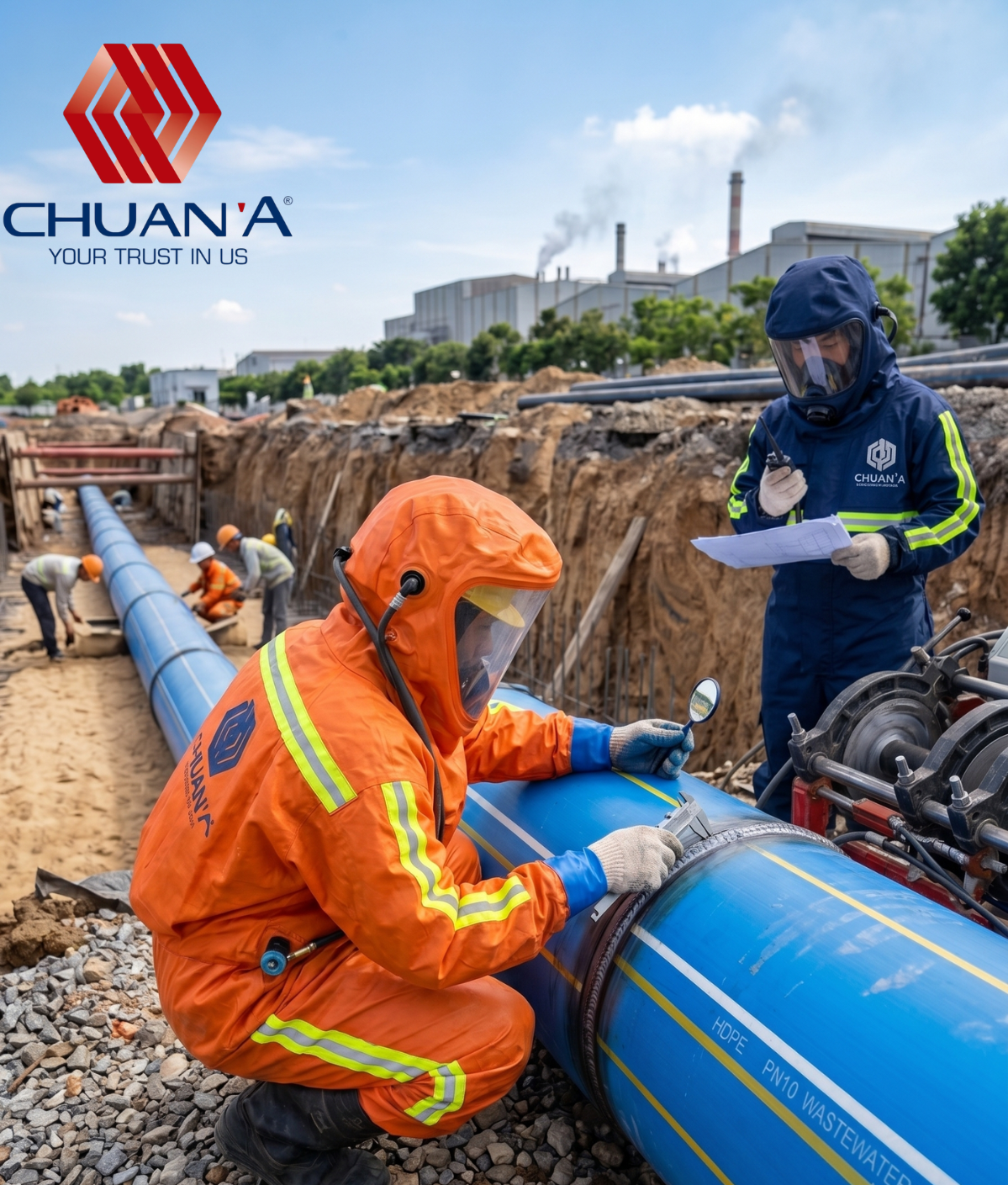
Turnkey industrial water supply, drainage, and wastewater treatment plant construction. ISO-compliant, cost-effective, and advanced technology.
In the era of industrialization and sustainable development, building a factory goes beyond setting up modern production lines; it heavily relies on auxiliary infrastructure. Among these, the water supply, drainage, and wastewater treatment (WWT) systems act as the "circulatory system" of the entire facility. A smooth-operating system not only guarantees a continuous water supply for production and daily use but also protects businesses from environmental legal risks.
Constructing this system is a complex challenge, requiring a tight integration of Mechanical, Electrical, and Plumbing (MEP) engineering, biochemical technology, and administrative legal regulations. This article provides a comprehensive look into the process from design, construction solutions, to the strictest technical standards.
A well-invested water supply, drainage, and wastewater treatment system brings three core values to businesses:
Industrial water supply must meet strict hardness, pH, and purity indexes depending on the industry (textiles, food, electronic components). A shortage or contamination of the input water will halt the entire production line.
A wastewater recycling system after treatment helps businesses save hundreds of millions of VND in clean water costs annually.
Discharging untreated or sub-standard wastewater (Column A or Column B according to Vietnam's QCVN) can expose enterprises to severe administrative fines or even operational suspension.
A complete factory water system consists of three independent yet complementary subsystems:
Water Source: Industrial park infrastructure water, groundwater (borewells), or surface water (rivers, lakes).
Pumping Station & Storage Tanks: Raw water tanks, filtered clean water tanks, and Variable Frequency Drive (VFD) booster pump systems.
Piping Network: Main pipelines and branches leading to production areas, offices, and firefighting systems.
Rainwater Drainage: Collects water from roofs and yards via gutters, manholes, and underground pipes to public receptors. It must be entirely separated from wastewater.
Wastewater Collection System: Enclosed pipelines collecting domestic wastewater (from toilets, canteens) and production wastewater, directing them to the central treatment plant.
A system of functional tanks (Equalization, Anaerobic, Aerobic, Clarifier, Disinfection) combined with mechanical equipment (air blowers, sludge pressers, automatic chemical dosing systems).
To ensure project quality, the contractor must strictly adhere to the following 5-step process:
Before bringing machinery to the site, engineers must measure the terrain, check geology (to prevent tank subsidence), and review basic design drawings. Cross-checking drawings with the actual site helps detect spatial conflicts between water pipes and ventilation (HVAC) or electrical cable trays.
Excavation & Foundation Reinforcement: Excavate foundations for the WWTP and underground piping system. For large-capacity reinforced concrete tanks, driving concrete piles for foundation reinforcement is mandatory.
Tank Concrete Pouring: Use commercial concrete with waterproofing additives (e.g., Sika). The pouring process must be continuous, minimizing construction joints to prevent wastewater leakage into the environment.
Sleeve Installation: Position and pre-install wall-penetrating sleeves before pouring concrete to avoid core drilling later, which compromises the tank structure.
Material Selection: HDPE or heavy-duty uPVC pipes for underground drainage; PPR or stainless steel pipes (SUS304/316) for clean water and chemical supply systems.
Welding & Connection Techniques: HDPE pipes are butt-fusion welded, and PPR pipes are socket-fusion welded to ensure 100% leak-proof joints. The network must maintain a standard slope ($1\% - 2\%$) for gravity drainage pipes.
Install submerged mechanical equipment: Submersible wastewater pumps, fine bubble diffusers at the bottom of the aerobic tank.
Install chemical dosing systems, plate-and-frame or belt press sludge dewatering machines.
Connect the central electrical control panel (PLC/SCADA), integrating online sensors (pH, DO, COD, TSS) for continuous water quality monitoring.
Pipeline Pressure Testing: Conduct hydrostatic pressure testing for water supply lines to detect any leaks.
Microbial Seeding: For biological WWTPs, process engineers will seed activated sludge, supply nutrients (molasses, urea), and aerate continuously to cultivate a stable microbial system before receiving actual wastewater.
Commissioning (Run-test): Run the system under load for 15 - 30 days to collect water samples for independent analysis and official acceptance by authorities.
Depending on the specific wastewater characteristics of each industry, contractors will advise on the appropriate technology:
| Technology Name | Operating Principle | Key Advantages | Suitable Industries |
|---|---|---|---|
| MBR Technology(Membrane Bioreactor) | Combines biological activated sludge with microfiltration/ultrafiltration membranes ($0.1 - 0.04\,\mu\text{m}$). | Eliminates secondary clarifiers, saves footprint, delivers ultra-clean effluent. | Office buildings, food, and pharmaceutical factories. |
| MBBR Technology(Moving Bed Biofilm Reactor) | Uses moving carriers for microorganisms to attach and grow. | Increases microbial density, handles high organic loads, easy capacity upgrade. | Textile dyeing, electroplating, and paper mills. |
| Physicochemical Combined | Uses coagulation-flocculation (alum, polymer) to settle and separate particles. | Effectively removes heavy metals, colloidal particles, and color. | Mechanical, chemical, and automotive paint plants. |
Once constructed, the system must undergo inspection and acceptance based on current national environmental regulations:
QCVN 40:2011/BTNMT: National technical regulation on industrial wastewater. This is the core regulation determining the permissible levels of pollutants such as BOD, COD, and heavy metals before discharge.
QCVN 14:2008/BTNMT: National technical regulation on domestic wastewater (applied to canteens and worker restrooms).
TCVN 4513:1988: Design standard for indoor water supply systems.
⚠️ Important Note: Before officially putting the project into operation, the investor must obtain an Environmental License (GPMT) in accordance with the latest Environmental Law.
Constructing industrial water supply, drainage, and wastewater treatment systems is a long-term strategic investment. Choosing a reputable contractor with optimized design capabilities and deep knowledge of environmental laws will help investors ensure smooth production, optimize capital flow, and aim toward a sustainable "Green Factory" model.
Contact us today to receive a free site survey and the most optimized turnkey solution quotation for your factory!
CHUAN'A CONSTRUCTION INVESTMENT JOINT STOCK COMPANY


