In the modern industrial economic landscape, optimizing production floor space and material storage areas has become a primary strategic challenge for enterprises. For factories, general warehouses, or outdoor material yards, constructing permanent steel-sheet roofs often faces building code restrictions, high initial investment costs, or a lack of operational flexibility. Therefore, smart mobile canvas roofing and retractable fabric structures have emerged as the ultimate solution, fully addressing the spatial demands of large-scale businesses.
The construction project of the retractable fabric roof system at Company Y... serves as a prime example of this trend. With a vast area requiring coverage, demanding high aesthetics and long-term durability against the harsh conditions of tropical monsoon weather, the client placed their absolute trust in our company for a turnkey installation. This comprehensive article provides a detailed construction log for June 8, 2026, analyzing the mechanical engineering solutions, structural framework, and quality control workflow from the fabrication workshop to the site, under the direct supervision of Mr. Bui Chi Hung.
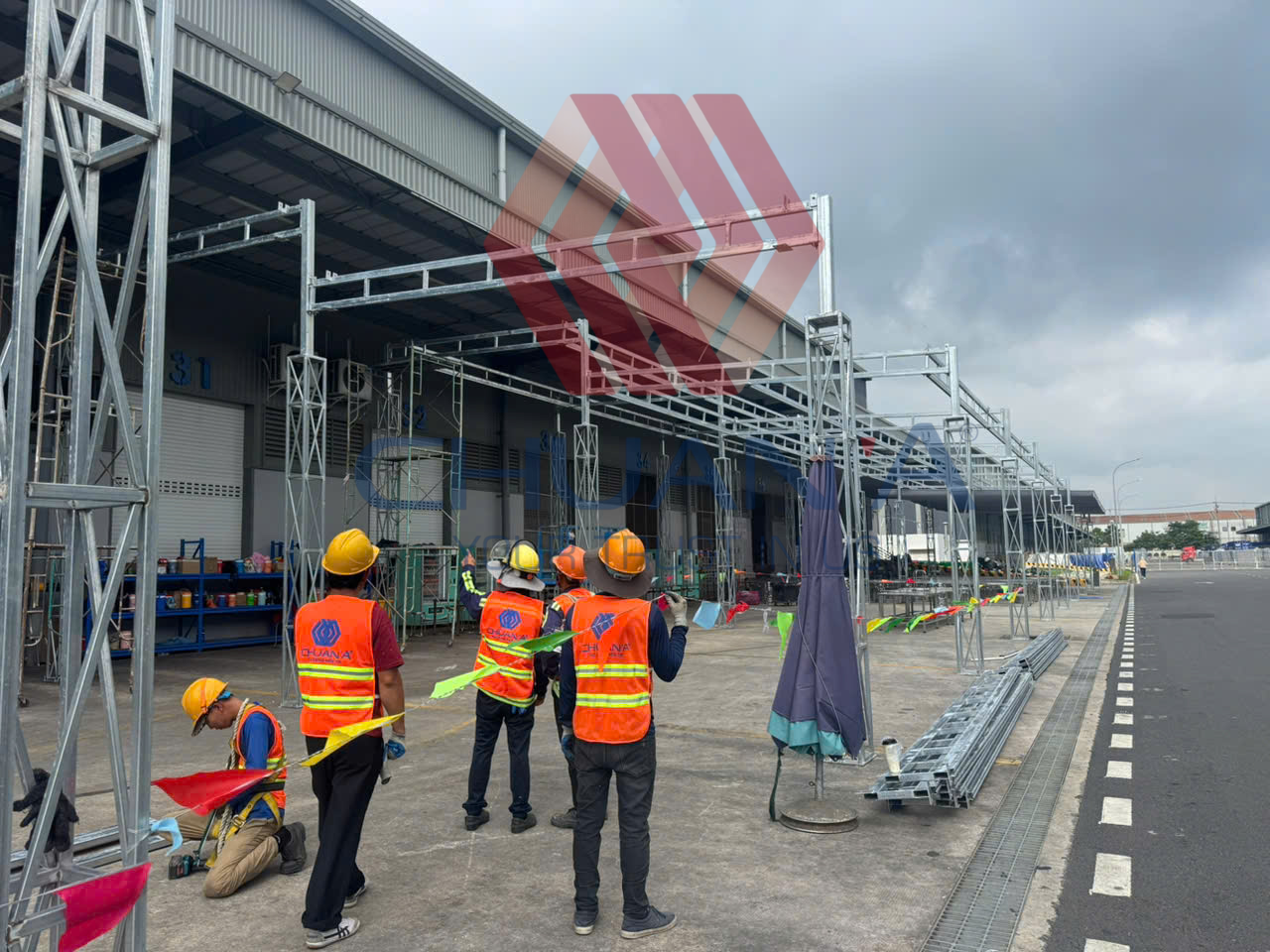
To guarantee strict quality control and avoid any operational downtime for Company Y's daily business activities, the engineering management team established a strategic workflow separating the construction area into three independent zones. Each zone corresponds to a distinct functional phase requiring dedicated foundation preparation and structural connections:
Zone 1: Currently executing the final adjustments and alignment of the structural guide rail framework. This includes anchoring high-strength expansion bolts, erecting columns, and calibrating track elevations.
Zone 2: Reached 35% of the total workload. The main structural load-bearing frame assembly is completed, and the team is moving forward with the interlocking crossbeam connections.
Zone 3: Undergoing intensive steel fabrication at Mr. Thoi's specialized workshop. Tasks include precision cutting, welding structural module guide tracks, sandblasting surface treatments, and applying anti-corrosive epoxy protective coatings.
The seamless coordination between the on-site construction team and Mr. Thoi's mechanical auxiliary workshop eliminates 100% of dead time. While site ground stabilization and foundation anchoring are underway at the factory site, the prefabricated structural steel components for Zone 3 are being shaped to exact geometric dimensions at the workshop, ready to be transported and assembled immediately once technical site conditions are met.
The guide rail track frame serves as the backbone of the entire retractable roof structure. It must withstand not only the dead load of the heavy-duty fabric canvas but also extreme wind uplift forces during heavy storms. The track installation process implemented today followed strict engineering protocols:
First, geodetic positioning and leveling are performed using high-precision industrial laser levels to determine the absolute alignment between supporting steel columns. The allowable elevation tolerance between the start and end points of the guide rails must not exceed ±2mm over a total span of 30 meters. Any structural misalignment or twisting would cause the pulley system to jam, leading to operational failure or premature wear of the canvas components.
Second, structural connection compliance is maintained by securely joining the galvanized structural steel box tracks to the column network using full-penetration structural welds or heavy-duty gusset plates. Site Supervisor Bui Chi Hung constantly inspects welding lines to ensure zero porosity or subsurface cracking.
The fabric threading and canvas suspension phases require high precision and synchronized execution by skilled technicians. The fabric selected for Company Y is a premium-grade architectural membrane featuring exceptional thickness, an integrated UV protection layer, and a self-cleaning anti-soiling coating. The process unfolds as follows:
First, galvanized steel or aluminum profile tension bars are threaded through pre-fabricated heat-sealed pockets on the fabric panels. This requires a uniform pulling force to prevent localized wrinkles or stress concentration areas on the membrane. Next, the canvas folds are attached directly to the heavy-duty rolling trolleys set inside the guide tracks. The crew ensures uniform spacing between fabric folds (typically 45cm to 50cm per fold) to guarantee clean, compact stacking when retracted, and optimal tension when fully extended for efficient rainwater drainage.
To complete such a complex volume of technical work within a single day, strategic labor deployment and machinery management are decisive factors. The site organization model at Company Y on June 8 was highly streamlined yet achieved peak operational efficiency:
The optimized crew consisted of 1 Site Technical Supervisor (GS) and 5 Skilled Workers (CN). Supervisor Bui Chi Hung directed field operations, reviewed engineering blueprints, managed occupational health and safety compliance (safety harnesses, helmets, scaffolding inspections), and certified each sub-stage before allowing work to proceed. The 5-man crew was split into two task forces: a structural welding unit working on high-elevation frames and a finishing unit prepping the fabric layout on the ground before crane lifting.
Advanced machinery synchronization included a mobile hydraulic truck crane to lift heavy steel box components and elevate pre-threaded canvas segments safely to design heights. Industrial concrete hammer drills paired with integrated vacuum extractors were utilized for foundation bolt anchoring, keeping the workspace completely free of concrete dust to protect Company Y's sensitive manufacturing machinery. Standardized scaffolding structures with spacious work platforms and double-lanyard fall protection systems were fully deployed for all heights above 4 meters.
The official project handover date is firmly set for July 1, 2026. Between now and the deadline, the engineering management team has mapped out a weekly milestone schedule, reserving a 5-day buffer period for system load testing, canvas tension calibration, and internal quality audits before final delivery to Company Y.
The quality acceptance parameters applied to this project include two main parts: Static Testing (structural integrity of the frame, flawless weld penetration, anti-corrosive coating thickness) and Dynamic Testing (smooth gliding of manual or motorized pulley systems, immediate rainwater runoff under simulated heavy downpours, and complete elimination of water pooling on the canvas surface). This rigorous quality management system stands as our strongest commitment to reliability and professional excellence for our valued clients.
CHUAN'A CONSTRUCTION INVESTMENT JOINT STOCK COMPANY