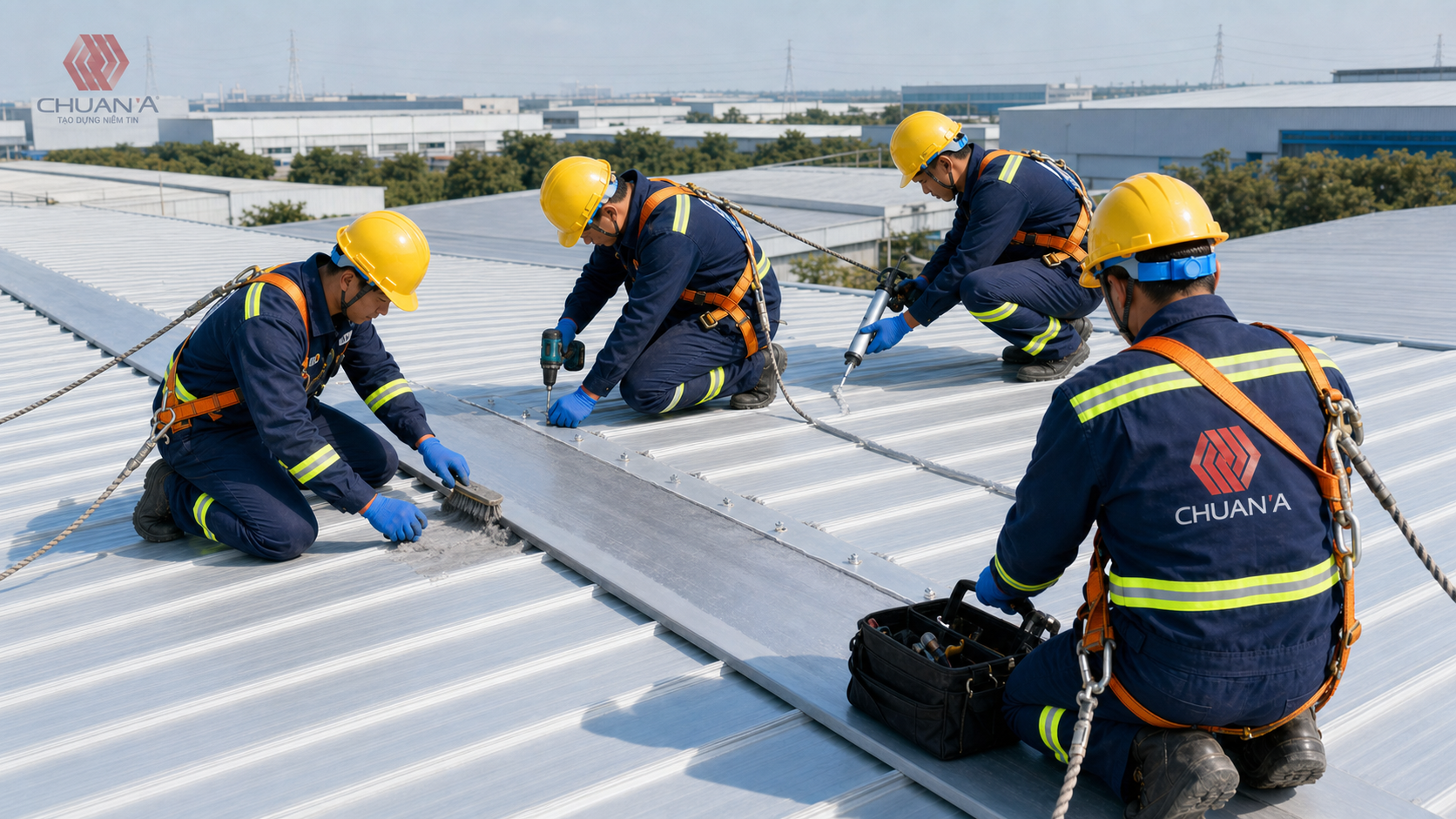
The same maintenance item can produce very different results depending on how it is carried out. Over-tightened screws deform the sheet and damage washers, coatings applied to damp surfaces peel early, and walking in the wrong places can dent sheets or create safety risks. These are common technical errors, and all of them are avoidable.
Periodic and technically correct factory roof maintenance in Dong Nai therefore has two parts: setting an inspection cycle suited to the roof condition, and following the technical requirements during execution. Missing either part reduces both the effectiveness and the service life of the work.
Chuan A performs factory roof maintenance in Dong Nai on a cycle proposed according to roof age, production environment and the repair history of each facility.
.png)
Not every roof requires the same inspection frequency. A newly installed roof and one in service for over ten years carry clearly different levels of risk.
| Service period | Typical characteristics | Reference inspection cycle |
|---|---|---|
| Under 3 years | Roof still in good condition; defects usually relate to original installation or added equipment. | One full inspection per year, focusing on roof penetrations and overlaps. |
| 3 to 7 years | Washers begin to age, screws may loosen from thermal movement, coating fades. | Annual inspection before the rainy season, combined with gutter cleaning. |
| 7 to 12 years | Rust spots appear, overlaps open up and gutters deteriorate. | Pre-rainy-season inspection plus an additional mid-year check. |
| Over 12 years | Widespread corrosion, reduced sheet thickness and multiple previously patched areas. | More frequent inspection and assessment of sectional replacement. |
Beyond roof age, the cycle should be adjusted for the environment: coastal facilities, areas with chemical vapour, heavy industrial dust or nearby heat sources generally require more frequent checks than the reference levels above.
.png)
Screws should be tight enough for the washer to seal against the sheet without deforming it. Over-tightening dents the sheet around the fastener head, creating a water-retaining point and destroying washer elasticity. Screws must be driven perpendicular to the surface and into the purlin line.
Where an existing hole has enlarged through corrosion or repeated removal, refitting the same screw size rarely restores the seal. In such cases a larger-diameter fastener or an alternative treatment of the location is required.
The overlap between sheets must meet the specification for the sheet profile and roof slope. Low-slope roofs require greater overlap than steeper ones. When treating overlaps, the surface should be cleaned before sealing material is applied so that adhesion is reliable.
Slope determines drainage speed. Sagging sections reduce the local slope, causing water to stand after rainfall and accelerating corrosion. Where standing water is found, the structural cause should be addressed rather than only sealing the surface.
Coatings should be applied to clean, dry surfaces under suitable weather conditions. Working immediately before rain, on damp surfaces or when the sheet temperature is excessive all affect adhesion and coating life. The number of coats and drying intervals should follow the material instructions.
Drilling, cutting and fastening on the roof generate metal filings. Left in place, these particles oxidise and create new rust spots, even on sections of roof that were previously sound.
After completing the work, the following should be carried out:
Most roof damage develops cumulatively. An over-tightened screw creates a water-retaining point, corrosion follows, spreads and eventually perforates the sheet. Similarly, coating applied to an unclean surface peels early and exposes the steel base.
When the work is executed correctly:
Chuan A Construction Investment Corporation provides industrial construction and facility maintenance solutions in Dong Nai and nearby areas.
Businesses may also review an effective factory roof maintenance process for the detailed inspection checklist and leaking and corroded factory roof treatment for guidance on assessing corrosion levels.
Chuan A receives factory roof maintenance requests in Dong Nai, Bien Hoa, Long Thanh, Trang Bom, Nhon Trach and nearby areas. Businesses in Binh Duong and Ho Chi Minh City may contact the company to discuss the project location, size and required scope of work.
Under normal conditions, a full inspection before the rainy season each year is appropriate. Older roofs or those in corrosive environments should be checked more frequently.
Excessive torque dents the sheet around the fastener head, creating a water-retaining point, while the rubber washer is compressed out of shape and loses its sealing function. This is a frequent reason why treated areas develop corrosion again quickly.
Ideal conditions require a dry surface and stable weather while the coating cures. Application before imminent rain or onto damp surfaces generally reduces adhesion and coating life.
Filings left on the sheet oxidise and create new rust spots. Cleaning after drilling and cutting protects sections of roof that are still in good condition.
Replacement panels should match the existing profile, thickness and coating so that overlap and weather protection remain reliable. Using a different profile typically leaves gaps at the junction.
Movement should follow purlin lines, avoiding corroded sections and skylight panels, with a safety harness attached to a suitable anchor point. On deteriorated roofs, crawl boards or working platforms should be used.
Correct technique combined with a suitable maintenance cycle reduces the number of unplanned incidents while extending the service life of the roof and drainage system.
CHUAN A CONSTRUCTION INVESTMENT CORPORATION
Contact Chuan A to build a periodic factory roof maintenance plan in Dong Nai.