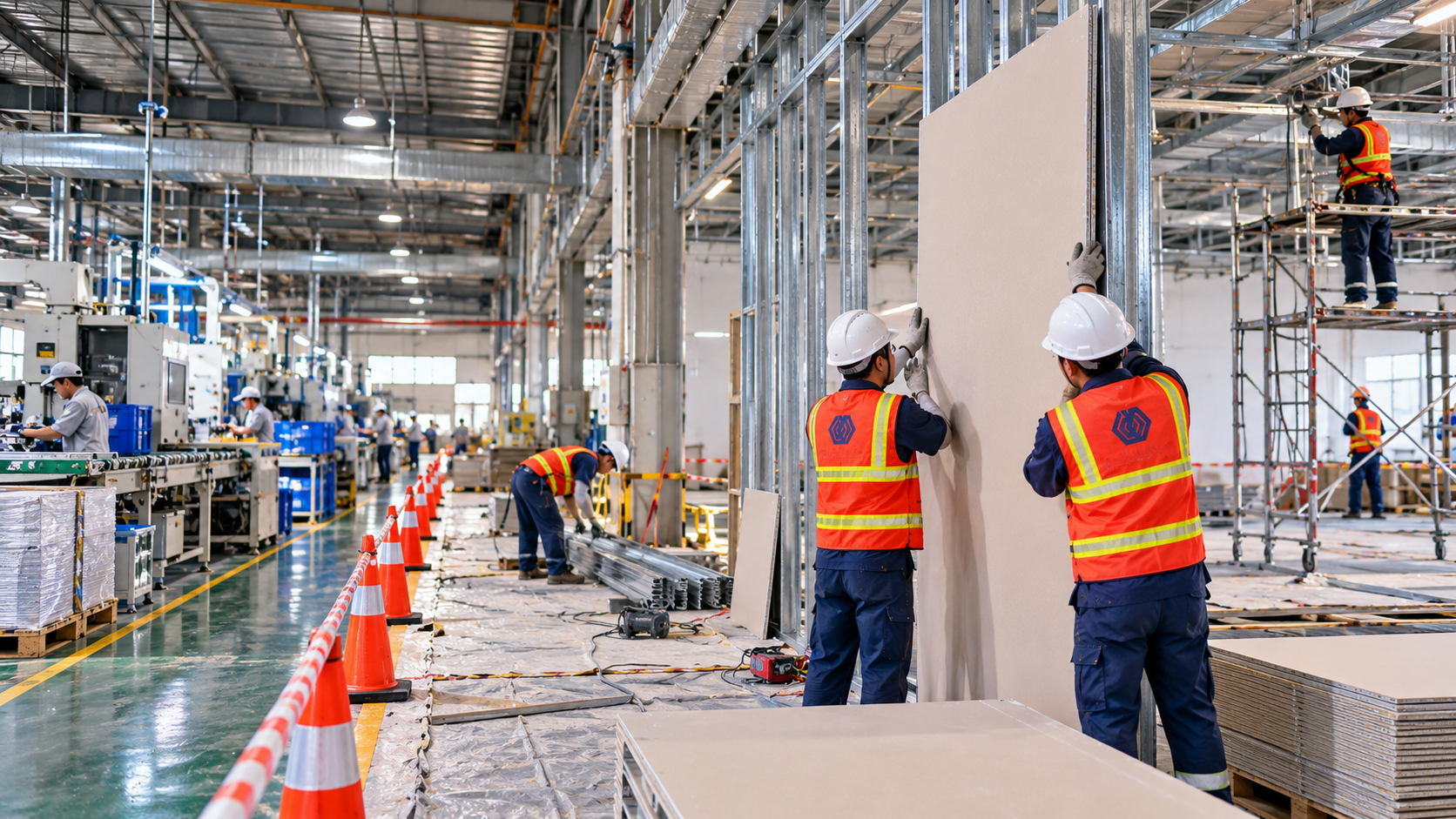
Renovating an operating factory is very different from building on an empty site. Production still has to continue, employees still need to move around the facility, machinery remains in operation, and materials still need to enter and leave the plant according to schedule. At the same time, the construction area creates noise, dust, stored materials, equipment, and restricted work zones.
For that reason, the challenge is not simply completing the renovation correctly. A practical plan also needs to answer three basic questions: where can the work take place, when can it take place, and how can construction be organized with minimal impact on production?
This is why an operating factory should normally be surveyed and planned before construction begins. Starting demolition first and figuring out site organization later can create conflicts with production lines and force changes to the construction schedule.
.png)
On a new construction site, most of the property is available for construction activities. In an operating factory, the construction area is only one part of a much larger operation. An area being renovated today may be a forklift route tomorrow, or a temporary storage area for goods waiting to be shipped.
Existing systems such as electrical lines, water supply, drainage, fire protection, ventilation, utility piping, or production equipment may also be located within or around the renovation area. A small change in the construction sequence can therefore affect other activities in the facility.
Renovation is not simply a matter of removing the old and installing something new. The more difficult part is connecting the new work to everything the factory is still using.
A site survey should begin with an understanding of how the factory currently operates. The team needs to know which areas are in continuous production, which areas can be temporarily shut down, where pedestrians walk, which routes are used by forklifts or trucks, and where construction materials cannot be stored.
Existing technical systems also need to be identified. Electrical systems, water and drainage lines, fire protection systems, ventilation, air conditioning, process piping, and cable routes may all run through the work area. Without a clear understanding of existing conditions, a contractor may discover a critical utility line only after construction has already started.
One of the first items to agree on with the factory team is which areas must remain operational and which areas can be used for construction. Not every part of a factory has the same level of sensitivity. Some areas may allow daytime work, some may only be available outside production hours, and others may need to remain untouched.
Identifying these zones early makes the construction plan much more practical. The site team knows where work is permitted, when activities can take place, and what protection measures need to be prepared.
.png)
For an operating factory, dividing the project into work zones is often easier to coordinate than opening the entire facility to construction at once. One area can be completed, cleaned, and handed back before the team moves to the next section.
This approach can be useful when a factory contains several production lines or connected work areas. While one section is under renovation, other parts of the facility may continue operating when site conditions allow it.
However, work zones cannot simply be drawn on a plan without considering actual movement. Boundaries between production and construction areas should be clearly defined, and pedestrian routes, forklift routes, and material delivery points should be agreed on before construction begins.
Dust and noise are often two of the biggest concerns during factory renovation. In facilities where production conditions need to be controlled, dust from drilling, cutting, breaking, or demolition can directly affect operations.
Temporary protection should therefore be considered as part of the construction plan. Depending on the work, this may include temporary partitions, protective coverings, dedicated material routes, or adjusted working hours for activities that generate significant noise.
Not every activity has to be carried out during normal production hours. Noisy work or activities that require a temporary shutdown of a particular system may be scheduled during lower-production periods when the factory and contractor can agree on a workable schedule.
Moving construction materials into an operating factory is very different from storing materials on an empty site. Trucks cannot simply arrive whenever materials are needed. Deliveries have to consider production shifts, forklift routes, vehicle access, loading areas, and pedestrian traffic.
Large materials such as structural steel, roofing sheets, frames, or mechanical equipment should have designated storage locations before delivery. Materials that block access routes or occupy production space can disrupt the factory even before construction work begins.
Construction equipment also needs to be positioned carefully. Cutting machines, welding machines, drills, lifting equipment, and forklifts should have defined work areas that do not interfere with existing factory operations.
Each renovation scope creates different challenges. For factory roof work, the main concerns often involve working at height and protecting the area below. If production lines or stored goods remain underneath, the work zone may require additional protection and tighter access control.
Floor renovation can involve concrete breaking, cutting, drilling, and dust generation. It can also affect forklift and material-handling routes. A floor section should not simply be opened without checking how people, equipment, and production materials currently move through the area.
Structural renovation and factory expansion require even closer coordination. Connecting new construction to existing structures may involve differences in elevations, connection points, electrical systems, utility piping, and other existing elements that affect the construction sequence.
When a factory remains operational, safety requirements apply not only to construction workers. Factory employees, visitors, drivers, and other personnel may also pass close to the work area.
Construction zones therefore need clear boundaries, warning signs, and appropriate access controls. Activities involving heat, sparks, or smoke require additional consideration when performed inside an active production environment.
If renovation work affects part of an existing fire protection system or another operating technical system, the shutdown and restoration plan should be agreed with the factory in advance. A system serving the facility should not be switched off simply because it is convenient for a construction activity.
Not every renovation project requires a complete production shutdown. Whether a shutdown is necessary depends on the renovation scope and how directly it affects the production process.
If the work area is independent and can be separated from production, phased construction may be possible. If the project affects the main electrical system, critical structural components, the roof directly above active production, or a process line that cannot be isolated, a planned shutdown period may be required.
Therefore, the better question is not simply whether the factory should stop production. The practical questions are: which section needs to stop, for how long, and which activities can be completed in parallel?
For an operating factory, the construction schedule should clearly identify work zones, activity periods, handover points, and the conditions required before moving to the next stage.
For example, one area may only become available after production equipment has been moved. Once demolition is complete, the area may need to be cleaned and handed back before the remaining factory space can operate normally. A relatively small construction task can therefore depend on several different teams.
Agreeing on the schedule early helps reduce situations where the construction team arrives before the work area is available, materials are delivered without a suitable storage location, or construction has to stop because a production line is still operating.
Chuan A's industrial construction scope includes renovation and expansion work, including retrofit activities, capacity upgrades, and improvements to internal circulation. For an operating facility, the specific scope needs to be determined after a site survey and discussion with the factory team. :contentReference[oaicite:3]{index=3}
Depending on the facility, the work may focus on a specific area such as the roof, floor, structural elements, supporting facilities, or an expansion section. The key is to consider the construction work together with the factory's existing operations rather than treating the renovation as an isolated construction package.
This approach is also consistent with Chuan A's maintenance and upgrading services for existing facilities, where the actual condition is reviewed first before a suitable work scope is developed. :contentReference[oaicite:4]{index=4}
A factory does not necessarily have to wait until the building has serious problems before considering an assessment. Adding a new production line, changing the production layout, increasing capacity, adding supporting areas, or experiencing repeated problems with internal traffic can all be reasons to review the existing facility.
Early assessment allows the business to identify potential conflicts between production requirements and construction work before they become urgent. The renovation can then be divided into stages instead of being rushed when the factory suddenly needs additional space or infrastructure.
For factories, manufacturing facilities, and industrial buildings in Dong Nai, Bien Hoa, Binh Duong, and nearby areas, Chuan A can discuss site surveys and renovation, upgrading, or expansion options based on the actual condition and operating requirements of the facility.
CHUAN A CONSTRUCTION INVESTMENT PROJECT JOINT STOCK COMPANY
Address: Amata Industrial Park Service Center, Long Binh Ward, Dong Nai Province, Vietnam.
Hotline: 0907 494 549
Email: info@chuana.com.vn
Website:https://chuana.com.vn/
Contact Chuan A to discuss site surveys, factory renovation, upgrades, or expansion for operating facilities in Dong Nai.


