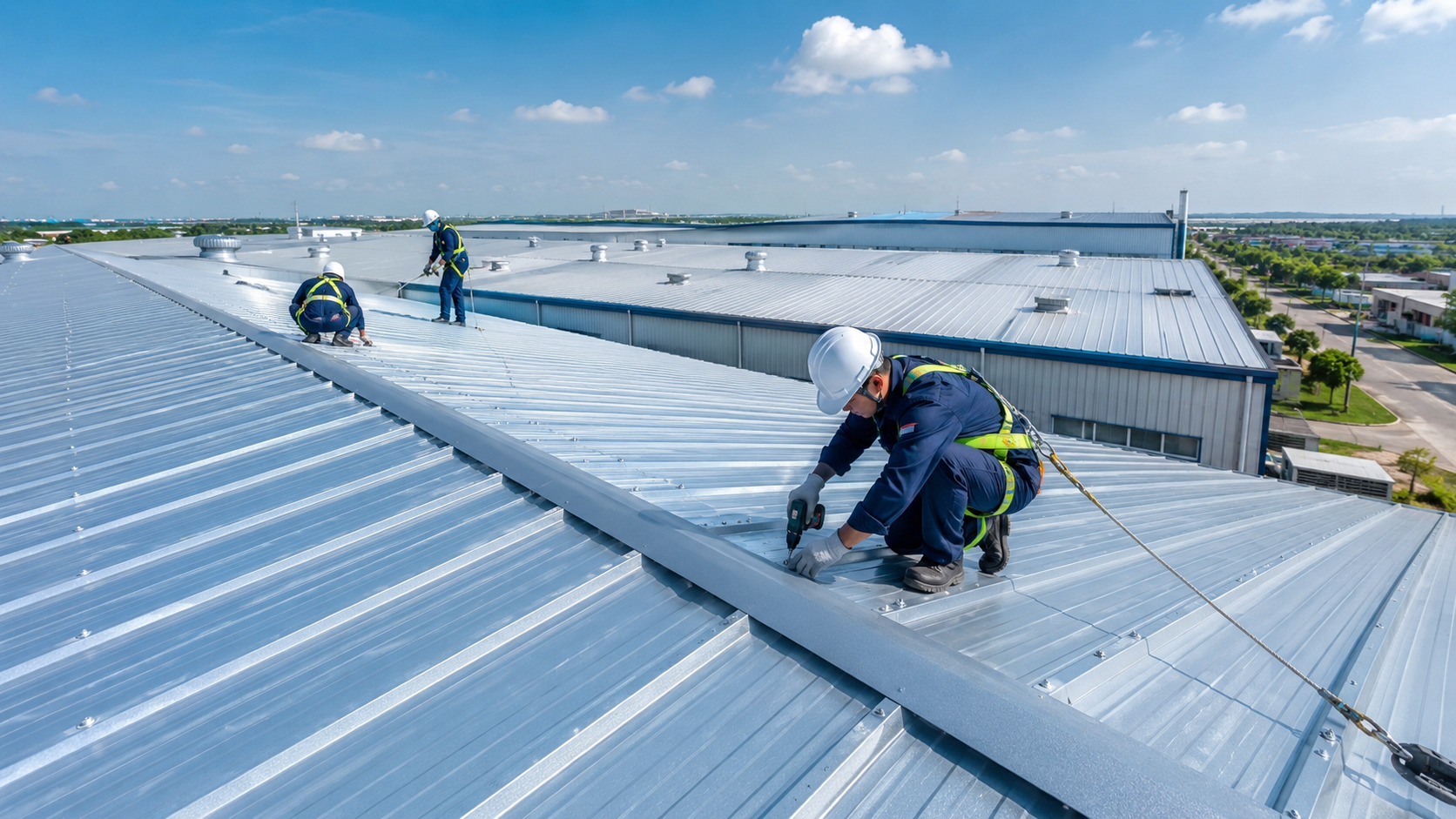
Factory roof maintenance is usually carried out across large areas, at different heights and across many interrelated components. Without a clear process, the work easily becomes incomplete: hidden sections are missed, or attention is limited to points where water has already been seen dripping.
An effective factory metal roof maintenance process in Dong Nai needs to answer three questions: what is inspected, in what order, and on what basis the work is confirmed as complete. Alongside these sits the documentation used to compare results across maintenance cycles.
Chuan A carries out factory roof maintenance in Dong Nai using a defined inspection checklist, roof zoning and acceptance criteria for each item.
.png)
These principles keep maintenance from depending on individual memory and allow the approach to remain consistent over years, even when responsible personnel change.
Before going onto the roof, the inspection scope and the location referencing method should be agreed so that records are consistent between both parties:
Using a shared zone numbering system allows damage locations to be described precisely, instead of relative descriptions such as "behind the factory" or "near the packing area".
| Component | Inspection content | Findings to record |
|---|---|---|
| Roofing sheets | Coating condition, corrosion level, deformation and dents. | Rust spots, faded coating, water-retaining areas, perforations. |
| Screws and washers | Fastener tightness, corrosion and washer elasticity. | Loose or displaced screws, missing or hardened washers. |
| Sheet overlaps | Overlap dimensions, open gaps and sealing material condition. | Open joints, failed sealant, water tracks through gaps. |
| Ridge caps and flashing | Connections, stability and resistance to wind-driven rain. | Displaced or bent components, lifted fasteners. |
| Gutters | Cleanliness, slope, joints and drainage performance. | Debris build-up, standing water, sagging, joint leaks. |
| Downpipes | Blockages, connection to gutters and discharge points. | Clogging, cracks, loose pipe brackets. |
| Roof penetrations | Sealing around pipe bases, fans and roof-mounted equipment. | Cracked sealant, open bases, water marks around installations. |
| Supporting structure | Purlins, connection plates, bolts and visible fixings. | Corrosion, sagging, long-term water marks, loose connections. |
| Factory interior | Ceilings, walls, columns and areas beneath the roof. | Damp marks, water trails, musty odours, active drips. |
Each damaged location should be recorded with photos and classified by severity to establish the order of treatment:
This classification supports more balanced budget allocation than either treating everything at once or reacting only after an incident.
The maintenance plan should be presented by roof zone, together with work content, expected materials and timing. Items to agree before mobilisation include:
Working bay by bay makes quality control easier than spreading work across the whole roof. After completing each zone, the following should be checked before moving on:
Clearing metal filings after drilling or cutting is frequently overlooked, yet it is a common cause of new corrosion points on the roof surface.
| Item | Completion criteria |
|---|---|
| Screws and washers | Full fastener count, secure fixing, sealed washer contact and no corroded screws remaining within the treated area. |
| Overlaps and ridge caps | No visible gaps, sealing material adhering evenly to a clean surface. |
| Corrosion treatment | Surface properly cleaned, continuous protective coating, edges and hidden areas included. |
| Sheet replacement | New sheets matching the existing profile, correct overlap and complete fixing. |
| Gutters and drainage | Free drainage under a water test, no standing water and no leaks at joints. |
| Roof penetrations | Bases sealed with no remaining gaps around installations. |
| Post-work cleaning | Roof, gutters and the area below cleared of surplus materials. |
For waterproofing items, a water test on the treated area normally gives a clearer result than visual inspection alone.
Documentation is what gives a maintenance process continuity. Records to keep after each cycle include:
After several cycles, these records reveal which zones repeatedly develop problems. That evidence supports a decision to move from repeated local repair to sectional replacement instead of continued patching.
.png)
Chuan A Construction Investment Corporation provides industrial construction and facility maintenance solutions in Dong Nai and nearby areas.
Businesses may also review factory metal roof maintenance and repair in Dong Nai for the difference between periodic maintenance and corrective repair, and roof maintenance inspection and quotation for the request and quotation process.
Chuan A receives factory roof maintenance requests in Dong Nai, Bien Hoa, Long Thanh, Trang Bom, Nhon Trach and nearby areas. Businesses in Binh Duong and Ho Chi Minh City may contact the company to discuss the project location, size and required scope of work.
The duration depends on roof area, the number of items requiring treatment, access conditions and permitted working hours. Projects with a clearly defined scope and few additional findings are normally completed faster.
A roof layout drawing if available, information on previously affected areas, the repair history, factory safety regulations and permitted working hours are all useful.
A water test on the treated area provides a practical confirmation of performance before handover, particularly for locations that have leaked repeatedly in the past.
Under normal conditions, a full inspection before the rainy season each year is a suitable baseline. Factories near the coast or exposed to chemical vapour and heavy dust should increase the frequency.
Even for modest roof areas, recording treated locations remains useful. Records help identify sections that repeatedly develop problems and avoid repeated repairs at the same point.
Interior observation for damp marks and drips can be done internally. Direct inspection on the roof requires safety equipment and experienced personnel, particularly where sheets are corroded or deteriorated.
A clear maintenance process allows a business to understand the roof condition over time rather than reacting only after an incident. Inspecting before the rainy season generally leaves more options in both method and scheduling.
CHUAN A CONSTRUCTION INVESTMENT CORPORATION
Contact Chuan A for factory metal roof maintenance services in Dong Nai.