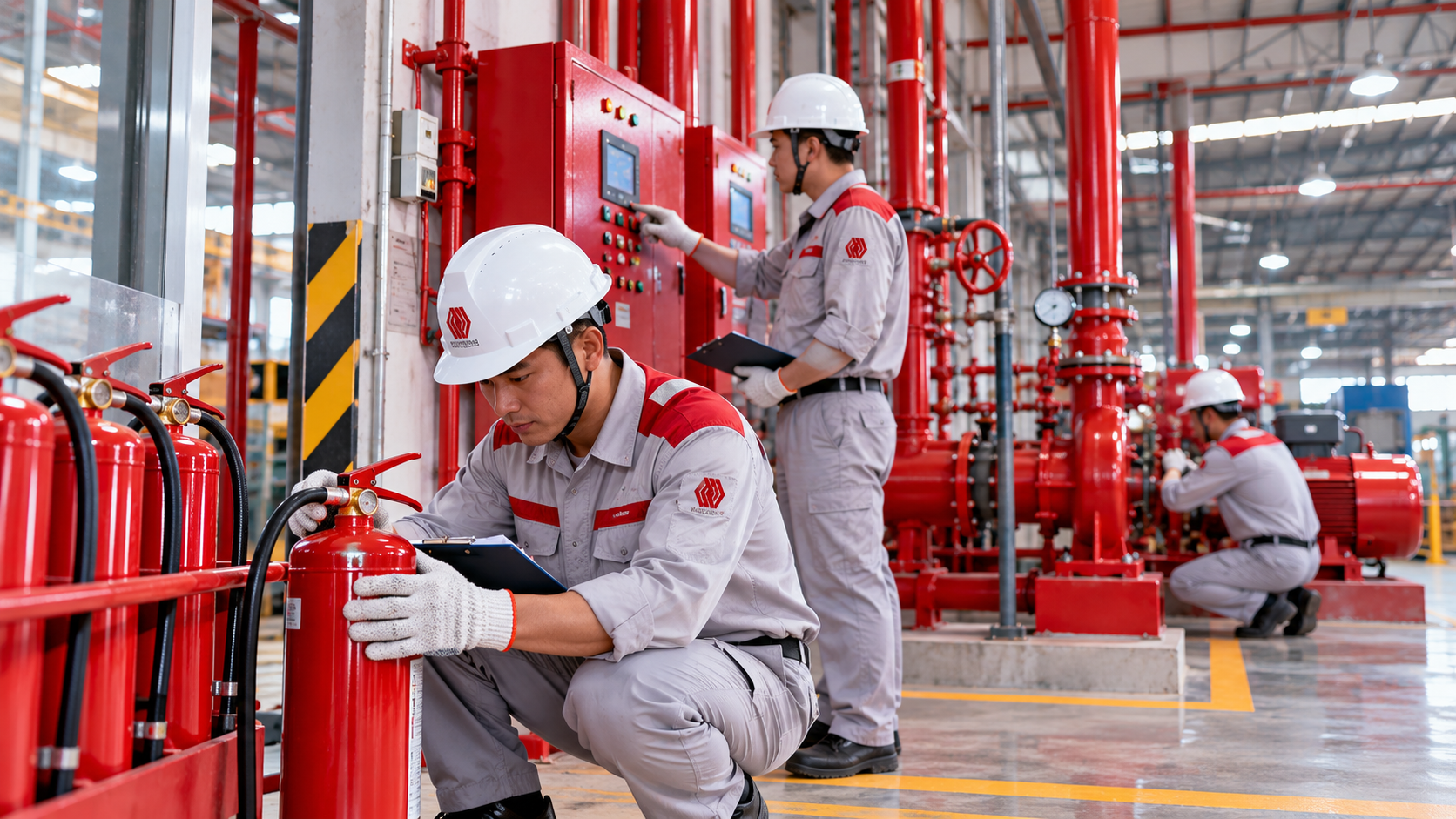
Having a complete fire protection system does not automatically mean that a factory is fully prepared for an emergency. During normal operation, the layout may change, equipment may be moved, storage areas may be expanded, evacuation routes may become restricted, and parts of the fire protection system may no longer remain in the same condition as when they were installed.
Periodic fire protection inspection should therefore be more than checking whether fire extinguishers are still on the wall or whether a fire alarm panel has power. A practical inspection needs a clear scope, an inspection sequence, documented findings, and a method for correcting problems that are identified.
For an operating factory, the inspection process should also reflect actual operations. A system may remain technically functional while changes to production areas, storage, machinery, or internal traffic reduce accessibility or create new risks.
.png)
In practical terms, it is a structured review of the factory's fire safety condition, the accessibility and usability of fire protection equipment, the condition of relevant technical systems, and the maintenance of safe operating conditions.
From an internal management perspective, the inspection should answer one important question: if an emergency occurred today, would the equipment, people, and operating conditions at the factory actually be ready to respond?
This internal inspection should be distinguished from periodic inspections conducted by competent state authorities. Vietnam's Decree 347/2026/ND-CP took effect on September 15, 2026 and amended the inspection procedures applicable to facilities within the authorities' management scope. :contentReference[oaicite:4]{index=4}
Industrial facilities change constantly. Machinery may be added, storage racks may be reconfigured, raw materials may be moved, and production layouts may change.
These changes can affect fire separation, access routes, fire protection equipment locations, or the ability to reach equipment quickly during an emergency.
A structured inspection process reduces the chance that different teams will inspect the facility in completely different ways each time. The responsible team knows what needs to be checked, how findings should be recorded, and what should happen after an issue is found.
Before entering the site, the responsible team should gather documents and information related to the factory's fire protection systems. The objective is to understand what systems exist, where they are located, and what has changed since the previous inspection.
Depending on the facility, the documentation may include fire safety rules, facility information, applicable design approval or appraisal documents, acceptance documentation, fire protection system records, and previous inspection or maintenance records. Decree 105/2025/ND-CP provides requirements concerning fire protection records at facilities, which should be maintained and updated in accordance with the actual condition of the site. :contentReference[oaicite:5]{index=5}
This step is easy to overlook. However, inspecting equipment without comparing it with the facility records may cause important changes in the layout or system configuration to be missed.
Before checking individual devices, the inspection should start with the overall factory environment. Check whether evacuation routes, emergency exits, access corridors, storage areas, and required clear spaces are being obstructed.
A common problem is that fire protection equipment remains physically present but is blocked by pallets, boxes, machinery, or stored goods. The equipment may still be installed correctly, but access becomes slower when it is actually needed.
Areas containing ignition sources, electrical equipment, combustible materials, and other potential fire hazards should also be reviewed according to the actual operating conditions of the facility.
Fire extinguishers, fire hose cabinets, hydrants, hose reels, and other on-site firefighting equipment should be inspected according to the actual system installed at the facility.
The inspection should not only confirm that equipment remains in its designated location. The external condition, accessibility, visible damage, and relevant components should also be reviewed according to the requirements of each equipment type.
Equipment containing seals, gauges, valves, hoses, or associated fittings should be assessed in accordance with its relevant technical requirements rather than relying only on visual observation.
The fire alarm system should be inspected according to the actual configuration of the facility, including the control panel, power supply, notification devices, and installed detection devices.
The team should pay attention to fault signals, warnings, and abnormal conditions displayed by the control panel. If the factory has changed machinery, partitions, storage areas, or other internal layouts, detector positions should also be reviewed to identify potential obstructions.
The objective is not simply to confirm that the panel has power, but to understand whether the system remains able to respond correctly according to its intended configuration.
For factories equipped with water-based fire suppression systems, the pump room, controllers, piping, valves, and related components should be reviewed within the scope of the installed system.
Fire pumps may remain unused for long periods, but they must remain ready to operate when needed. Inspection should therefore consider equipment condition, operational readiness, and abnormal indications that may affect the system.
Valve areas should also remain accessible and in suitable condition. A valve or connection point blocked by production materials can create difficulties during an emergency.
Sprinkler heads should be inspected together with the surrounding space. When storage racks, production equipment, or technical systems are changed, sprinkler coverage or access may be affected.
Fire protection piping should also be reviewed for signs of leakage, corrosion, mechanical impact, or changes resulting from factory renovation.
The sprinkler head and piping network should not be treated as separate issues. System performance depends on the condition and arrangement of the entire fire protection network.
Fire protection equipment is not the only factor that determines how people respond to an emergency. Employees and visitors must also be able to identify and reach safe evacuation routes.
The inspection should therefore include emergency exits, circulation routes, exit signs, and related evacuation areas. Goods, pallets, or temporary materials should not reduce the usable width or accessibility of designated routes.
This becomes particularly important in factories where layouts are frequently changed. Major production or storage rearrangements should trigger another review of evacuation routes.
Inspection results should be recorded rather than communicated only verbally. Each issue should identify the location, condition, priority, and responsible person or department for follow-up.
Inspection records help the business understand which problems have been corrected, which are waiting for parts, and which require specialist assistance. They also make it easier to compare the condition of the system over time.
.png)
A common mistake is to treat fire protection as only fire extinguishers, alarms, and pumps. In practice, the operating condition of the factory also affects fire safety.
These surrounding conditions can change faster than the equipment itself. A technically functional system can still become less effective if the environment around it has changed.
Problems that directly affect safety should not simply be carried forward to the next inspection cycle. Findings should be classified so that the factory knows which items require immediate action, which can be scheduled, and which require specialist assessment.
For example, an obstructed emergency exit may be corrected immediately by the facility team. A problem involving a fire pump, control panel, or suppression system may require qualified technical personnel to inspect and repair the equipment.
This approach prevents the inspection report from becoming a long list of problems without a clear order of priority.
This distinction is important. Internal inspection is part of the facility's own fire safety management and is intended to identify problems early and maintain safe operating conditions.
State inspection, on the other hand, is a regulatory activity conducted by competent authorities under the legal framework. Decree 347/2026/ND-CP provides that the police, competent construction authorities, and commune-level People's Committees according to their assigned authority may conduct periodic inspections of facilities within their management scope. The revised procedure includes annual planning, notice three working days in advance, and a formal inspection record. :contentReference[oaicite:6]{index=6}
Therefore, an internal inspection does not replace a regulatory inspection. A well-managed internal process instead helps the factory remain prepared and makes it easier to demonstrate that fire protection equipment, documentation, maintenance, and corrective actions are being actively managed.
Not every issue can be resolved through a basic internal checklist. A more detailed assessment may be appropriate when a factory has expanded, changed its function, increased warehouse capacity, modified production lines, renovated structural areas, or added significant mechanical and electrical systems.
Changes to the layout, storage, electrical systems, fire protection piping, or technical infrastructure may affect the suitability of the existing fire protection arrangement. These changes deserve additional review instead of waiting for a routine inspection to reveal a problem.
Chuan A provides fire protection services for industrial facilities covering surveying, design, installation, testing, commissioning, and maintenance. The actual service scope depends on the existing system configuration and the condition of each facility.
For an operating factory, a site assessment helps determine which equipment needs inspection, which parts of the facility have changed, and which systems require maintenance or corrective work. This is generally more practical than applying exactly the same inspection checklist to every factory.
For factories, manufacturing facilities, and industrial buildings in Dong Nai, Bien Hoa, Binh Duong, and nearby areas, Chuan A can discuss fire protection inspection, maintenance, and corrective work based on the actual requirements of the project.
CHUAN A CONSTRUCTION INVESTMENT PROJECT JOINT STOCK COMPANY
Address: Amata Industrial Park Service Center, Long Binh Ward, Dong Nai Province, Vietnam.
Hotline: 0907 494 549
Email: info@chuana.com.vn
Website:https://chuana.com.vn/
Contact Chuan A to discuss fire protection inspection, testing, maintenance, and corrective services for factories in Dong Nai.


