In the era of modern industrialization, optimizing land utilization and protecting factory assets and raw materials from negative weather impacts are vital challenges for manufacturing enterprises. Yueda Company, a pioneer in industrial operations, decided to invest in a synchronized, large-scale canvas canopy system. This project is not merely a temporary shelter but an industrial-grade canvas roof infrastructure applying precision mechanical engineering, capable of force resistance, withstanding heavy winds, and ensuring the overall architectural aesthetics of the factory campus.
To ensure that the construction achieves absolute quality according to civil and industrial construction standards, on-site supervision plays a pivotal role. Engineer Bui Chi Hung, a seasoned expert in structural steel, was trusted with the responsibility of Chief Supervisor. The supervisor's role is not limited to checking headcount or reminding about the schedule, but extends to strictly controlling each technical process: from the depth of concrete drilled holes, the chemical volume for bolt anchoring, the co-planarity of the roof truss system, to establishing safety perimeters for self-propelled mobile cranes. The daily report dated June 5, 2026, reflects a crucial milestone of progress, proving the professionalism and high sense of responsibility of the entire construction site command.
The construction log dated June 5, 2026, recorded a massive volume of work broken down into three core tasks, coordinated seamlessly between human labor and heavy machinery.
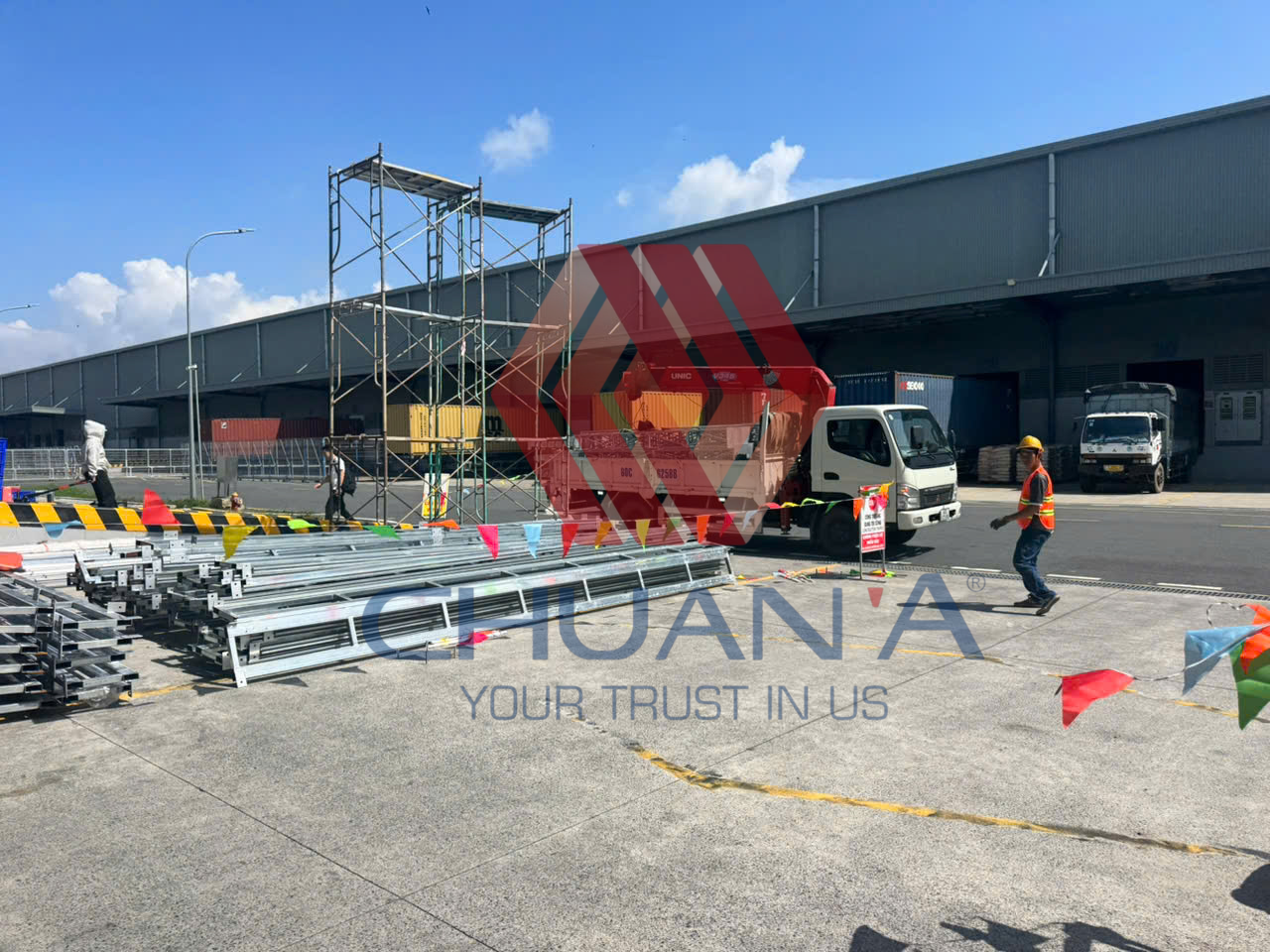
Work Item 1 (CV1) - Structural Steel Roof Frame Installation: This constitutes the backbone of the entire canopy construction. The roof trusses are fabricated from high-grade built-up structural steel, coated with anti-corrosion and marine-grade paint. The installation process demands extreme geometric accuracy. Technicians must locate the column axes and align the verticality using digital total stations and automatic levels. Under the coordination of Supervisor Bui Chi Hung, primary beam components and secondary purlins/bracings were lifted by specialized cranes into elevated connection points. Every structural weld and high-strength bolt connection underwent ultrasonic flaw testing and torque measurements using hydraulic torque wrenches, ensuring that the structural frame distributes loads evenly under wind load vectors.
Work Item 2 (CV2) - Structural Chemical Bolt Anchoring: The interface between the existing factory concrete floor and the steel columns of the canopy experiences massive shear and tension pull-out forces. Therefore, a chemical bolt anchoring method was implemented instead of standard mechanical expansion anchors. The process involves four strict steps:
Heavy-duty rotary hammer concrete drills are used to drill deep into the concrete slab according to the design diameter and depth.
A high-capacity industrial vacuum cleaner paired with specialized wire brushes is deployed to thoroughly clean all concrete dust out of the drilled holes - this is a critical step as residual dust can reduce chemical bonding strength by up to 70%.
A two-component epoxy adhesive (such as Ramset Epcon G5 or Hilti RE 500) is injected into 2/3 of the hole volume.
The threaded steel bolt is inserted while being rotated continuously to ensure the chemical completely fills the thread grooves. All anchored bolts are kept undisturbed during the specified curing time before installing the steel baseplates and torqueing the nuts.
Work Item 3 (CV3) - Industrial Site Cleaning & Comprehensive Safety Audits: The differentiator of a professional contractor lies in the daily management of site housekeeping and internal quality control. Upon finishing the drilling and structural erection, the worker crew gathered all welding slag, empty chemical cartridges, scrap steel pieces, and utilized industrial vacuums to clean the concrete floor surfaces, restoring a clean space for adjacent operational activities of Yueda's factory. Simultaneously, Supervisor Bui Chi Hung executed a comprehensive safety checklist: auditing the stability of erected scaffolding towers, inspecting mobile crane hoisting cables, and guaranteeing that no tools were left unsecured on the elevated steel frame, absolutely preventing any dropped object hazards.
The personnel organizational model at the Yueda construction site strictly adheres to the principle of "Lean - Efficient - Mechanized". The direct labor force consists of one Technical Supervisor (Engineer Bui Chi Hung) and five highly skilled mechanical steelworkers. Although the headcount is compact, labor productivity is maximized thanks to clear task structuring and robust support from modern machinery and equipment systems.
The self-propelled mobile crane serves as the "powerhouse arm" that eliminates manual heavy lifting, taking responsibility for raising steel beam assemblies weighing hundreds of kilograms safely and precisely into the air. Heavy-duty concrete drills accelerate the speed of creating holes in high-strength concrete slabs without inducing micro-fractures in the surrounding structures. The industrial vacuum system completely resolves the challenge of fine dust pollution on-site, protecting workers' respiratory health and keeping the factory environment immaculate. The certified scaffolding system is built structurally sound, featuring spacious work platforms, guardrails, and lifeline ropes so that steelworkers remain completely secure while operating at heights. This seamless combination minimizes any delay risks caused by human constraints and elevates the contractor's professional profile.
The core objective of the project management team is to complete the entire canvas canopy system and hand it over for operational use on July 1, 2026. Counting from the report milestone on June 5, 2026, the construction team has exactly 25 days remaining to execute the subsequent phases, including: completing purlin connections, installing the roof gutter and drainage system, tensioning the specialized heavy canvas fabric (premium PVC fabric coated with UV-resistant and flame-retardant layers), as well as load testing and final acceptance handover.
To control the milestones along the Critical Path, Engineer Bui Chi Hung applies bar-chart scheduling and Daily Progress Tracking updates. Completing the truss framing erection and column-base chemical anchoring in this phase serves as an extremely vital stepping stone, clearing the elevated workspace to prepare for the canvas roof tensioning phase. The site command has already established contingency plans for adverse weather conditions (heavy rain or gusty winds), optimizing night shifts for low-noise tasks, determined not to permit any slippage compared to the contract executed with the Yueda client.
Summing up the construction log of June 5, 2026, the canvas canopy installation project at Yueda Company was executed successfully, achieving 100% of the daily targeted volume, ensuring absolute occupational safety with zero technical incidents. The synergy between the meticulous management capability of Supervisor Bui Chi Hung, the proficient craftsmanship of the five mechanical steelworkers, and the powerful assistance of modern machinery has forged the core value of the construction project.
We understand that every completed canvas canopy structure represents not only the technical pride of our contracting company but also a comprehensive asset protection solution, expanding logistics spaces and optimizing economic efficiency for our partner Yueda. The entire site management team commits to sustaining this high sense of responsibility, strictly abiding by safety regulations, closely inspecting incoming materials and installation workflows to drive the project across the finish line exactly on time by July 1, 2026, with the most perfect quality, fully deserving the trust placed in us by the investor.
CHUAN'A CONSTRUCTION INVESTMENT JOINT STOCK COMPANY