An overheated factory can affect worker comfort, equipment conditions and daily operations. Buying more fans without identifying the cause often produces disappointing results.

Roofs and walls absorb solar radiation and transfer heat indoors. Ovens, presses, motors and hot piping can add heat throughout the working day.
Check whether areas under the roof are hotter than workstations, which production zones feel uncomfortable and whether conditions deteriorate in the afternoon.
Measure temperature and relative humidity in several areas and at different operating times. Map major heat sources, outdoor-air inlets, exhaust fans and locations where people remain for long periods.
If manufacturing processes produce dust, fumes or solvent vapors, the ventilation design must account for containment, local extraction and appropriate treatment.
Well-positioned louvers, openings and high-level outlets can support airflow driven by wind and warm-air buoyancy.
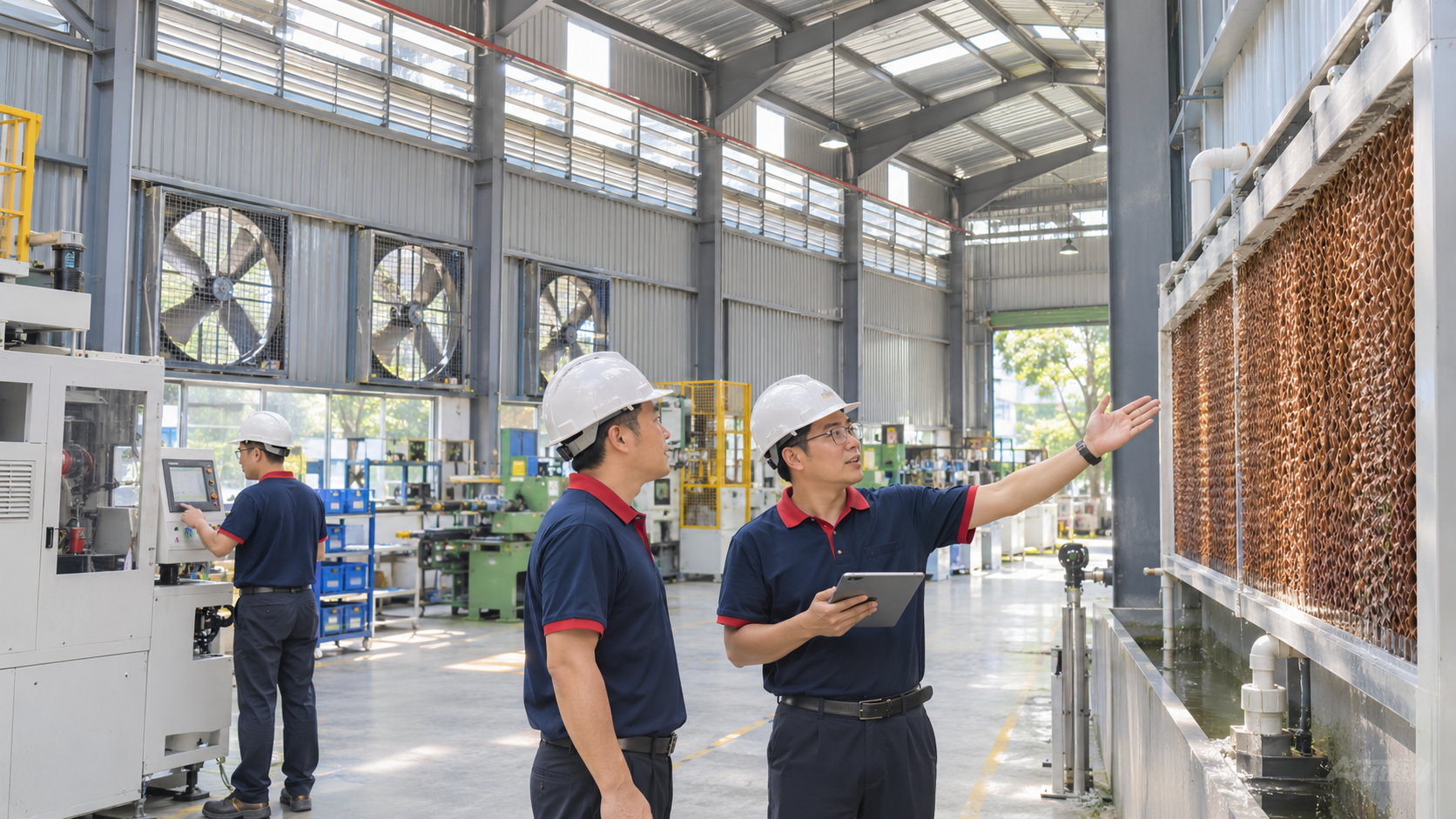
Roof or wall-mounted exhaust fans remove warm indoor air. They need suitable replacement-air paths: adding exhaust capacity without adequate inlets may reduce actual airflow or pull air through undesirable locations.
Industrial circulation or high-volume fans can improve perceived comfort when air conditions are appropriate. Fans move air; they do not directly lower its temperature.
Roof insulation, reflective surfaces and suitable roof assemblies can reduce heat transfer into the workspace. An upgrade should consider the existing roof condition, added loads, moisture management, fire performance and weatherproofing at roof penetrations.
For furnaces, presses and other concentrated sources, hoods and local exhaust ductwork can capture heat closer to where it is released. This may be more effective than trying to cool an entire large building.
Direct evaporative systems pass air through wetted cooling media, which cools the supply air while increasing its moisture content. They generally perform better in dry conditions. In hot, humid environments, their cooling potential decreases, and the added humidity may be unsuitable for certain products or processes.
Quality-control rooms, operator cabins and areas containing temperature-sensitive equipment may need controlled cooling and humidity.
A warehouse with few heat-producing machines may first benefit from roof treatment and balanced ventilation. A workshop with one exceptionally hot production line should investigate source extraction. A process requiring stable humidity should not automatically use direct evaporative cooling. Dusty or fume-producing operations need professionally designed extraction rather than simply more airflow.
Compare proposals on the same basis: design airflow, installation scope, electricity, noise, maintenance, water consumption and expected production disruption.
Mechanical improvements should be supported by a workplace heat-risk program. Provide access to drinking water and cooler rest areas, arrange suitable breaks, train workers to recognize heat-related illness and adapt workloads when necessary.
Refer to NIOSH workplace heat-stress recommendations for additional safety guidance.
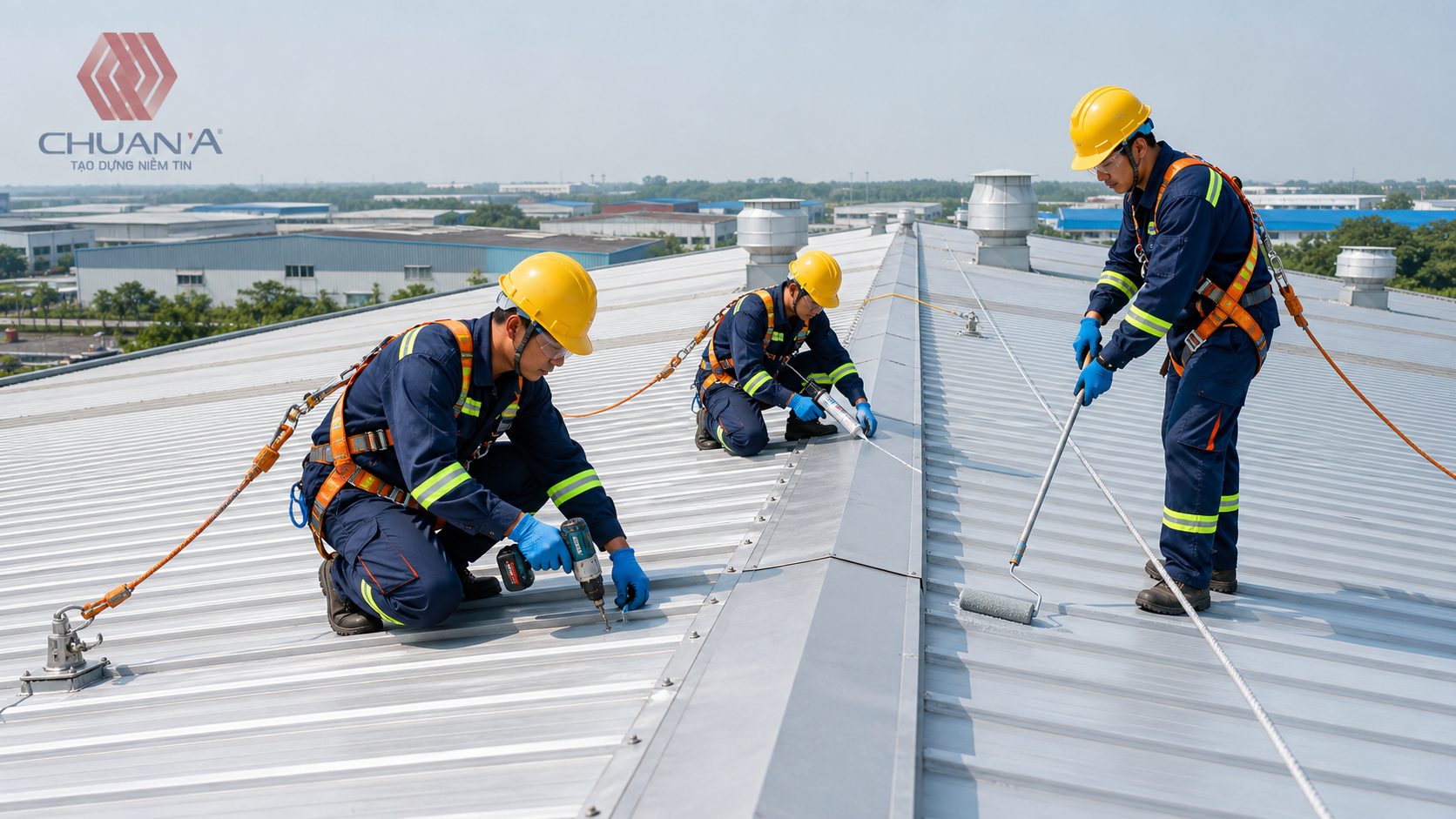
Inspect fan blades, belts, motors, filters, louvers, ducts and cooling media. Water-based systems require regular cleaning and measures to control deposits and standing water.
For related information, read Chuan A's factory ventilation design considerations and industrial metal roof construction and insulation.
Chuan A publishes information about industrial M&E, HVAC, roofing and factory maintenance activities. Businesses may discuss the building's existing ventilation, heat sources and potential renovation requirements. The precise scope and technical approach should be confirmed through a site assessment.
CHUAN A CONSTRUCTION INVESTMENT PROJECT JOINT STOCK COMPANY
Address: Amata Industrial Park Service Center, Long Binh Ward, Dong Nai Province, Vietnam.
Hotline: 0907 494 549
Email: info@chuana.com.vn
Website:https://chuana.com.vn/
Contact Chuan A to discuss factory roof inspection, repair, maintenance, or renovation services in Dong Nai.