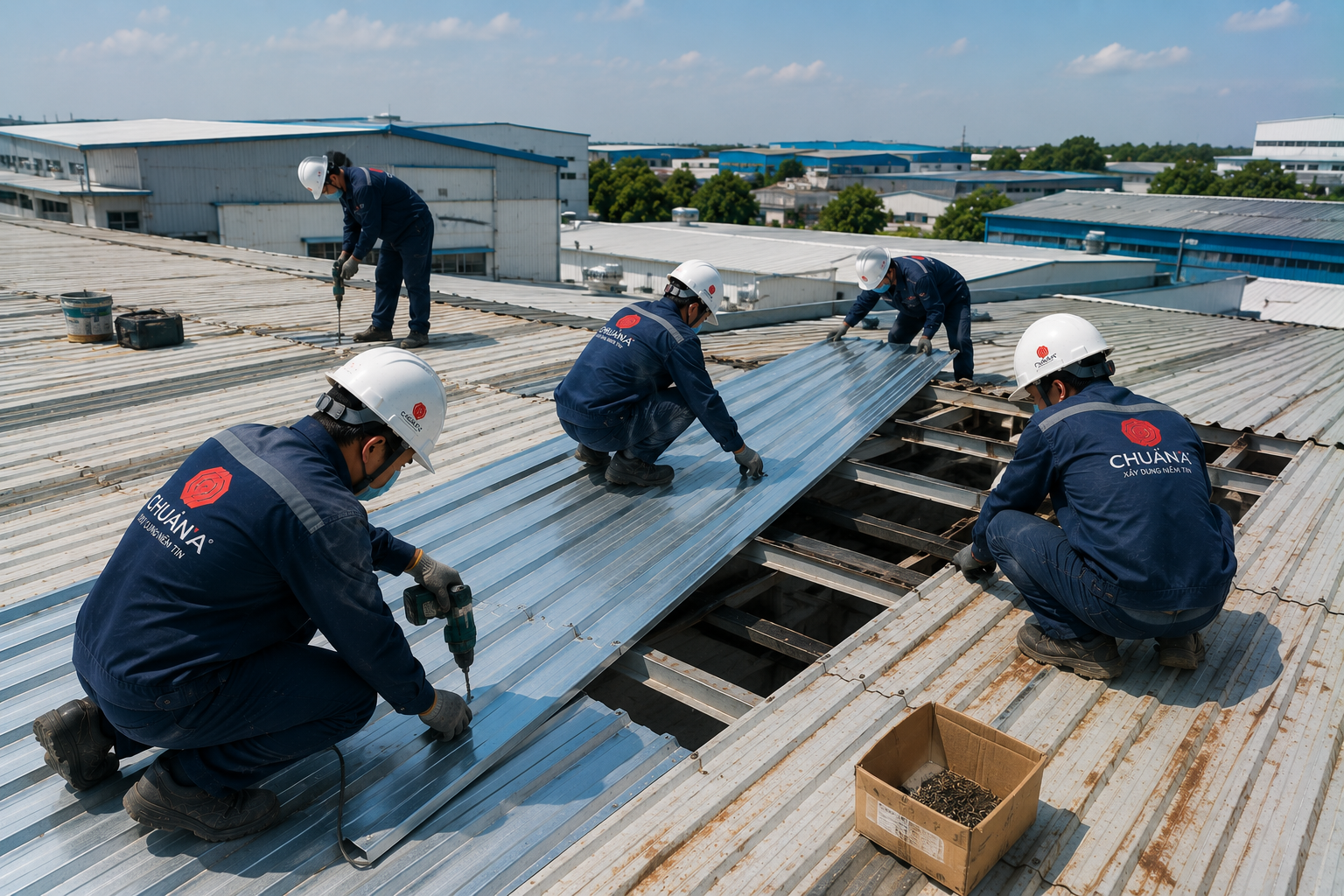
When factory roofing begins to deteriorate, facility managers must decide whether localized repair remains appropriate or whether replacement provides a better long-term approach.
Replacing roofing too early can create unnecessary capital expenditure. Continuing to repair severely deteriorated roofing, however, can lead to repeated maintenance costs and increased leakage risk.
The decision should be based on roof condition rather than age alone.
Metal roof repair is generally suitable when defects are limited to specific locations.
Examples include a small number of loose fasteners, isolated seam deterioration, minor corrosion or a localized leak.
If the majority of the roof remains in serviceable condition, targeted repairs may extend useful service life.
Factory roof sheet replacement becomes more relevant when deterioration is widespread.
Extensive corrosion, multiple perforated sheets, severe deformation and recurring leakage are common indicators.
Repeated repairs to the same area can also suggest that localized solutions are no longer addressing the underlying condition.(10).png)
A roof should not be judged only by its worst location.
Divide large factory roofs into zones and document the condition of each section.
This can reveal whether replacement is necessary across the entire building or only in selected areas.
Maintenance history provides useful evidence.
A section that has required repeated leak repairs should receive closer assessment.
By contrast, an isolated first-time defect on an otherwise sound roof may require only a targeted repair.(10).png)
Repair generally requires less immediate expenditure than replacement, but initial cost is only one factor.
Repeated maintenance may involve labor, access equipment, production disruption and protection of goods or machinery.
Lifecycle cost should therefore be considered when comparing options.
Surface oxidation is different from advanced material loss.
Light corrosion may be treatable, while heavily thinned or perforated metal may no longer provide reliable service.
A structured metal roof maintenance method should classify corrosion severity before corrective work is selected.
The function of the area below the roof also matters.
Roofing above electrical equipment, production machinery or valuable inventory may require a more conservative maintenance strategy.
Preventive action may be preferable where a leak could create significant operational consequences.(9).png)
If replacement is selected, factory roofing sheet selection should consider more than purchase price.
Coating systems, sheet thickness, corrosion resistance, thermal performance and the industrial environment should all be reviewed.
The objective is to select roofing that is appropriate for actual service conditions.
Roof deterioration is rarely uniform.
Businesses may replace high-risk zones first while continuing preventive maintenance on sections that remain serviceable.
Phased replacement can distribute expenditure and reduce disruption to factory operations.
The choice between repair and replacement should consider deterioration severity, affected area, maintenance history, leakage consequences and lifecycle cost.
A detailed roof condition assessment provides a stronger basis for the decision than relying only on roof age or the most recent leak.
Timely maintenance helps businesses monitor building conditions, reduce leakage risks and extend the service life of metal roofing. When deterioration is identified, an early inspection can help determine an appropriate repair or replacement strategy.
CHUAN A CONSTRUCTION INVESTMENT CORPORATION
Address: Amata Industrial Park Service Center, Long Binh Ward, Dong Nai Province, Vietnam.
Hotline: 0907 494 549
Email: info@chuana.com.vn
Website:https://chuana.com.vn/
Contact Chuan A to discuss factory metal roof inspection, maintenance, repair or replacement requirements in Dong Nai.


