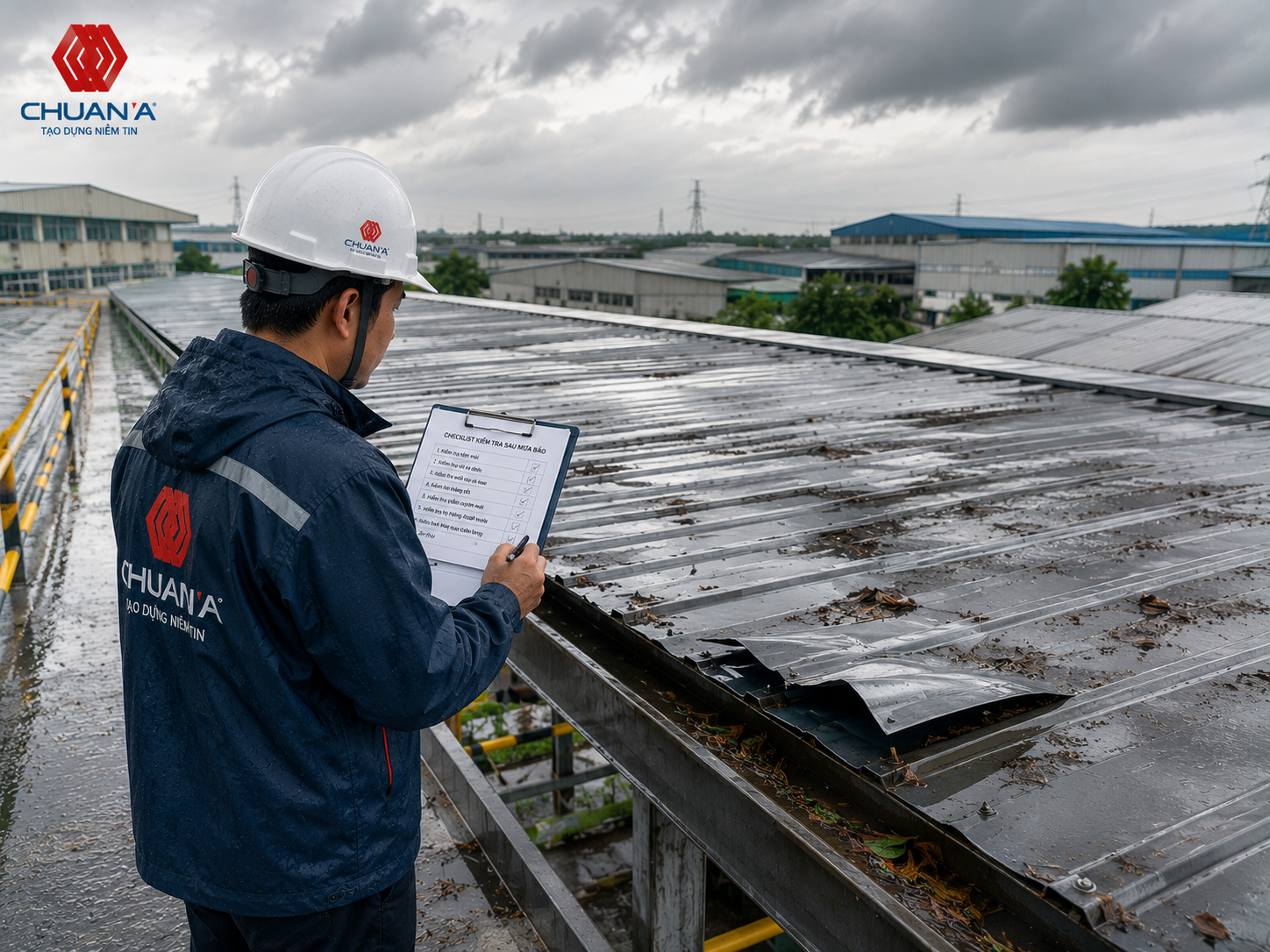
Heavy rainfall and strong winds can expose existing weaknesses in industrial roofing or create new defects. A slightly loose fastener may deteriorate further, a roof sheet can become deformed, or debris can suddenly restrict drainage.
A post-weather inspection should therefore form part of a complete factory metal roof maintenance strategy.
Before detailed inspection, review the roof for obvious changes.
Look for displaced sheets, deformation, debris and unusual conditions.
Roof access should always follow the facility's safety requirements.(27).png)
Strong winds can affect roof edges and areas with weakened connections.
Bent or deformed sheets may interfere with drainage and create locations where water accumulates.
Fasteners in exposed roof areas deserve particular attention.
Loose screws and damaged washers can increase water-entry risk during future rainfall.
Wind-driven rain can enter small gaps at sheet overlaps.
Seams and sealing materials should be checked for movement, separation or deterioration.
Heavy rainfall can transport debris into gutters.
Drainage systems should be checked even when they were recently cleaned because a single severe weather event can create new blockages.(27).png)
Ventilation equipment, pipes and skylights can be affected by strong wind.
Sealing details around these components should be inspected.
New water marks or damp areas inside the factory can help identify roof zones requiring closer investigation.
Locations with previous leakage history should receive priority.
Repeated problems may indicate that the underlying cause requires a different repair approach.(25).png)
Severely deformed, perforated or heavily corroded sheets should be assessed for replacement.
Repeated localized repairs may not be appropriate when the roofing material itself has significantly deteriorated.
Post-weather inspection results should be documented.
Photographs and location records help businesses identify sections that are particularly vulnerable to severe weather.
Post-storm roof inspection can identify new damage before another rainfall event turns it into a larger problem.
Checking sheets, fasteners, seams, drainage and penetrations provides businesses with a clearer understanding of roof condition after severe weather.
Timely maintenance helps businesses monitor building conditions, reduce leakage risks and extend the service life of metal roofing.
CHUAN A CONSTRUCTION INVESTMENT CORPORATION
Address: Amata Industrial Park Service Center, Long Binh Ward, Dong Nai Province, Vietnam.
Hotline: 0907 494 549
Email: info@chuana.com.vn
Website:https://chuana.com.vn/
Contact Chuan A to discuss factory metal roof inspection, maintenance, repair or replacement requirements in Dong Nai.


