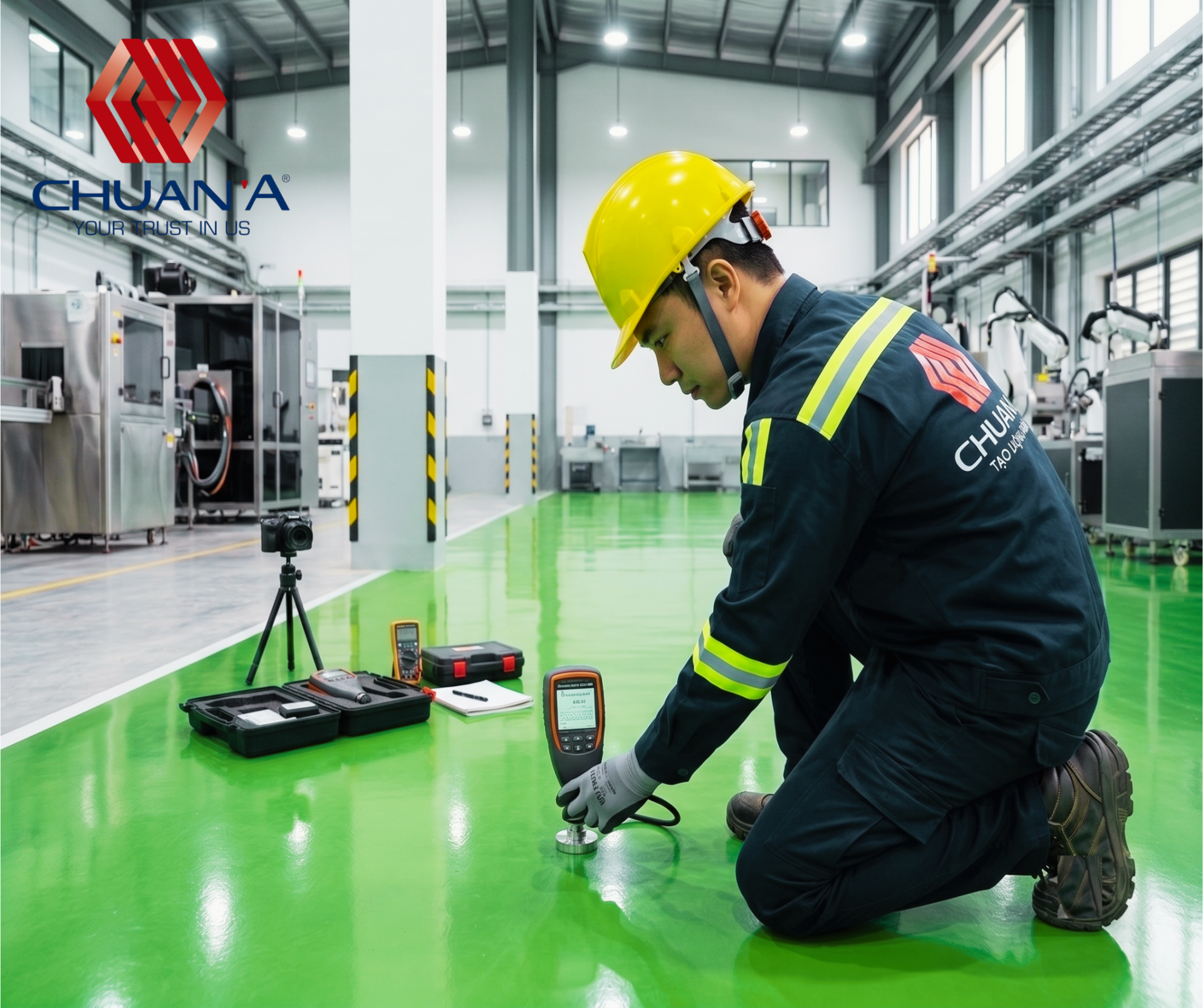
Comprehensive guide on ISO-compliant acceptance standards for factory epoxy floor coatings. Detailed testing procedures for adhesion, thickness, smoothness, and durability by Chuan A Company.
In modern industrialization, factory floors serve as a foundational structure directly impacting the production environment, operational safety, and product quality. Implementing ISO-compliant epoxy floor coatings has become mandatory for enterprises aiming to optimize operations and meet stringent regulatory frameworks such as GMP, HACCP, and ISO 9001.
At Chuan A Company, we recognize that a successful epoxy floor project goes far beyond initial aesthetic appeal. True quality lies in mechanical strength, load capacity, chemical resistance, and long-term durability. This article provides a comprehensive analysis of the ISO-compliant acceptance standards for industrial factory epoxy floor coatings, equipping project owners and managers with precise evaluation metrics.
Inspecting and accepting epoxy floors according to international ISO standards yields tangible strategic advantages:
Ensuring Consistency & Quality: Technical parameters are measured using specialized tools rather than subjective visual judgment.
Extending Structural Lifespan: Early detection of potential defects such as delamination, pinholes, or debonding allows immediate mitigation.
Hygiene & Chemical Resistance: Full compliance with cleanroom and safety requirements for food, pharmaceutical, electronics, and automotive manufacturing.
Optimizing Maintenance Costs: Minimizing operational breakdown risks after project handover.
To ensure transparency and high technical accuracy, Chuan A Company strictly adheres to the following international ISO frameworks:
ISO 8501-1: Surface preparation standards for concrete/steel substrate prior to coating application.
ISO 2808: Methods for the determination of film thickness (Dry Film Thickness - DFT).
ISO 4624: Pull-off test for adhesion evaluation.
ISO 15184: Determination of film hardness by pencil test.
ISO 2813: Measurement of specular gloss of non-metallic paint films.
ISO 14644: Cleanrooms and associated controlled environments standard.
Concrete surfaces before and after epoxy application must meet stringent flatness requirements to avoid water pooling and facilitate smooth forklift operations.
Technical Criteria:
Use a 2-meter straightedge to check any location across the floor.
Maximum allowable clearance for Self-leveling Epoxy systems: ≤ 2mm.
Maximum allowable clearance for Roller-applied Epoxy systems: ≤ 3mm.
Surface Condition: The finished surface must be smooth, free of roughness, dust accumulation, or foreign particles embedded during curing.
Adhesion strength is a vital indicator determining whether the coating film will peel or delaminate under heavy mechanical loads.
Testing Method: Digital Pull-off Adhesion Tester.
Technical Requirement:
Minimum adhesion strength must reach 1.5 MPa to 2.0 MPa on standard concrete substrates.
The failure mode must occur within the concrete substrate (Concrete Failure), not between the epoxy layer and concrete interface. This demonstrates superior bonding.
Film thickness directly governs the load-bearing capacity and durability of factory floors.
| Epoxy Coating System | Standard Thickness | Measurement Method | Test Frequency |
|---|---|---|---|
| Roller-Applied System (3 Layers) | 100 µm – 150 µm | Dry Film Thickness (DFT) Gauge | 5 spots / 100m² |
| Self-Leveling System | 1.0mm – 3.0mm | Caliper / Ultrasonic Gauge / Cut sample | 5 spots / 100m² |
| Anti-Static / Chemical Resistant System | 1.5mm – 2.0mm | Digital Thickness & Resistance Gauge | 10 spots / 100m² |
Gloss Level: Measured using a 60° Gloss Meter.
High Gloss finish: > 85 GU.
Semi-Gloss / Matt finish: 30 – 60 GU according to design specifications.
Color Uniformity:
Color must be 100% consistent across the entire floor, free of color shifts, roller marks, or agglomeration.
Zero blotchiness, haloing, or discoloration caused by ambient moisture or incomplete chemical reaction.
Pencil Hardness Test: The cured film (after full 7-day cure) must achieve a hardness rating from 2H to 4H.
Impact Resistance: Evaluated using a free-falling weight impact tester. The surface must show no cracking, chipping, or micro-fracturing at the impact zone.
Anti-Static Performance (ESD - ISO 61340): Surface resistance maintained between $10^6 \, \Omega$ and $10^9 \, \Omega$ for electronic assembly plants.
Chemical Resistance: No blistering, discoloration, or softening upon exposure to industrial chemicals (dilute acids, alkalis, oils, solvents) during specified test periods (24h to 48h immersion).
To ensure every delivered floor complies strictly with ISO benchmarks, Chuan A Company executes a comprehensive Quality Control defect remediation matrix:
| Observed Defect | Root Cause | Chuan A Remediation Protocol |
|---|---|---|
| Peeling & Blistering | High concrete moisture (>5%), inadequate surface cleaning. | Grind off damaged areas, force-dry substrate, apply specialized moisture-barrier primer. |
| Pinholes / Bubbles | Improper de-aeration during self-leveling pouring, high ambient heat. | Spike-roll during correct wet window; sand down and apply corrective repair coat. |
| Uncured Coating | Incorrect A:B mixing ratio or insufficient agitation. | Scrape off uncured material completely, solvent clean, and re-apply from substrate. |
| Color Variation | Mixed paint batches or uneven film application. | Apply an additional uniform topcoat from a single production batch. |
To guarantee that every epoxy floor meets rigorous ISO standards, Chuan A Company follows a proprietary 5-step quality management workflow:
Step 1: Substrate Survey & Assessment: Measure moisture content ($<4\%$), verify concrete grade ($>250$), flatness, and profile.
Step 2: Surface Preparation (ISO 8501): Shot blasting or heavy-duty diamond grinding to achieve optimal mechanical anchor profile.
Step 3: Deep-Penetrating Primer Application: Enhancing inter-coat bonding between concrete substrate and epoxy matrix.
Step 4: Intermediate & Topcoat Application: Utilizing precision squeegee and vacuum techniques to yield a perfectly level plane.
Step 5: Final Measurement & Handover: Conduct DFT, adhesion, gloss, and hardness testing after 7-day cure, issuing ISO-standard certificate of acceptance.
Adhering to ISO-compliant acceptance standards for factory epoxy floors is the ultimate assurance of engineering excellence and operational safety. Mastering technical metrics for flatness, adhesion, thickness, and aesthetic uniformity enables project leaders to make well-informed decisions, safeguarding capital investment.
With years of proven expertise in industrial flooring, Chuan A Company takes pride in delivering comprehensive, ISO-certified epoxy flooring solutions. We pledge uncompromised quality on every square meter, empowering the sustainable growth of your enterprise.
CHUAN A COMPANY – INTERNATIONAL STANDARD INDUSTRIAL FLOORING SOLUTIONS
Professional - Dedicated - ISO Quality Excellence
CHUAN'A CONSTRUCTION INVESTMENT JOINT STOCK COMPANY
- Hotline: 0907 494 549
- Website: chuana.com.vn
- Email: info@chuana.com.vn
- Facebook: Chuẩn A Corporation
- YouTube: @chuanaconstruction
- TikTok: @chuanaconstruction


