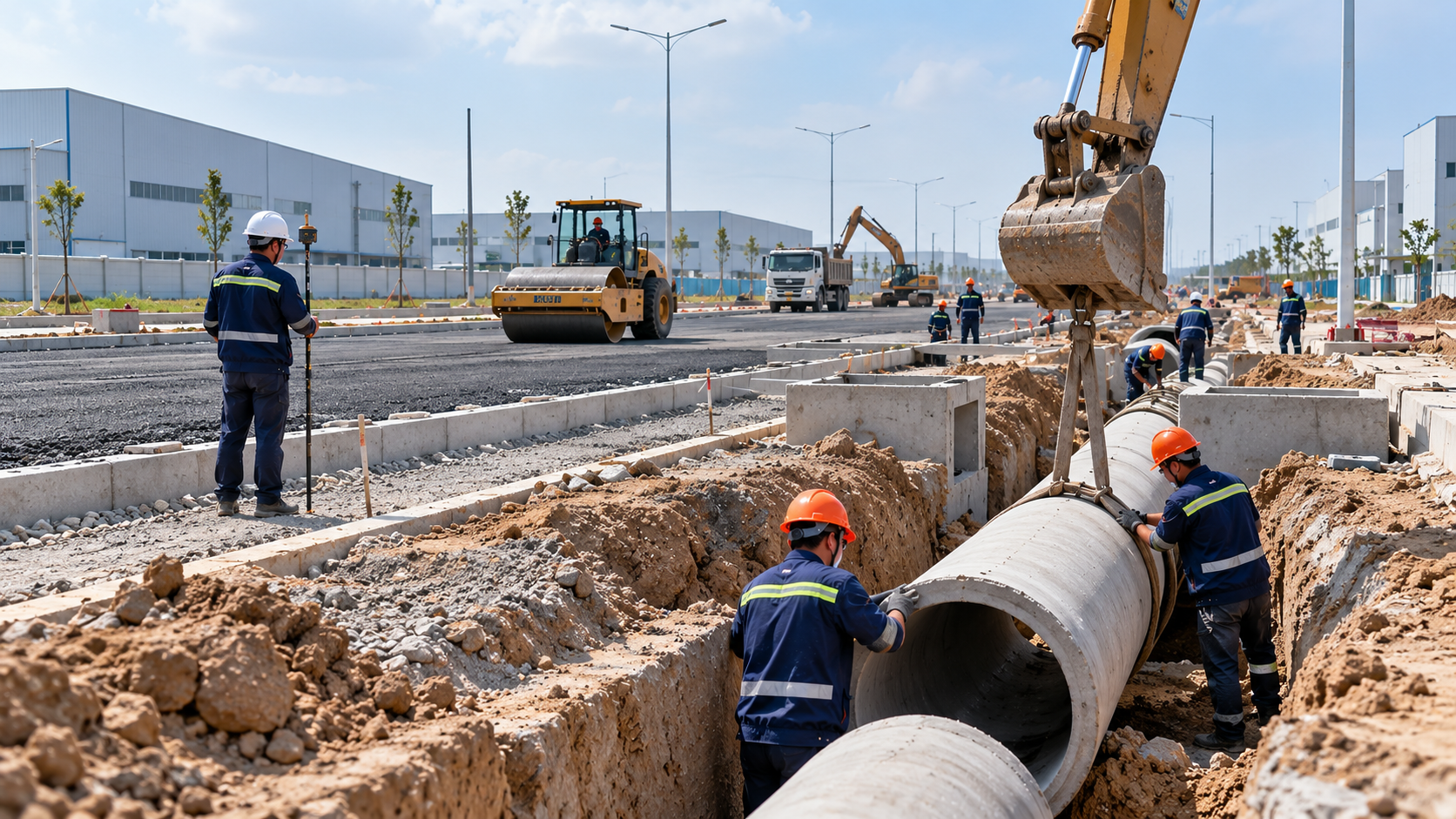
Industrial park infrastructure construction provides the essential foundation for manufacturing plants, warehouses, and logistics facilities. A functional industrial park requires coordinated transportation networks, land grading, drainage, water distribution, power infrastructure, and supporting utilities.
Unlike an individual building project, industrial infrastructure involves multiple interconnected construction activities. Careful sequencing and coordination help minimize rework, control costs, and support long-term operations.
Earthwork activities include clearing, excavation, filling, elevation adjustment, and ground treatment when necessary.
Construction methods should be selected based on geotechnical investigations, topographic data, and approved design requirements.
Industrial roads connect manufacturing facilities, logistics areas, entrances, and external transportation routes.
Pavement structures must be designed for applicable vehicle loads, traffic demand, drainage conditions, and expected use.
Infrastructure may include water distribution pipelines, stormwater drains, wastewater collection systems, manholes, and associated structures.
Network layouts must be coordinated with site planning and environmental requirements.
Technical infrastructure may include electrical distribution lines, substations, roadway lighting, and telecommunications conduits.
Utility locations should be coordinated with road structures and other underground services..png)
The construction team reviews terrain, geotechnical conditions, boundaries, elevations, and existing underground facilities.
Early identification of site constraints helps reduce construction risks.
Excavation and filling are performed according to approved elevations and specifications.
Material selection, layer thickness, compaction, and ground stability require appropriate quality control.
Water pipelines, drainage systems, manholes, electrical conduits, and other buried infrastructure are installed according to coordinated drawings.
Before backfilling, relevant elevations, slopes, connections, materials, and test results must be verified.
After underground works satisfy applicable conditions, road base layers and pavement structures are constructed.
Inspections should address material quality, compaction, thickness, elevations, and other specified requirements.
Lighting equipment, electrical installations, sidewalks, curbs, road markings, and supporting infrastructure are completed as required.
Completed work is reviewed against approved engineering documents, material test results, and applicable acceptance criteria.
Handover occurs when the relevant technical and legal requirements have been satisfied..png)
Poor coordination between underground utilities and surface construction can result in expensive rework.
Completing a roadway before installing or verifying buried utility networks may require reopening the pavement, increasing costs and delaying delivery.
Cable conduits, water pipelines, and drainage systems should be reviewed for crossing locations, separation distances, elevations, and protection requirements.
Road gradients, finished ground elevations, and stormwater collection systems must function together to reduce undesirable water accumulation.
Dividing large sites into coordinated work zones can improve equipment utilization and reduce conflicts between contractors..png)
Fill materials, aggregate bases, and pavement layers should meet engineering specifications.
Acceptance should rely on appropriate inspections and testing rather than visual assessment alone.
Pipe alignment, elevations, slopes, connections, and performance should be inspected according to project requirements.
Concealed work must be inspected at the appropriate stage before subsequent construction.
Construction planning should address internal traffic, excavation safety, lifting operations, dust, noise, and construction wastewater.
Construction logs, inspection reports, test results, and as-built drawings should be maintained throughout the project to support handover and future maintenance.
Industrial park infrastructure costs depend on project size, soil conditions, earthwork quantities, road pavement structures, pipeline lengths, and utility requirements.
Weather, material availability, site access, and the sequence of operations also affect scheduling.
Investors should prepare quantity-based estimates, coordinate procurement, and establish clear responsibilities across project participants.
Changes involving underground infrastructure should be reviewed before permanent pavement work is completed.
Chuan A provides industrial construction and technical infrastructure services, including site grading, internal roads, water and drainage systems, and supporting works.
Explore Chuan A's industrial park infrastructure solutions and its Amata Industrial Park site grading project.
Project owners planning infrastructure development should prepare approved site plans, available survey information, project scope, and operational requirements to support technical discussions and construction planning.
CÔNG TY CP ĐẦU TƯ XÂY DỰNG CÔNG TRÌNH CHUẨN A
Address: Amata Industrial Park Service Center, Long Binh Ward, Dong Nai Province, Vietnam.
Hotline: 0907 494 549
Email: info@chuana.com.vn
Website: https://chuana.com.vn/