Loading...
Yêu cầu báo giá
Loading...
Yêu cầu báo giá
Factory Compressed Air Piping in Dong Nai | Industrial Utility 2026

Factory Compressed Air Piping in Dong Nai | Industrial Utility 2026

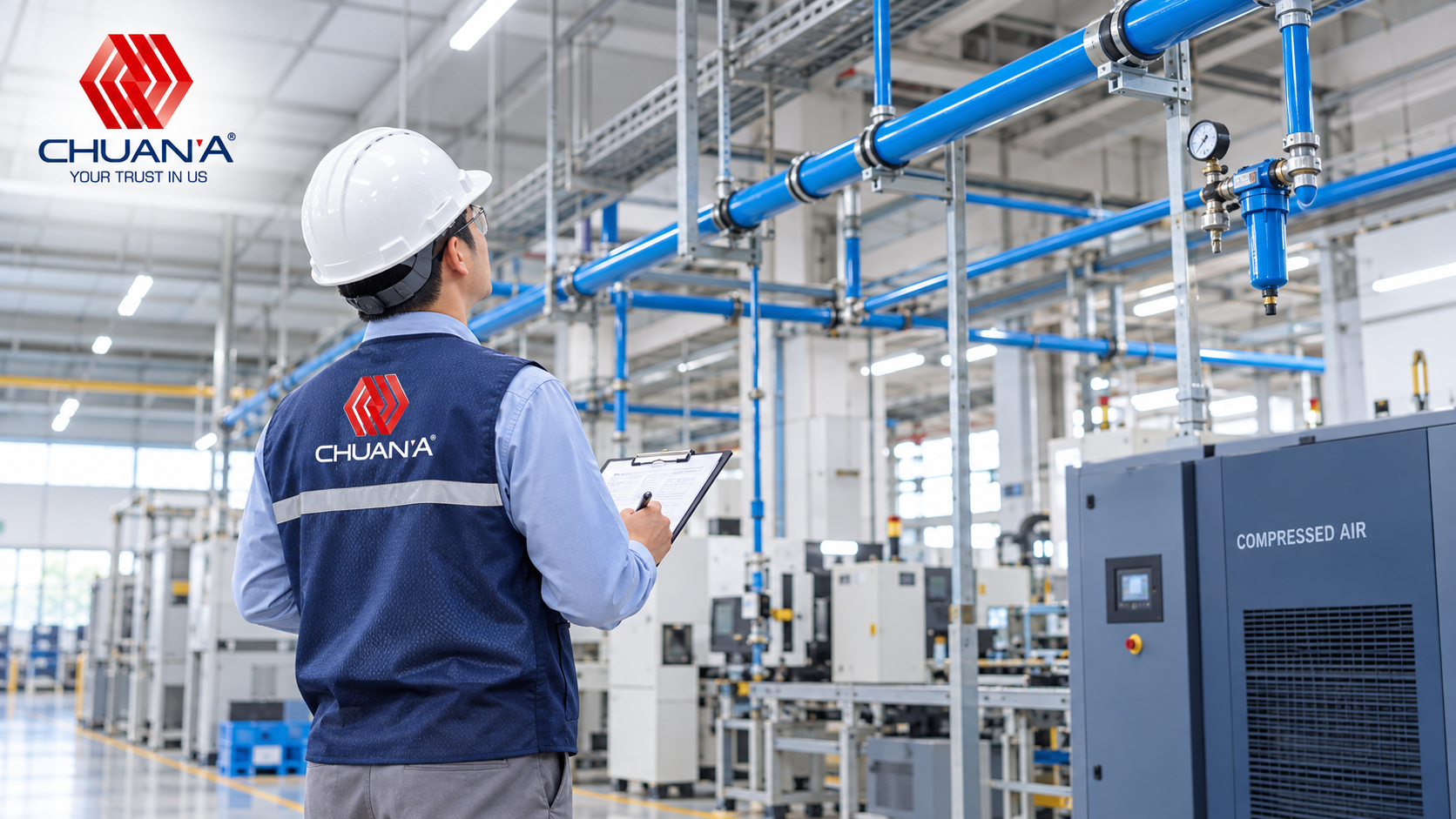
Survey, installation and retrofit of factory compressed-air piping in Dong Nai for production lines, machinery and industrial utility expansion.

Mở/Đóng

    Compressed air is used in many factories for automation equipment, machinery, packaging systems and other manufacturing processes.

    As production lines expand, the air-distribution system also needs to change. Continuously adding new branches to an existing network without reviewing the overall arrangement can make the system increasingly difficult to manage and maintain.

    1. What Does a Factory Compressed-Air System Include?

    Depending on project scope, the distribution system may involve:

    • Compressed-air source.
    • Main distribution piping.
    • Branch piping.
    • Isolation valves.
    • Points of use.
    • Pipe supports.
    • Suitable condensate-management arrangements.
    • Machine connection points.
    • Monitoring systems where applicable.

    2. When Should the System Be Upgraded?

    • New production lines are added.
    • Machines are relocated.
    • The factory expands.
    • Many new consumption points are added.
    • Existing piping has been rerouted repeatedly.
    • Sections are difficult to isolate for maintenance.
    • Multiple leaks are present.
    • As-built documentation is no longer accurate.

    3. Production Layout Directly Affects the Air Network

    When machinery moves, utility piping may need to be reorganized to avoid:

    • Excessively long routes.
    • Unnecessary routing through unrelated areas.
    • Interference with access ways.
    • Conflicts with other MEP systems.
    • Difficult maintenance access.

    Compressed air should therefore be considered during production-layout planning.

    4. Logical Network Zoning

    A clearly organized distribution network makes it easier to:

    • Isolate individual zones.
    • Perform maintenance with less impact on other areas.
    • Expand the network.
    • Identify problems.
    • Manage points of use.

    5. Leakage Control

    Small leaks distributed throughout the system can create significant operating losses.

    Typical areas to check include:

    • Connections.
    • Valves.
    • Flexible hoses.
    • Machine connection points.
    • Branches that are no longer used.

    Unused branches should be properly managed rather than remaining uncontrolled.

    6. Project Process

    Step 1: Site Survey

    Identify the compressed-air source and existing network.

    Step 2: Collect Demand Information

    Identify machines, locations and requirements for each area.

    Step 3: Develop the Solution

    Plan the main line, branches and future expansion capability.

    Step 4: Coordination

    Check routing against electrical systems, sprinklers, ducts and structure.

    Step 5: Installation

    Install supports, piping, valves and points of use.

    Step 6: Inspection

    Inspect the completed system according to the project scope.

    Step 7: As-Built Documentation

    Update actual routing for future maintenance.

    7. Retrofitting an Operating Factory

    Much of the new piping can often be installed before making the final connection to the existing network.

    The tie-in should then be completed during an agreed period to minimize production disruption.

    8. Coordination With Other Utilities

    The overhead space in a factory often already contains:

    • Cable trays.
    • Water pipes.
    • Sprinklers.
    • Ductwork.
    • Structural members.
    • Lighting.

    Compressed-air piping should be coordinated to avoid adding new clashes.

    9. Common Mistakes

    • Adding too many branches without updating drawings.
    • No isolation valves by zone.
    • Piping that is difficult to access.
    • Routes interfering with machinery.
    • No allowance for expansion.
    • Poor leakage management.
    • Failure to update the network after machine relocation.

    10. What Determines Cost?

    • Pipe length.
    • Pipe size.
    • Material.
    • Number of branches.
    • Number of points of use.
    • Supports.
    • Installation height.
    • Whether the factory remains operational.
    • Retrofit complexity.
    • Construction schedule.

    11. Frequently Asked Questions

    Can existing compressed-air piping be reused?

    Potentially, if its condition and capacity remain suitable after assessment.

    Does relocating one machine require replacing the entire network?

    Not necessarily. A branch may be modified or locally rerouted.

    Can the system be modified while production continues?

    Yes, by completing preparation work in advance and scheduling the final tie-in.

    Should system drawings be maintained?

    Yes. They are highly useful for future expansion and troubleshooting.

    12. Contact

    If your business needs to expand or retrofit a factory compressed-air system in Dong Nai, the existing network and future production-line plan should be reviewed together.

    CHUAN A
    Hotline: 0907 494 549
    Email: info@chuana.com.vn

    • Chia sẻ qua viber bài: Factory Compressed Air Piping in Dong Nai | Industrial Utility 2026
    • Chia sẻ qua reddit bài:Factory Compressed Air Piping in Dong Nai | Industrial Utility 2026

    News

    Loading...

    News Categories

    Loading...

    Thư viện ảnh

    Loading...

    Related Posts

    Loading...
    Loading...
    CHUAN A CONSTRUCTION INVESTMENT JOINT STOCK COMPANY