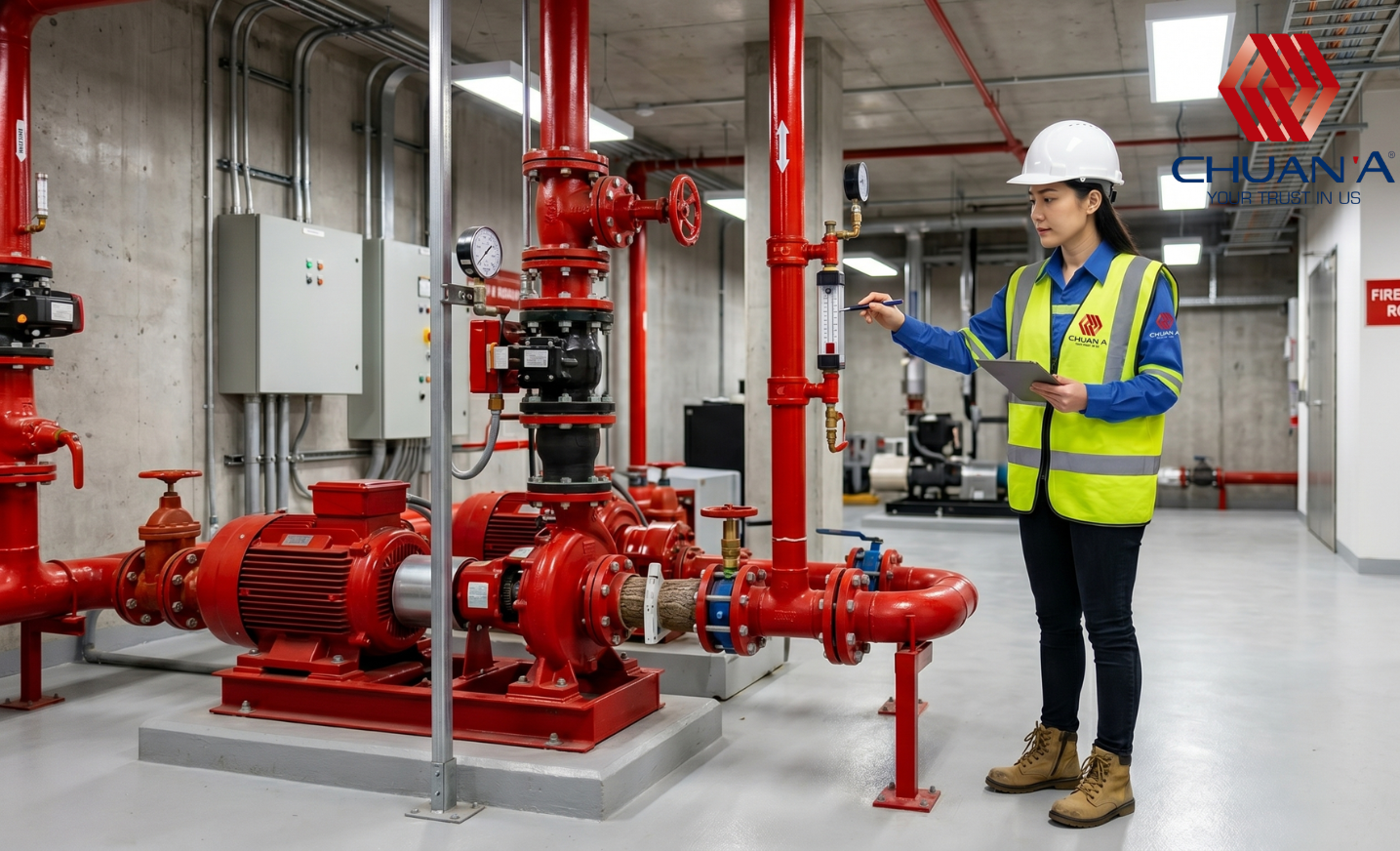
Choosing a contractor with full construction and fire fighting (FFP) capability certificates is a decisive factor for project success and safety. Deep analysis of legal, technical risks and solutions for investors.
In the era of rapid industrialization, modernization, and urbanization, construction projects—ranging from high-rise residential buildings, commercial centers, and industrial parks to manufacturing plants—are continuously increasing in both number and scale. While this development brings a new face to the economy, it simultaneously poses unprecedented challenges in terms of quality management and safety. Among these, construction safety and fire fighting and prevention (FFP) safety are two core, inseparable factors throughout the lifecycle of any building.
However, current market realities reveal a worrying trend: many investors, driven by schedule pressures or the desire to optimize initial costs, choose young, inexperienced consulting, construction, or supervision units. More seriously, some of these units lack the full operation capability certificates required by law. Consequently, numerous projects cannot pass final acceptance inspections upon completion, incur massive rectification costs, or face suspension orders. Furthermore, technical flaws and substandard fire safety systems can lead to catastrophic consequences for human lives and property when incidents occur.
Therefore, understanding and strictly enforcing the principle of only cooperating with units possessing full construction and FFP capability certificates is no longer an optional recommendation. It is a mandatory legal requirement and a robust shield protecting all investment capital.
To gain a thorough understanding, we must first clarify the nature of these capability certificates under the perspective of Vietnamese law.
According to the Law on Construction and its guiding Decrees (such as Decree No. 15/2021/ND-CP), a construction capability certificate is an official assessment issued by competent state authorities (the Ministry of Construction or provincial Departments of Construction) to organizations participating in construction activities. This certificate classifies an organization's capacity into Class I, Class II, or Class III based on strict criteria regarding personnel (degrees, individual practice certificates), practical experience (number and scale of completed projects), and technical equipment.
An enterprise operating without this certificate lacks the legal standing to sign contracts and execute tasks such as master planning, design, vetting, construction, or project supervision.
In parallel with construction, the fire safety sector is strictly managed by the Police Department of Fire Fighting and Prevention and Rescue (FFP & R) under the Ministry of Public Security. According to Decree No. 136/2020/ND-CP and the latest updates, organizations business-providing FFP services (including design consultancy, vetting, construction, installation, and maintenance of FFP systems) must be granted a Certificate of Eligibility for Fire Fighting and Prevention Service Business.
This certificate proves that the unit possesses a team of experts with individual FFP design/construction practice certificates, along with the necessary facilities, vehicles, and technical equipment to ensure the proper execution of services.
The first and most direct factor is legality. A construction project must undergo an extremely rigorous document review process to be legally started and completed.
Permit Phase: Architectural, structural, and fire safety design documents must be signed and stamped by a certified capable unit. If an uncertified unit is used, your application will be rejected during the initial vetting round.
Acceptance Phase: This is currently the most challenging bottleneck for many investors. During final construction and fire safety acceptance, authorities thoroughly inspect the capability profiles of all participating contractors. If a contractor is found to lack the required capability at the time of construction, the project will not receive an official acceptance document. This means the building cannot open for commercial operations, leading to capital stagnation and severe revenue losses.
Units holding high-class certificates have passed natural market screening and state supervision. To maintain their certificates, they must possess:
A team of chief engineers, architects, and site managers with decades of experience.
Standardized internal quality control processes (ISO).
Deep knowledge of geology, materials, and advanced structural solutions.
By entrusting projects to these units, investors can rest assured that structural loads are precisely calculated, offering high durability against weather and time, and minimizing risks of sinking, cracking, or water leakage—the chronic failures of careless construction.
In recent years, fire safety regulations in Vietnam, particularly QCVN 06 (National Technical Regulation on Fire Safety for Buildings and Structures), have been continuously updated with increasingly stringent standards that align with international practices.
A professional, fully certified FFP contractor will:
Understand and Apply Correctly: They know how to classify a building's fire resistance rating, calculate safe evacuation distances, smoke extraction ventilation systems, and optimize automatic fire suppression systems (Sprinklers, Drenchers, gas systems, aerosols...).
Prevent Material Waste: Incompetent units often over-design or create flawed blueprints, forcing investors to pay exorbitant costs for unnecessary fireproof materials, or conversely, under-designing systems so they fail during an actual fire.
Paradoxically, many investors choose low-cost contractors (without certificates) to save 10% to 15% on initial costs, only to pay double or triple later to fix the consequences.
Hidden Costs of Delays: Every month a project is delayed due to fire safety acceptance issues translates to months of bank interest expenses and lost business opportunities.
Rectification Costs: Tearing down structures to reroute fire piping or replacing substandard fireproof materials after a government inspection is a financial nightmare.
Insurance and Operations: Major insurance companies often refuse to sell fire and explosion insurance or charge extremely high premiums for buildings constructed by unverified entities.
The greatest asset of any enterprise or investor is its reputation and its people. A fire or structural collapse not only wipes out physical infrastructure but can also completely destroy a brand built over decades, while bringing severe criminal liabilities to executives. Choosing a fully certified unit is the most humane and responsible action to protect the lives of hundreds or thousands of people who will live and work inside that building.
To better appreciate the importance of this issue, let us analyze specific risk scenarios when investors compromise on contractor capability:
| Sector | Technical Risks | Legal & Financial Consequences |
|---|---|---|
| Structural Construction | - Structural deviations, weak foundations.
- Use of substandard materials.
- Leaks and wall cracks after a short period. | - Project suspension orders.
- Expensive reinforcement and repair costs.
- Severely reduced building lifespan. |
| Fire Safety Systems | - Sprinkler heads fail to activate.
- Corridor smoke extraction system failures.
- Fire doors fail to meet EI standards. | - Rejection of vetting/acceptance certificates.
- Administrative fines, closure orders.
- Human tragedies if a fire occurs. |
To protect themselves, investors must establish a clear verification process during the bidding or partner selection phase:
Public Database Search: All legitimate construction capability certificates are published transparently on the Construction Capability Portal of the Ministry of Construction (nanglucxaydung.gov.vn). Request the certificate ID and verify it online.
Verify FFP Certificate Legitimacy: Demand the original Certificate of Eligibility for FFP Service Business issued by the Police Department of FFP & R or the provincial fire police. Check the expiration date and authorized scope of work.
Evaluate Key Personnel Profiles: A company may hold an organizational certificate, but who are the individuals directly managing your project (Site Manager, Design Team Leader)? Request individual practice certificates for these key personnel.
Site Visits: Do not rely solely on paper profiles. Take the time to visit similar projects that the unit has designed or constructed to gather feedback from previous investors.
In a context where legal regulations are tighten and public awareness of building safety is rising, choosing a unit with full construction and FFP capability certificates is no longer a matter of debating prices. It is a smart, long-term investment that guarantees absolute peace of mind for the investor.
Remember, a sustainable building must be constructed on a rock-solid legal foundation and through the dedication of genuine experts. Do not gamble your assets, brand, and human lives on unfounded low-cost promises.
CHUAN'A CONSTRUCTION INVESTMENT JOINT STOCK COMPANY