Loading...
Yêu cầu báo giá
Loading...
Yêu cầu báo giá
Factory Transformer Substation Contractor in Dong Nai | 2026

Factory Transformer Substation Contractor in Dong Nai | 2026

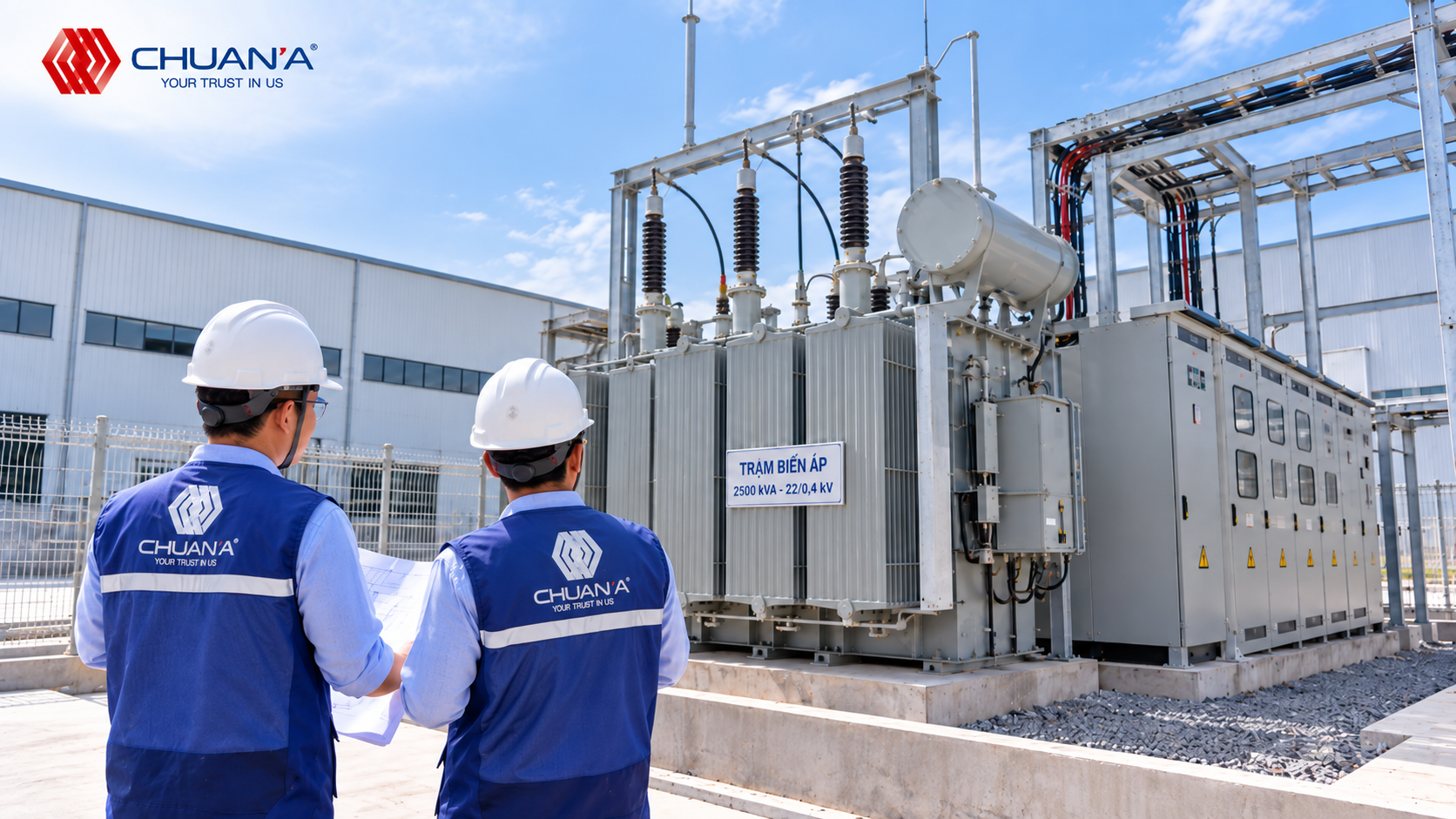
Survey, installation and upgrade of factory transformer substations in Dong Nai for production expansion, additional loads and industrial electrical infrastructure.

Mở/Đóng

    When a factory first begins operation, its electrical supply system is normally designed around the production scale and connected loads planned at the time of investment. After several years, however, a business may add machinery, expand production lines, build additional warehouses or increase output.

    At that point, the original electrical capacity may no longer be suitable.

    Installing or upgrading a factory transformer substation in Dong Nai should therefore consider total demand, future production plans, medium-voltage systems, low-voltage distribution and the way power is delivered to different factory areas.

    1. The Role of a Transformer Substation in a Factory

    A transformer substation is an important part of the power supply system in many industrial facilities.

    It does not operate independently. It is directly related to:

    • Incoming power supply.
    • Medium-voltage systems.
    • Transformers.
    • Main switchboards.
    • Distribution panels.
    • Power cables.
    • Production machinery.
    • Backup systems.
    • Grounding.
    • Related technical infrastructure.

    When power capacity changes, downstream systems should also be reviewed.

    2. When Should a Factory Consider an Upgrade?

    Typical situations include:

    • Adding a new production line.
    • Installing high-power machinery.
    • Expanding the factory.
    • Building additional warehouses.
    • Existing loads frequently operating near capacity.
    • Changing the production process.
    • Adding HVAC or chiller systems.
    • Expanding utility systems.
    • Existing switchboards and distribution networks having limited spare capacity.

    An early assessment helps businesses plan proactively instead of waiting until production demand exceeds existing power capacity.

    3. Capacity Should Not Be Selected Only From Current Equipment

    One important step is determining the actual load requirement.

    The review should consider:

    • Existing connected loads.
    • Planned equipment.
    • Operating characteristics.
    • Appropriate design utilization factors.
    • Expansion plans.
    • Required backup strategy.

    An undersized solution may require another upgrade soon.

    On the other hand, an unnecessarily oversized solution may increase initial capital cost.

    4. Substation Location Must Be Coordinated With the Factory Layout

    The location should be reviewed against multiple considerations:

    • Access.
    • Cable routing.
    • Operating space.
    • Maintenance space.
    • Internal roads.
    • Nearby buildings.
    • Future expansion.
    • Safety requirements.
    • Fire protection and related technical systems.

    For operating factories, future equipment transportation and replacement should also be considered.

    5. Coordination With the MSB and Low-Voltage Network

    Increasing substation capacity while keeping the existing low-voltage system unchanged without assessment may simply create a new bottleneck elsewhere.

    The review should include:

    • Main switchboards.
    • Cables.
    • Busways where applicable.
    • Distribution boards.
    • MCC panels.
    • Power routes.
    • Connection points.
    • Grounding systems.

    The objective is to ensure that the complete distribution chain remains suitable for the new demand.

    6. Project Process

    Step 1: Existing-System Survey

    Collect load information and inspect the current system.

    Step 2: Determine Demand

    Understand production output, machinery and expansion plans.

    Step 3: Develop the Solution

    Prepare an electrical supply and distribution concept.

    Step 4: Engineering and Coordination

    Review layout, cables, structure and technical systems.

    Step 5: Construction Preparation

    Prepare construction methods, safety planning and shutdown arrangements where required.

    Step 6: Installation

    Carry out installation according to approved documents.

    Step 7: Inspection and Handover

    Perform inspections and testing within the project scope and complete handover documentation.

    7. Upgrading a Substation in an Operating Factory

    This requires careful planning.

    The business should establish:

    • Available power shutdown periods.
    • Areas that must remain energized.
    • Preparation work that can be completed in advance.
    • Switching sequence.
    • Responsible coordination personnel.
    • Backup arrangements where included in the project.

    A well-prepared shutdown can significantly reduce production impact.

    8. QA/QC During Construction

    Typical control items may include:

    • Equipment.
    • Materials.
    • Installation locations.
    • Cable routing.
    • Connections.
    • Grounding.
    • Equipment labeling.
    • Inspection records.
    • Manufacturer documentation.

    9. Handover Documentation

    Clear documentation supports the Facility team in future operation.

    It may include:

    • As-built drawings.
    • Electrical diagrams.
    • Equipment information.
    • Inspection records.
    • Operating documentation.
    • Equipment schedules.
    • Change records for retrofit projects.

    10. What Determines Project Cost?

    Project cost depends on:

    • Required capacity.
    • Substation type.
    • Equipment selection.
    • Medium-voltage system scope.
    • Low-voltage scope.
    • Cables.
    • Civil infrastructure.
    • Site layout.
    • Construction conditions.
    • Connection distance.
    • Retrofit requirements.
    • Shutdown requirements.

    A site survey and clearly defined scope are therefore needed before preparing a detailed budget.

    11. Frequently Asked Questions

    Does adding machinery always require a larger transformer?

    Not necessarily. Existing load and available spare capacity should first be assessed.

    Can a substation be upgraded while the factory remains in production?

    Yes, but power transfer and shutdown planning must be carefully coordinated.

    Is replacing the transformer with a larger unit enough?

    This should not be assumed without checking the MSB, cables and downstream distribution system.

    Should future expansion be considered?

    Yes. A reasonable level of spare capacity can help the factory respond more effectively to future growth.

    12. Contact

    If your business is preparing to expand production capacity or needs an assessment of a factory transformer substation in Dong Nai, the incoming power source and downstream distribution network should be reviewed together.

    CHUAN A CONSTRUCTION INVESTMENT JSC

    Hotline: 0907 494 549
    Email: info@chuana.com.vn
    Website: chuana.com.vn

    • Chia sẻ qua viber bài: Factory Transformer Substation Contractor in Dong Nai | 2026
    • Chia sẻ qua reddit bài:Factory Transformer Substation Contractor in Dong Nai | 2026

    News

    Loading...

    News Categories

    Loading...

    Thư viện ảnh

    Loading...

    Related Posts

    Loading...
    Loading...
    CHUAN A CONSTRUCTION INVESTMENT JOINT STOCK COMPANY