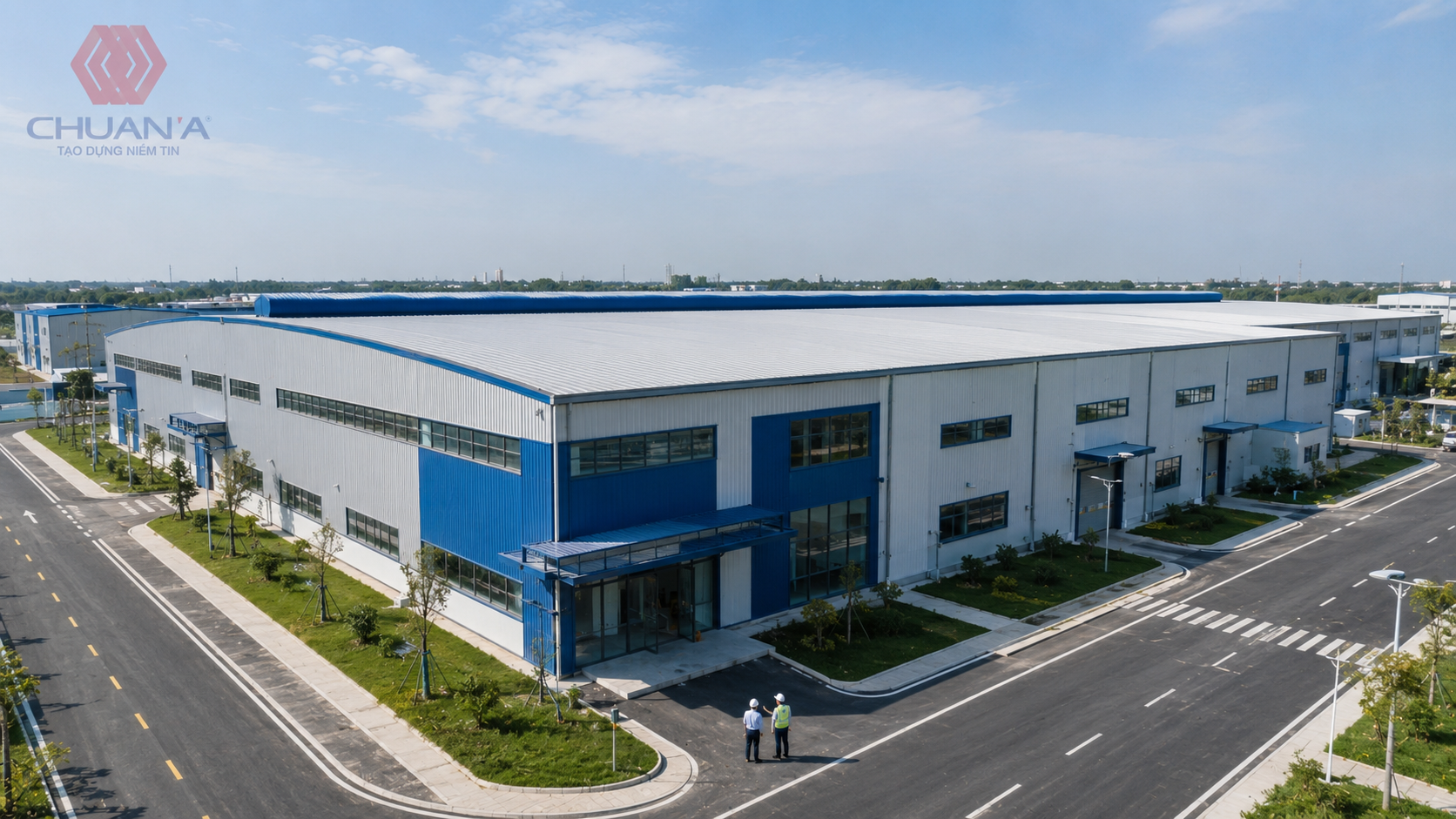
Factory metal roof structure is an important topic that investors should understand before building, renovating, replacing, or repairing the roof of an industrial facility. A metal roof system is not simply a few roofing sheets placed on a steel frame. Beneath that simple-looking surface is a complete system of steel frames, purlins, roofing sheets, screws, rubber washers, ridge caps, edge trims, flashing, gutters, downpipes, and leak-prevention details.
For factories, manufacturing plants, and warehouses, metal roofs often cover large areas and are constantly exposed to sun, rain, wind, vibration, industrial dust, and seasonal temperature changes. If one component of the roof system is designed or installed incorrectly, the whole building may face problems such as leakage, standing water, corrosion, roof sheet loosening, loud noise, or increased maintenance costs.
Understanding factory metal roof structure helps investors read quotations more accurately, control material quality, choose the right contractor, and understand why a durable roof cannot be judged only by the roofing sheet price per square meter. A roof system is like an industrial orchestra: the roofing sheet is the visible instrument, but if purlins, screws, gutters, and accessories play out of rhythm, the entire performance goes wrong when the first rain arrives.
(2).png)
A factory metal roof structure is the combination of components that create the roof covering system for an industrial building. This system protects the production space below from sun, rain, wind, and dust while supporting drainage and stable factory operation.
A basic factory metal roof usually includes a load-bearing frame, purlins, roofing sheets, roofing screws, rubber washers, ridge caps, edge trims, gutters, downpipes, and leak-prevention details. Depending on the project, the roof may also include insulated roofing, heat-reduction layers, ventilation fans, skylights, roof penetrations, or technical equipment installed on the roof.
The main difference between industrial metal roofs and residential roofs is scale and operating requirements. Factory roofs are usually longer, wider, higher, and more technically complex. Therefore, every detail must be calculated carefully. It is not enough to simply cover the building and call the job complete.
The load-bearing frame is the main skeleton supporting the entire metal roof. In factory buildings, this frame is often made of pre-engineered steel or structural steel suitable for building span, height, roof load, and operating conditions.
The frame must support the roof’s own weight, wind load, maintenance load, and any equipment that may be installed on the roof. If the frame is weak, misaligned, or incorrectly calculated, the roof system may vibrate, sag, deform, or become unsafe during bad weather.
When installing a factory metal roof, investors should pay attention to steel quality, bolted connections, welds, protective coating, and erection accuracy. A good roof must start with a strong supporting frame because no armor stays strong if the skeleton beneath it is shaking.
Purlins are installed on the roof frame and directly support the roofing sheets. They are arranged at specific spacing depending on roofing type, load requirements, roof slope, and structural design.
If purlin spacing is too wide, roofing sheets may sag, vibrate, create noise, or lose load capacity. If purlins are not installed at the correct elevation, the roof may become uneven, hold standing water, or make sheet overlaps difficult to align. Purlins are not just support bars. They are the rails that shape the entire roof surface.
For older factories, when replacing or renovating the roof, purlins should be checked for corrosion, sagging, bending, weakness, or incorrect spacing. If purlins have deteriorated, installing new roofing sheets without reinforcement may still lead to problems during operation.
Metal roofing sheets are the main covering layer of the roof system. This is the part directly exposed to sun, rain, wind, and dust. Factory roofing sheets may include single-layer metal sheets, cool-coated sheets, color-coated sheets, PU insulated sheets, EPS insulated sheets, or specialized roofing materials depending on project requirements.
When choosing roofing sheets, investors should consider thickness, coating, rib profile, heat resistance, noise reduction, color durability, and the operating environment. For factories with many workers or heat-generating machinery, insulated roofing can improve the working environment. For warehouses that need to optimize cost, single-layer roofing may be suitable if ventilation and heat control are handled properly.
The quality of roofing sheets directly affects roof lifespan. Sheets that are too thin or have poor coating can corrode, dent, vibrate, or deteriorate quickly in industrial conditions. Therefore, quotations should clearly state roofing type, thickness, and material standards.
Roofing screws connect metal sheets to purlins. Each screw point penetrates the roofing sheet surface, so screw quality and fastening technique strongly affect leak resistance.
Screws need suitable length, corrosion-resistant material, and quality rubber washers. The washer seals the screw hole and prevents rainwater from entering below. If the washer cracks, ages, is over-compressed, or is not tightened enough, water can enter through the screw hole.
Common mistakes include using low-quality screws, fastening screws in the wrong position, overtightening and deforming the sheet rib, or undertightening and leaving the screw loose. One small screw can open the road for a large water stain, so this detail should not be carelessly minimized.
The ridge cap is installed at the roof peak where two roof slopes meet. Its function is to cover the joint at the top of the roof and prevent rainwater and wind-driven rain from entering the building.
The ridge cap must have suitable size, correct installation direction, secure screw fastening, and properly sealed edges. If the ridge cap is too narrow, misaligned, open, or has peeling sealant, the roof peak can easily leak during heavy rain with wind.
In factory metal roof structure, the ridge cap is a small detail that cannot be ignored. It is like the zipper at the top of an industrial raincoat. If the zipper is open, the whole raincoat loses its purpose.
Edge trims cover roof edges, improve appearance, and reduce rainwater entering the sheet edges. Flashing refers to protective details installed at roof-to-wall junctions, roof-to-equipment junctions, or around roof penetrations.
Junction areas have high leakage risk because wind can push water into gaps. If these areas are only sealed with temporary sealant without proper flashing, water may return after materials expand and contract under sun and rain.
Edge trims and flashing must be designed according to actual project conditions, especially at high wall junctions, exhaust fan bases, ventilation pipes, technical boxes, or roof connection areas. These accessories act like guards at the weakest borders of the roof system.
Gutters collect rainwater from the roof and lead it toward downpipes. For factories with large roof areas, a large volume of rainwater may flow into gutters within a short time. Therefore, gutters must have suitable size, proper slope, and appropriate material.
Gutters that are too small, poorly sloped, clogged, corroded, or leaking at joints can cause water to overflow back into the roof and create leakage. In many cases, the roof leaks not because the roofing sheets are damaged, but because the gutter system cannot drain water fast enough.
When designing a factory metal roof system, gutters should be calculated together with roof area, rainfall, number of downpipes, and drainage direction. Rainwater does not negotiate, so the gutter system must be prepared to receive it from the beginning.
Downpipes receive water from gutters and lead it to the drainage system below. If the number of downpipes is insufficient, their diameter is too small, or their positions are unsuitable, water remains in the gutters longer and increases the risk of overflow and leakage.
Downpipes should be placed in suitable positions, easy to inspect, and easy to clean. For large factories, water flow should be calculated to determine the right number of downpipes. It is also important to prevent leaves, industrial dust, or foreign objects from blocking drainage.
A roof system is only truly effective when rainwater has a clear route from the roof surface to the drainage system. Without enough downpipes or with poor placement, gutters become water storage instead of water transport.
For many factories, a metal roof must not only prevent rain but also reduce heat. Insulation may include PU roofing, EPS roofing, insulation wool, reflective insulation, or other solutions suitable for each project.
Insulation helps reduce heat transfer from the roof to the interior, lower rain noise, and improve the working environment. For factories with workers inside, heat-generating machinery, or temperature-sensitive goods, this component is worth considering.
However, insulation materials must be installed correctly to avoid displacement, moisture absorption, or reduced performance over time. Heat reduction should not only be judged on the first day of installation, but also by long-term effectiveness.
Roof penetrations are areas where equipment or pipes pass through the roof, such as exhaust fans, ventilation pipes, technical pipes, equipment bases, skylights, or ventilation systems. These are high-risk leakage points if not treated correctly.
Each roof penetration requires flashing, sealant, protective accessories, and suitable water direction. If the roof is simply cut and patched with sealant, the sealant may crack after exposure to sun and rain, allowing water to enter through the junction.
In a factory metal roof system, roof penetrations are like small doors opened in the armor. Each door needs its own lock, gasket, and cover. Otherwise, water will find its way inside.
Understanding metal roof structure helps investors control quality better. When reviewing a quotation, investors can check whether the contractor has included roofing sheets, purlins, screws, ridge caps, edge trims, gutters, downpipes, and leak-prevention work.
This knowledge also helps avoid unfair price comparison. A low quotation may exclude accessories, gutters, roof penetration treatment, or use low-quality screws. If investors only compare the final price without understanding the roof structure, they may choose a solution with higher maintenance cost later.
Especially for operating factories, understanding roof structure makes maintenance faster. When leakage occurs, the technical team can identify whether the cause may come from sheet overlaps, screws, ridge caps, gutters, or roof penetrations instead of only looking at the dripping point.
The first mistake is focusing only on roofing sheets and ignoring accessories. Good sheets with poor screws, damaged washers, open ridge caps, or undersized gutters can still leak. A roof is a system, not a single material item.
The second mistake is unsuitable purlin arrangement. Purlin spacing that is too wide or uneven purlin elevation can cause roof sagging, standing water, or misaligned sheet installation.
The third mistake is careless junction treatment. Wall junctions, exhaust fan bases, roof penetrations, and roof edges need proper flashing. Temporary sealant may work for a few months, but leakage can return when materials expand and contract.
The fourth mistake is insufficient drainage design. A large roof with small gutters, too few downpipes, or poor gutter slope can overflow during heavy rain.
When maintaining a factory metal roof, the inspection should include roofing sheets, screws, rubber washers, sheet overlaps, ridge caps, edge trims, flashing, gutters, downpipes, and roof penetrations. These points directly affect leak resistance and roof lifespan.
Gutters should be cleaned periodically to prevent debris, dust, or foreign objects from blocking water flow. Screws and washers should be checked because they can age after years of use. Junctions and roof penetrations should be observed carefully after the rainy season.
Good maintenance helps detect small defects before they become major problems. For factories, repairing one screw today can be much cheaper than treating widespread leakage during the rainy season.
CHUAN’A provides industrial construction solutions and factory work items, in which the metal roof system directly affects building durability and operation.
When consulting and installing factory metal roofs, CHUAN’A focuses on checking the system as a whole, including frames, purlins, roofing sheets, screws, rubber washers, ridge caps, gutters, downpipes, roof penetrations, and leak resistance. This approach helps reduce the risk of a newly installed roof deteriorating quickly or leaking after a short time.
For factories, manufacturing plants, and warehouses in Dong Nai, Bien Hoa, Binh Duong, and nearby areas, understanding and installing the metal roof structure correctly helps investors reduce risks, optimize maintenance costs, and improve building lifespan.
What components are included in a factory metal roof structure?
A factory metal roof structure usually includes steel frames, purlins, roofing sheets, roofing screws, rubber washers, ridge caps, edge trims, flashing, gutters, downpipes, and leak-prevention details.
Which parts of a metal roof are most likely to leak?
Common leak-prone points include sheet overlaps, roofing screws, ridge caps, gutters, roof penetrations, and wall junctions.
Do purlins need to be replaced when replacing a metal roof?
Not always. However, if purlins are corroded, sagging, weak, or incorrectly spaced, they should be reinforced or replaced before new roofing sheets are installed.
Are gutters important in a factory metal roof system?
Yes. Gutters determine how rainwater is collected and drained. If gutters are undersized, clogged, or poorly sloped, the roof may still leak even when the roofing sheets are in good condition.
Factory metal roof structure includes many connected components, from steel frames, purlins, roofing sheets, screws, ridge caps, flashing, gutters, and downpipes. Each detail affects roof durability, leak resistance, and maintenance cost. Investors should understand the roof system to control quotations, choose suitable materials, ensure correct installation, and maintain the roof effectively. CHUAN’A can support investors with survey, consulting, and factory metal roof installation in Dong Nai, Bien Hoa, Binh Duong, and nearby areas.
CHUAN'A CONSTRUCTION INVESTMENT JOINT STOCK COMPANY


