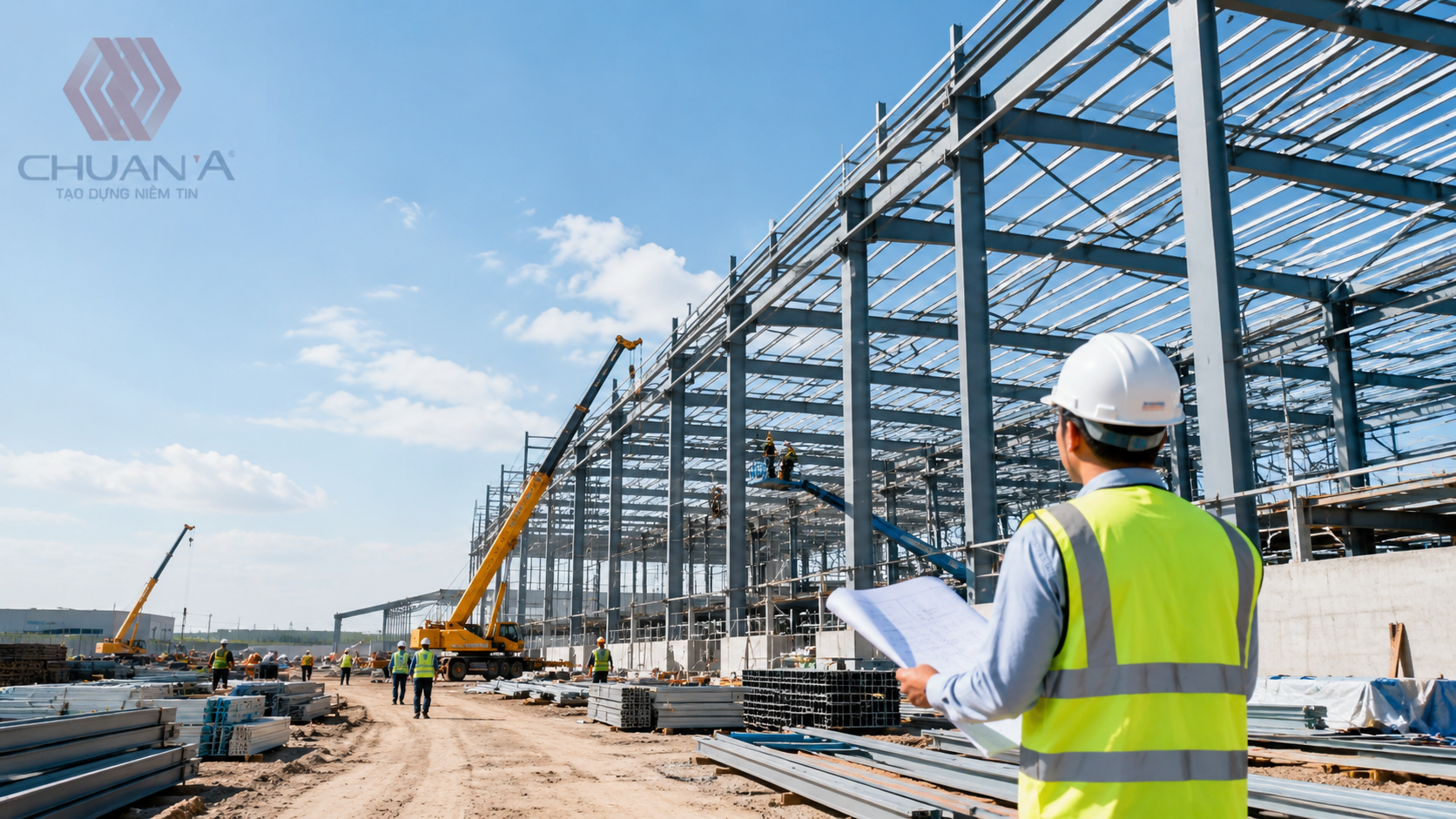
Factory metal roof replacement becomes necessary when the existing roof system has deteriorated, leaks repeatedly, shows widespread corrosion, has deformed sheets, damaged roofing screws, or no longer supports proper drainage. For factories, manufacturing plants, and warehouses, a metal roof is not only a cover against sun and rain. It protects goods, machinery, electrical systems, and production activities below.
Many investors try to repair local leaks many times to save cost. However, if the whole roof system has already deteriorated, patching one area while another area leaks can increase maintenance cost without solving the root problem. At that point, replacing the metal roof is no longer an unwanted expense, but a long-term investment to protect the facility.
A factory roof is the armor of the building. When the armor only has a few scratches, repair may be enough. But when it is punctured, corroded, and loose at many connections, temporary patching only makes the business nervous whenever the sky turns gray.
Factory metal roof replacement is the process of removing part or all of the old roofing sheets, inspecting purlins and related structural elements, and installing new metal roofing together with roof accessories such as roofing screws, rubber washers, ridge caps, edge trims, flashing, gutters, and downpipes when required.
This work can be carried out on operating factories, temporarily stopped factories, or old facilities that need renovation before being used again. Depending on actual conditions, investors may replace the whole roof, replace only heavily damaged areas, or combine roof replacement with purlin reinforcement, gutter renovation, and leak-prevention treatment.
Roof replacement is different from local leak repair. Leak repair usually focuses on a few defects such as damaged screws, open sheet overlaps, or clogged gutters. Factory roof replacement is a broader solution, suitable when most of the roof system can no longer operate reliably.
Not every leaking metal roof needs immediate replacement. If the roof is still relatively new and only has a few minor defects, local leak repair may be reasonable. However, if the roof shows several signs of deterioration at the same time, investors should consider replacement to avoid greater risks.
The first sign is repeated leakage. If the same area or multiple areas continue leaking after previous repairs, the whole roof system may have a larger problem. Water can travel through many paths, making point-by-point patching ineffective.
The second sign is widespread corrosion. When the protective coating fails, metal sheets gradually corrode, become thinner, and may develop holes. If corrosion appears only locally, spot treatment may work. But if corrosion spreads widely, replacement is safer.
The third sign is widespread damage to roofing screws and rubber washers. Loose screws, corroded screws, cracked rubber washers, or deformed washers create many water-entry points. When too many screw points fail, local screw replacement may not be efficient anymore.
The fourth sign is roof sagging, standing water, or sheet deformation. Standing water increases the risk of leaks and corrosion. If the cause comes from deformed sheets, weak purlins, or unsuitable roof slope, a detailed survey is needed to decide whether roof replacement or structural renovation is required.
The fifth sign is deteriorated gutters and drainage system. Corroded, undersized, clogged, or poorly sloped gutters can cause water to overflow back into the roof. When replacing roofing sheets, investors should consider upgrading drainage at the same time so the new roof will not face old problems.
.png)
Local repair is suitable when the roof is still in fair condition and only has a few clearly identified defects. For example, a few loose screws, an open sheet overlap, peeling ridge cap sealant, or clogged gutters. In such cases, targeted repair can save cost.
Roof replacement is suitable when the roof has reached the end of its lifespan, leaks in many areas, has widespread corrosion, has weak or brittle sheets, has many failed screws, or requires repeated repair too often. If every rainy season requires another roof repair team, the accumulated cost may exceed the original plan.
Investors should compare local repair cost with replacement cost based on lifecycle value. A cheaper option today may not be truly cheap if it needs to be repeated many times over the next few years. Sometimes a new roof is the cleanest way to stop the exhausting maintenance loop.
Single-layer metal roofing is a common option for projects that need to optimize cost. It is lightweight, easy to install, fast to complete, and suitable for many factory types. However, its heat and noise reduction performance is limited without additional support.
Cool-coated or color-coated metal roofing is often used for factories that require a clean surface, better heat reflection, and a professional appearance. When choosing this type, investors should consider thickness, coating quality, brand, and factory environment.
PU or EPS insulated roofing is suitable for factories that need heat reduction, rain noise reduction, and an improved working environment. Initial cost is higher, but it can bring operational benefits if the facility has many workers, heat-generating equipment, or more stable temperature requirements.
Specialized roof panels may be used for certain projects with higher requirements for insulation, hygiene, appearance, or operational performance. Roofing material should be selected based on factory function, budget, and environmental conditions instead of simply choosing the lowest price.
Before replacement, the contractor should inspect the entire existing roof condition. A careful survey helps define the correct replacement scope, avoid missing problems, and reduce unexpected costs during installation.
The first item is the condition of old roofing sheets. The contractor should check corrosion, holes, deformation, fading, brittleness, and frequently leaking areas. If deterioration is uneven, replacement can be divided into zones.
The second item is purlins and roof-supporting structure. If purlins are corroded, sagging, misaligned, or weak, installing new sheets on them may not be safe. In many cases, purlin reinforcement or replacement is needed before new roofing sheets are installed.
The third item is gutters and drainage. A new roof with old undersized, clogged, or corroded gutters can still leak. Therefore, gutter size, slope, joints, and drainage capacity should be checked.
The fourth item is roof penetrations, including exhaust fans, ventilation pipes, technical pipes, equipment bases, and wall junctions. These areas must be waterproofed carefully when the new roof is installed.
Step 1: Survey the existing condition. The contractor inspects the old roof, purlins, gutters, leak points, roof slope, site conditions, and the area below the roof. For operating factories, production impact risks must also be assessed.
Step 2: Recommend the replacement solution. Based on roof condition and usage needs, the contractor recommends full or partial replacement, suitable roofing material, purlin reinforcement, gutter renovation, and leak-prevention solutions.
Step 3: Plan construction and safety measures. Roofing work is performed at height, so safety harnesses, helmets, walkways, warning areas, falling-object prevention, and protection below the roof are required.
Step 4: Remove the old roof. Old roofing sheets, old screws, damaged ridge caps, and deteriorated accessories are removed by zones. Old materials should be collected neatly to avoid danger to people and assets below.
Step 5: Inspect and treat purlins. After removing the old sheets, the contractor inspects purlins again. If corrosion, sagging, misalignment, or weakness is found, it must be handled before new sheets are installed.
Step 6: Install new roofing sheets. New sheets are installed in the correct direction, with correct overlap, correct elevation, and suitable screws. Screws must have quality rubber washers and be tightened with proper force to reduce leakage at screw holes.
Step 7: Install ridge caps, edge trims, flashing, and gutters. These details determine leak resistance. Junctions, roof peaks, roof edges, and roof penetrations must be treated carefully.
Step 8: Inspect and hand over. After completion, the contractor checks joints, screws, gutters, downpipes, roof penetrations, and cleans the site before acceptance.
Replacing the roof of an operating factory is more complicated than working on an empty building. Below the roof may be machinery, goods, production lines, electrical systems, or workers. Therefore, construction planning must be tightly organized.
The contractor should work by zones and avoid removing large roof areas without protective measures. The area below should be warned, important assets should be moved or covered, and work may be scheduled outside production hours or on holidays if needed.
Investors and contractors should agree in advance on schedule, scope, working hours, falling-object prevention, electrical safety, and emergency plans for unexpected rain. During roof replacement, the sky is a variable that does not check anyone’s meeting calendar, so backup planning is essential.
Replacement cost depends on roof area, roofing material, sheet thickness, purlin condition, roof height, construction difficulty, old roof removal, gutter system, accessories, leak prevention, and required schedule.
If the project requires insulated roofing, purlin reinforcement, large gutter replacement, or work on an operating factory, the cost will differ from a simple roof replacement on an empty building. Therefore, an accurate quotation should be based on an actual survey.
Investors should not compare only square-meter prices while ignoring work scope. A low quotation that excludes removal, gutters, accessories, or warranty may not be truly affordable.
Timely roof replacement reduces water leakage risks and protects goods, machinery, and electrical systems inside the factory. Especially for manufacturing businesses, preventing production interruption can be much more important than roof repair cost alone.
A new roof also improves building appearance, increases safety, reduces repeated maintenance costs, and can improve the working environment if insulated roofing is used. For factories prepared for leasing, functional conversion, or production expansion, roof replacement is a valuable upgrade.
Most importantly, replacing the roof at the right time gives investors control. Instead of waiting for severe leakage during the rainy season and rushing into repair, businesses can plan the work at a suitable time, control costs, and reduce risks.
CHUAN’A provides industrial construction and factory renovation solutions, in which factory metal roof replacement helps facilities operate more reliably, last longer, and reduce leakage risks. For each project, CHUAN’A emphasizes site survey before recommending a solution.
Common inspection items include old roofing sheets, purlins, roofing screws, rubber washers, ridge caps, gutters, roof penetrations, wall junctions, and drainage capacity. Synchronized treatment helps the new roof look good at handover and perform better during operation.
For factories, manufacturing plants, and warehouses in Dong Nai, Bien Hoa, Binh Duong, and nearby areas, choosing the right roof replacement contractor helps investors reduce unexpected costs, optimize budgets, and gain more confidence during rainy seasons.
When should a factory metal roof be replaced?
Roof replacement should be considered when sheets are widely corroded, leaks happen repeatedly, screws and washers are widely damaged, the roof sags, standing water appears, gutters are seriously deteriorated, or local repair is no longer effective.
Can only part of the metal roof be replaced?
Yes. If only certain areas are damaged, investors can replace selected roof sections to save cost. However, a careful survey is needed to avoid the remaining old areas continuing to leak after the new areas are replaced.
Will roof replacement affect factory production?
It can if the work is not planned properly. For operating factories, the contractor should work by zones, protect the area below, control safety, and choose suitable working hours to reduce disruption.
Should investors choose normal roofing or insulated roofing for replacement?
Normal roofing is suitable when initial cost optimization is the priority. Insulated roofing is suitable for factories that need heat reduction, rain noise reduction, and a better working environment. The choice should depend on function, budget, and operating needs.
Factory metal roof replacement is necessary when the old roof has deteriorated, leaks repeatedly, has widespread corrosion, or no longer protects the building effectively. Replacing the roof at the right time helps businesses reduce leakage risks, protect production, optimize maintenance costs, and extend building lifespan. For long-term performance, investors should survey the existing condition carefully, choose suitable roofing material, inspect purlins, treat gutters, ridge caps, roofing screws, and roof penetrations properly. CHUAN’A can support investors with survey, consulting, and factory metal roof replacement in Dong Nai, Bien Hoa, Binh Duong, and nearby areas.
CHUAN'A CONSTRUCTION INVESTMENT JOINT STOCK COMPANY


