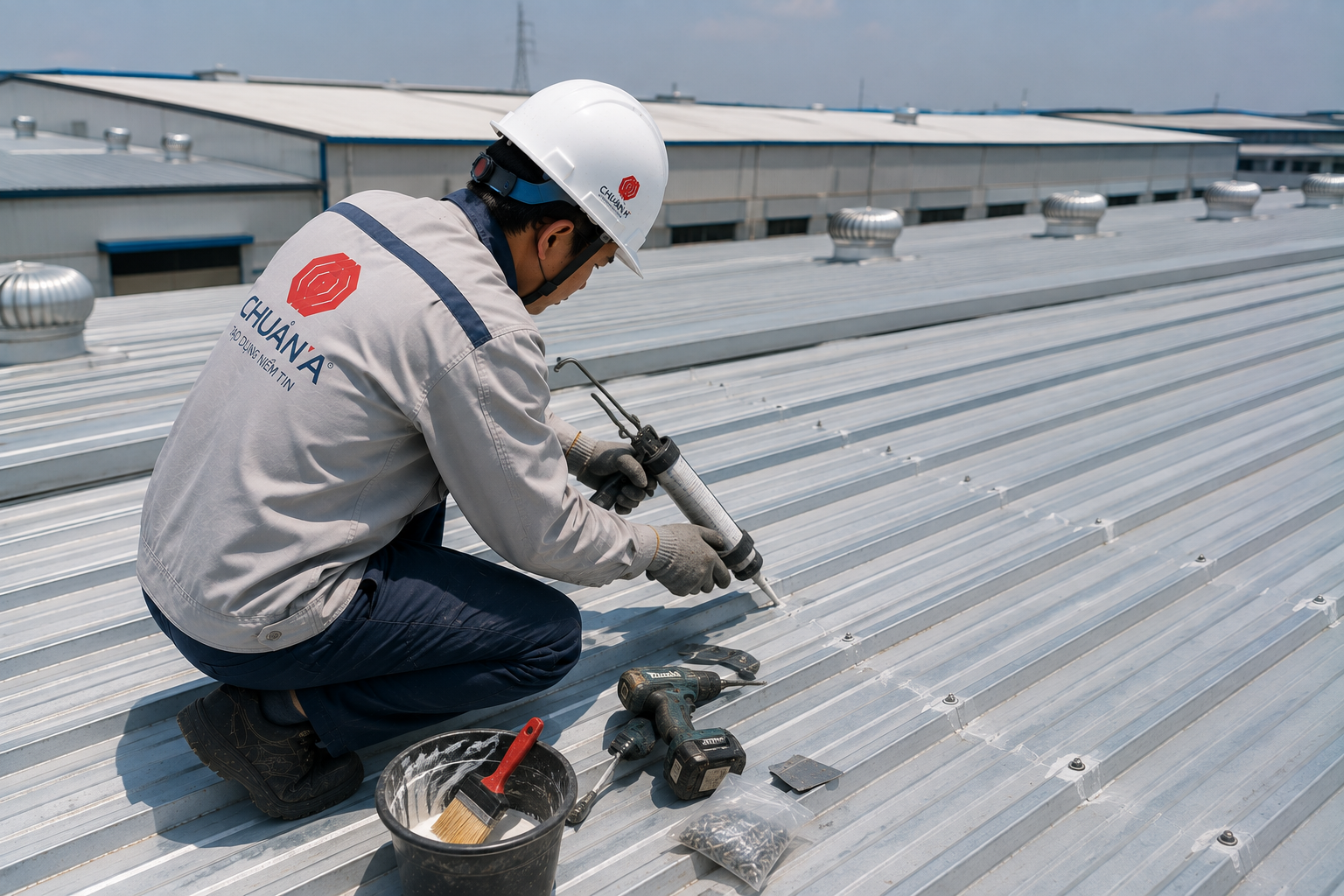
Factories located in industrial parks often have large roof areas, continuous production schedules and multiple pieces of mechanical equipment installed above the roof line.
These conditions make factory metal roof maintenance more complex than maintenance on a small commercial building.
A useful maintenance program needs to consider not only roof condition but also factory operations, access, drainage and the consequences of work above production areas.
Industrial environments vary significantly.
Humidity, dust, temperature and airborne contaminants can influence how quickly roofing materials deteriorate.
Two factories located in the same industrial park may therefore require different inspection frequencies.
Large roofs should be divided into manageable inspection zones.
Each zone can be identified by a code and linked to photographs and defect records.
This makes it easier for maintenance teams to return to exact locations during future inspections.
Some roof locations deserve more frequent attention.
Examples include gutters, fasteners, seams, roof penetrations, ventilation equipment and areas with previous leakage history.
Prioritizing these areas helps businesses use maintenance resources efficiently.(15).png)
Roof work can affect factory activities below.
Sheet removal, drilling, access equipment and repair materials may require coordination with production teams.
Scheduling work during lower-impact periods can reduce disruption.
Large factory roofs collect significant volumes of rainfall.
Blocked gutters or outlets can therefore create substantial water accumulation.
Drainage inspection and cleaning should form part of routine industrial roof maintenance.(13).png)
Industrial roofs commonly contain exhaust fans, ventilation units, pipes and technical penetrations.
Every penetration introduces additional joints and sealing details.
These locations should be included in regular leak-prevention inspections.
Corrosion may develop faster in one area than another due to differences in moisture or industrial exposure.
Photographic records make it easier to compare deterioration between inspection cycles.(15).png)
Roof replacement does not always need to cover the entire building.
If one zone has severe corrosion while another remains serviceable, businesses can replace deteriorated sections first.
Phased factory roof replacement can help distribute costs and reduce production impact.
Factory roofing sheet selection should consider operating conditions rather than relying only on price.
Important factors include thickness, protective coatings, corrosion resistance, thermal requirements and compatibility with existing structure.
Each inspection should document date, zone, defects, photographs and corrective work.
These records allow different maintenance teams to understand roof history and continue monitoring consistently.
Factory metal roof maintenance in industrial parks requires both technical inspection and operational planning.
Dividing roofs into zones, prioritizing high-risk areas, maintaining drainage and coordinating work with production teams can improve the consistency of maintenance programs.
Timely maintenance helps businesses monitor building conditions, reduce leakage risks and extend the service life of metal roofing.
CHUAN A CONSTRUCTION INVESTMENT CORPORATION
Address: Amata Industrial Park Service Center, Long Binh Ward, Dong Nai Province, Vietnam.
Hotline: 0907 494 549
Email: info@chuana.com.vn
Website:https://chuana.com.vn/
Contact Chuan A to discuss factory metal roof inspection, maintenance, repair or replacement requirements in Dong Nai.


