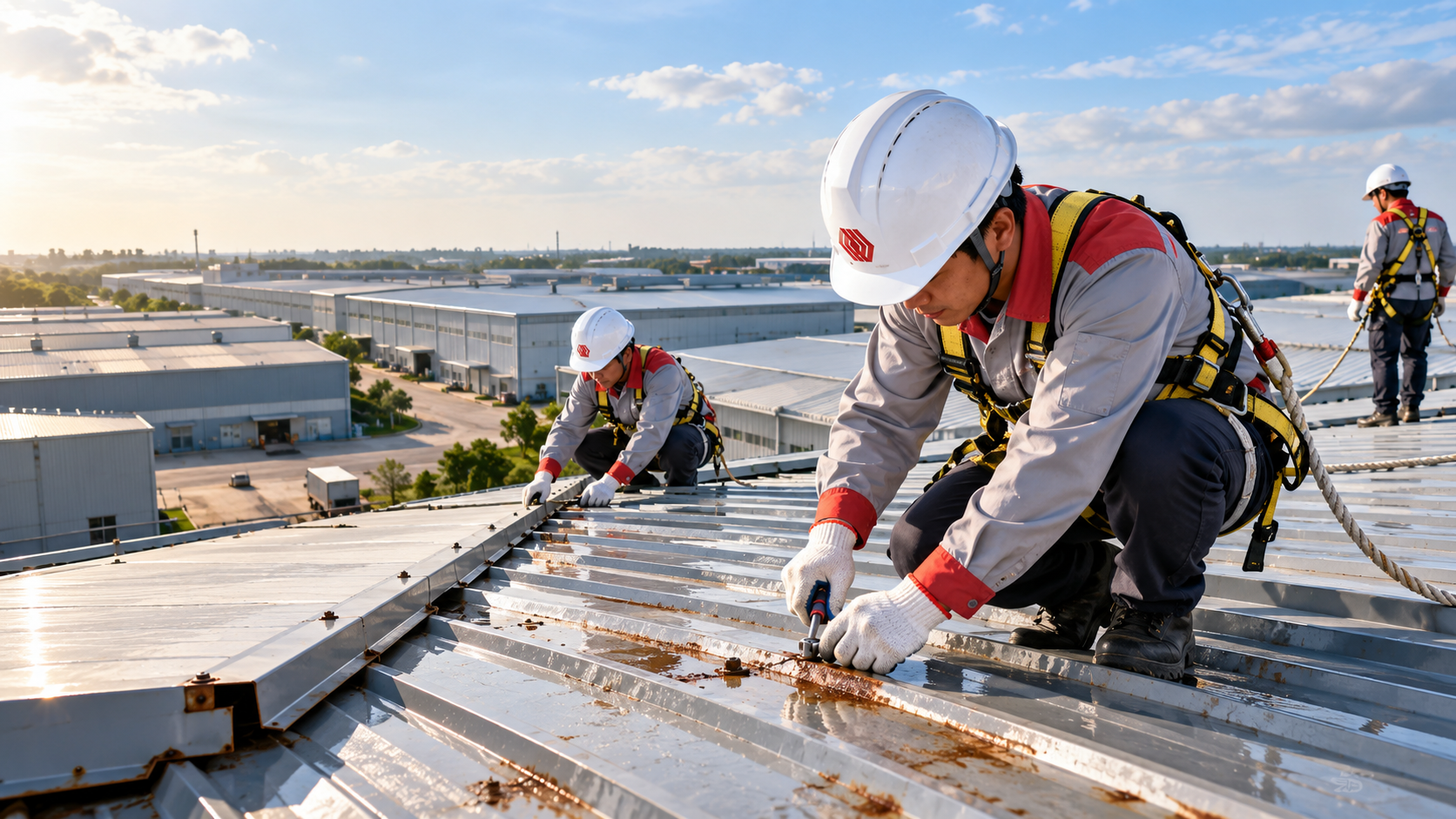
Factory metal roofs are often noticed only when water begins entering the building or visible damage appears. However, several warning signs can appear before a major roofing problem develops, and these early indicators are often overlooked because they do not immediately stop production.
A few loose fasteners, a small area of corrosion, or a gutter that drains slowly may not seem urgent on a normal day. If these conditions continue, however, the repair scope can become larger and the cost of corrective work can increase.
For an operating factory, timing also matters. Waiting until water reaches a production line, warehouse, or electrical equipment turns planned maintenance into emergency repair. Recognizing early warning signs is therefore an important part of deciding when to call for a professional roof inspection.
.png)
Not every sign of deterioration has the same level of urgency. A small isolated rust spot may be included in a maintenance plan, while a displaced sheet after severe weather or a leak directly above electrical equipment requires much faster attention.
Businesses should consider three factors: the extent of the damage, where it is located, and how it may affect factory operations. The following five warning signs deserve particular attention.
Active water leakage is the most obvious warning sign and should not be ignored. Water may enter around sheet overlaps, fasteners, roof penetrations, wall junctions, or gutters.
The point where water appears inside the building is not necessarily the exact location where it enters the roof. Water can travel along roofing sheets, purlins, and connections before reaching the visible drip point below.
For this reason, simply applying sealant where water is visible may not address the source of the problem. A roof inspection should look beyond the visible drip area and identify how water is actually entering the building.
If water is reaching machinery, raw materials, finished goods, or electrical equipment, the issue should receive a higher priority. The affected area should be protected while access to potentially unsafe electrical equipment is controlled according to the facility's safety procedures.
Chuan A provides factory metal roof maintenance and repair services in Dong Nai, with the repair scope determined from an actual site assessment rather than applying the same solution to every facility. :contentReference[oaicite:9]{index=9}
After heavy rain or strong winds, a factory should inspect the roof even if no water has appeared inside the building yet. A shifted sheet, lifted overlap, or damaged connection can reduce the roof's ability to resist water before an obvious leak develops.
If roofing sheets appear bent, displaced, or unusually raised, untrained personnel should not climb onto the roof to investigate without appropriate fall-protection and roof-access procedures. Damage after severe weather may involve weakened connections that are not easy to assess from ground level.
When abnormal conditions are identified after severe weather, the affected area should be controlled and inspected by qualified personnel. Chuan A also lists repair work for conditions such as roof uplift, displaced sheets, and weather-related damage. :contentReference[oaicite:10]{index=10}
A small rust spot does not automatically mean that an entire roof needs replacement. However, widespread corrosion, especially around frequently wet areas, sheet edges, fasteners, and connection points, should trigger a closer inspection.
Continued corrosion can affect the condition of the roofing material and cause previously repaired areas to fail again. Once holes or significant loss of sheet integrity begin to appear, simple surface covering may no longer be appropriate for the actual condition.
During inspection, localized corrosion should be distinguished from broader deterioration. These conditions may lead to very different solutions, such as localized repair, replacement of selected sheets, sectional replacement, or a larger roof replacement assessment.
Roof age should also not be used as the only criterion. Chuan A notes that deterioration can depend on the production environment, repair history, chemical vapors, industrial dust, and other site conditions. :contentReference[oaicite:11]{index=11}
This is a higher-priority warning sign because the problem may extend beyond the metal sheets themselves. If part of the roof is visibly sagging, the roof line has changed significantly, or supporting components appear deformed, the condition should not be treated as a simple sheet replacement issue.
Metal roofing is connected to purlins and the supporting structure. If a structural component has a problem, installing new sheets alone will not address the underlying cause. Areas exposed to long-term water intrusion or unusual loads should therefore be assessed as a complete assembly.
If sagging or deformation is observed, unnecessary access to the roof should be restricted until the condition has been assessed. Work at height requires appropriate safety measures, particularly when the condition of the roof is uncertain.
In some cases, a factory owner may assume that the roof itself is leaking when the actual source is the drainage system. Gutters filled with debris, corrosion, deformation, or restricted outlets can cause water to rise and overflow into roof edges and junctions.
A common warning sign is repeated overflow at the same location after heavy rain, water running back toward the roof edge, or persistent water staining on nearby walls. Repairing a roofing sheet without correcting the drainage problem may only result in the leak returning.
Roof maintenance should therefore include gutters, roof drains, downpipes, and relevant junctions. These components all affect the ability of the roofing system to manage rainwater.
.png)
Not every roofing defect requires an emergency response. Some items can be incorporated into planned maintenance, such as roof cleaning, fastener inspection, minor corrosion treatment, and monitoring of localized deterioration that is not affecting operations.
Problems that are actively causing leaks, making roofing sheets unstable, affecting electrical equipment or stored goods, or showing possible structural involvement should receive a higher inspection priority.
Chuan A distinguishes between scheduled preventive maintenance and corrective repair. Preventive maintenance is used to identify deterioration early, while corrective repair focuses on damage that has already developed and may require faster action. :contentReference[oaicite:12]{index=12}
The first step is to record the location and operational impact. If water is entering the facility, the business should identify what is located underneath the affected area so machinery, products, and other assets can be protected while the issue is being assessed.
If electrical equipment may be exposed to water, personnel should not approach or handle potentially unsafe equipment without following the facility's electrical and safety procedures. The affected area should be controlled and the appropriate technical personnel should be involved.
Personnel without suitable training should also avoid climbing onto a damaged roof after severe weather. Roof access needs appropriate work-at-height controls. Chuan A notes that roof access methods, fastener torque, and site conditions can directly affect both the quality and safety of maintenance work. :contentReference[oaicite:13]{index=13}
No. The correct solution depends on the actual scope and condition of the damage. If the sheets remain serviceable and the problem is limited to fasteners, washers, overlaps, ridge caps, or a small number of localized areas, repair may be appropriate.
If the roof has widespread deterioration, multiple holes, significant loss of material integrity, or repeated repair requirements, the business may need to consider sectional replacement or a larger replacement project.
Before requesting a quotation for complete replacement, it is therefore useful to have the roof inspected and the defects classified. Chuan A also presents repair, sectional replacement, and broader replacement assessment as different options depending on actual roof conditions. :contentReference[oaicite:14]{index=14}
This should be agreed before work starts. If the area underneath contains production lines, warehouse goods, or employees, roof maintenance cannot be organized in the same way as work on an empty building.
The factory and contractor should agree on work zones, working hours, material routes, temporary protection, and the conditions for returning the area to normal use. Activities that create significant noise or require restrictions below may be scheduled around the production plan.
A site assessment also helps define the actual repair scope so that a larger area of the roof is not opened unnecessarily. This can reduce disruption while still addressing the damaged components.
A practical maintenance plan normally starts with an overall inspection rather than waiting for individual failures. Important areas include roofing sheets, fasteners and washers, sheet overlaps, ridge caps, gutters, roof penetrations, junctions, and related structural components.
The inspection frequency should not be identical for every factory. New roofs, older roofs, facilities exposed to chemical vapors, and roofs with extensive previous repairs have different risk conditions. Chuan A also recommends adjusting inspection frequency based on roof age, production environment, and repair history. :contentReference[oaicite:15]{index=15}
Chuan A provides inspection, maintenance, repair, and metal roof replacement services for factories in Dong Nai. The scope is determined according to the actual roof condition, production environment, drainage performance, and operational requirements of each facility. :contentReference[oaicite:16]{index=16}
The process should not begin by automatically choosing a roofing material or quoting a complete replacement. For an operating facility, identifying the cause, extent, and priority of the damage gives the business a clearer basis for choosing localized repair, preventive maintenance, sectional replacement, or a broader replacement strategy.
For factories, warehouses, and industrial facilities in Dong Nai, Bien Hoa, Binh Duong, and nearby areas, Chuan A can discuss roof inspections and appropriate maintenance, repair, or replacement options based on actual site conditions.
CHUAN A CONSTRUCTION INVESTMENT PROJECT JOINT STOCK COMPANY
Address: Amata Industrial Park Service Center, Long Binh Ward, Dong Nai Province, Vietnam.
Hotline: 0907 494 549
Email: info@chuana.com.vn
Website:https://chuana.com.vn/
Contact Chuan A to discuss factory roof inspection, maintenance, repair, or replacement services in Dong Nai.


