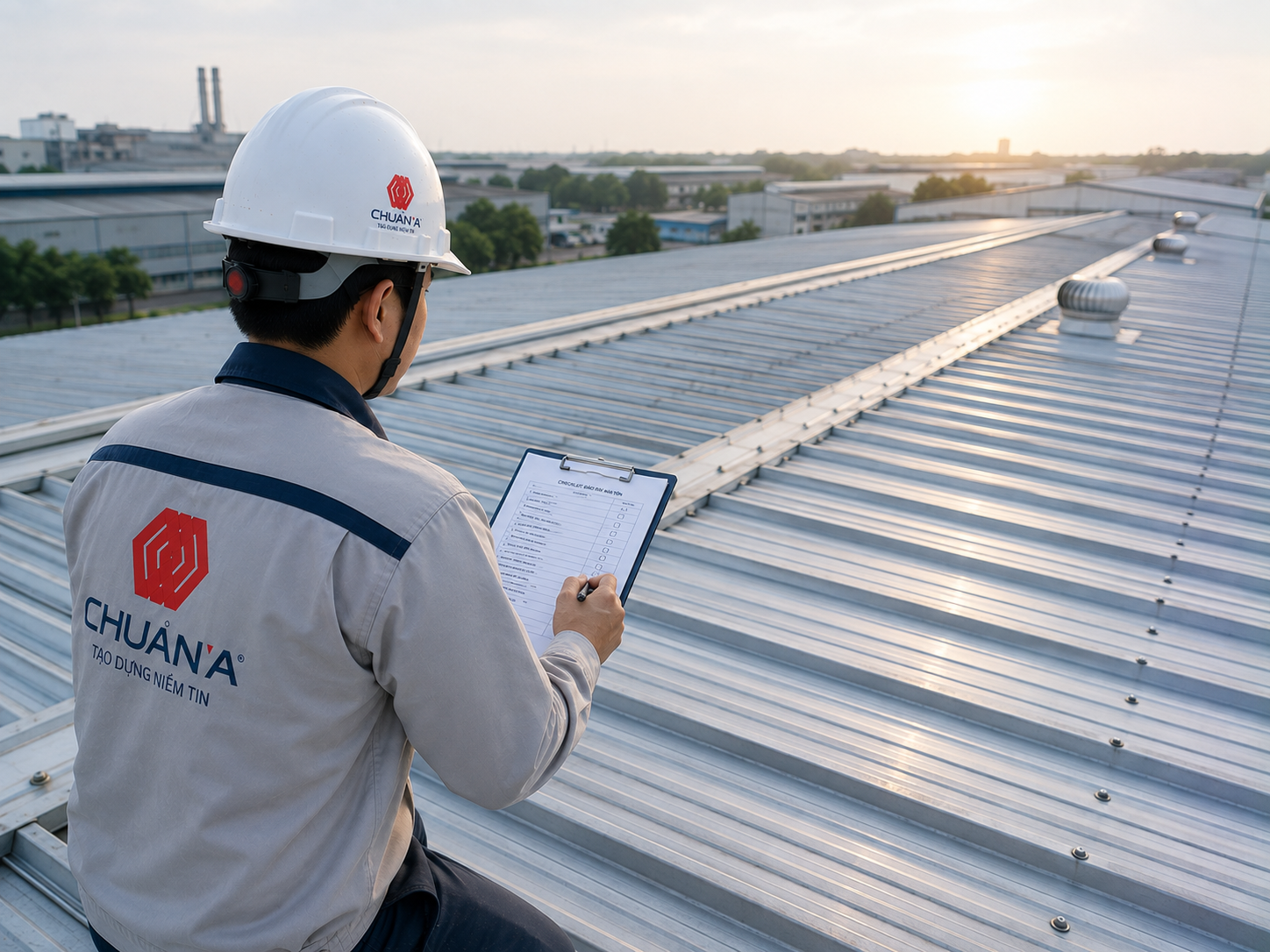
Large industrial roofs can be difficult to inspect consistently without a structured process. Small defects may be overlooked when technicians rely only on general observation.
A documented factory metal roof maintenance checklist helps maintenance teams inspect the same critical components during every maintenance cycle.
Begin by examining metal sheets for dents, deformation, damaged coatings and signs of standing water.
Large roofs should be divided into zones so that defects can be recorded accurately.
Corrosion often develops around sheet edges, fasteners, seams and damaged coating areas.
Maintenance teams should record both the location and severity of corrosion.
Fasteners should be checked for looseness and corrosion.
If several fasteners show deterioration in the same area, the surrounding section should receive a more detailed inspection.(19).png)
Washers help prevent water from entering through fastener holes.
Cracked, hardened or distorted washers may reduce water resistance.
Metal sheet overlaps should be checked for gaps and deteriorated sealing materials.
Wind-driven rain can enter seams that appear acceptable during dry weather.
Sealants around seams, penetrations and wall interfaces can deteriorate with ultraviolet exposure and thermal movement.
The checklist should identify cracked, separated or brittle sealing materials.(19).png)
Gutters should be inspected for debris, corrosion, holes and leaking joints.
Restricted drainage can cause water to accumulate on areas that were not intended to hold water.
Gutters can only perform properly if outlets remain clear.
Drainage pipes should be checked for blockages and damage.
Ventilation equipment, pipes, skylights and other penetrations introduce additional sealing details.
These areas often require closer inspection than normal roof surfaces.
Transitions between metal roofing and walls can become leakage points if flashing or sealants deteriorate.
Every maintenance cycle should include locations with previous repair history.
Repeated problems in one area may indicate that the original cause has not been fully addressed.
Sheets with advanced corrosion, repeated perforation or severe deformation should be marked for replacement evaluation.
Localized repair may remain appropriate for minor defects, but severely deteriorated sheets may no longer provide reliable service.(17).png)
A checklist is most useful when inspection results are retained.
Each record should include the date, zone, defect, photograph and recommended action.
Over time, this information can reveal sections that deteriorate faster than others.
When replacement is required, factory roofing sheet selection should consider environmental conditions, protective coatings and compatibility with existing roofing.
A structured maintenance checklist improves consistency and reduces the chance of overlooking roof defects.
Sheets, fasteners, washers, seams, sealants, gutters, penetrations and previous repair locations should all be included in routine inspection.
Timely maintenance helps businesses monitor building conditions, reduce leakage risks and extend the service life of metal roofing.
CHUAN A CONSTRUCTION INVESTMENT CORPORATION
Address: Amata Industrial Park Service Center, Long Binh Ward, Dong Nai Province, Vietnam.
Hotline: 0907 494 549
Email: info@chuana.com.vn
Website:https://chuana.com.vn/
Contact Chuan A to discuss factory metal roof inspection, maintenance, repair or replacement requirements in Dong Nai.


