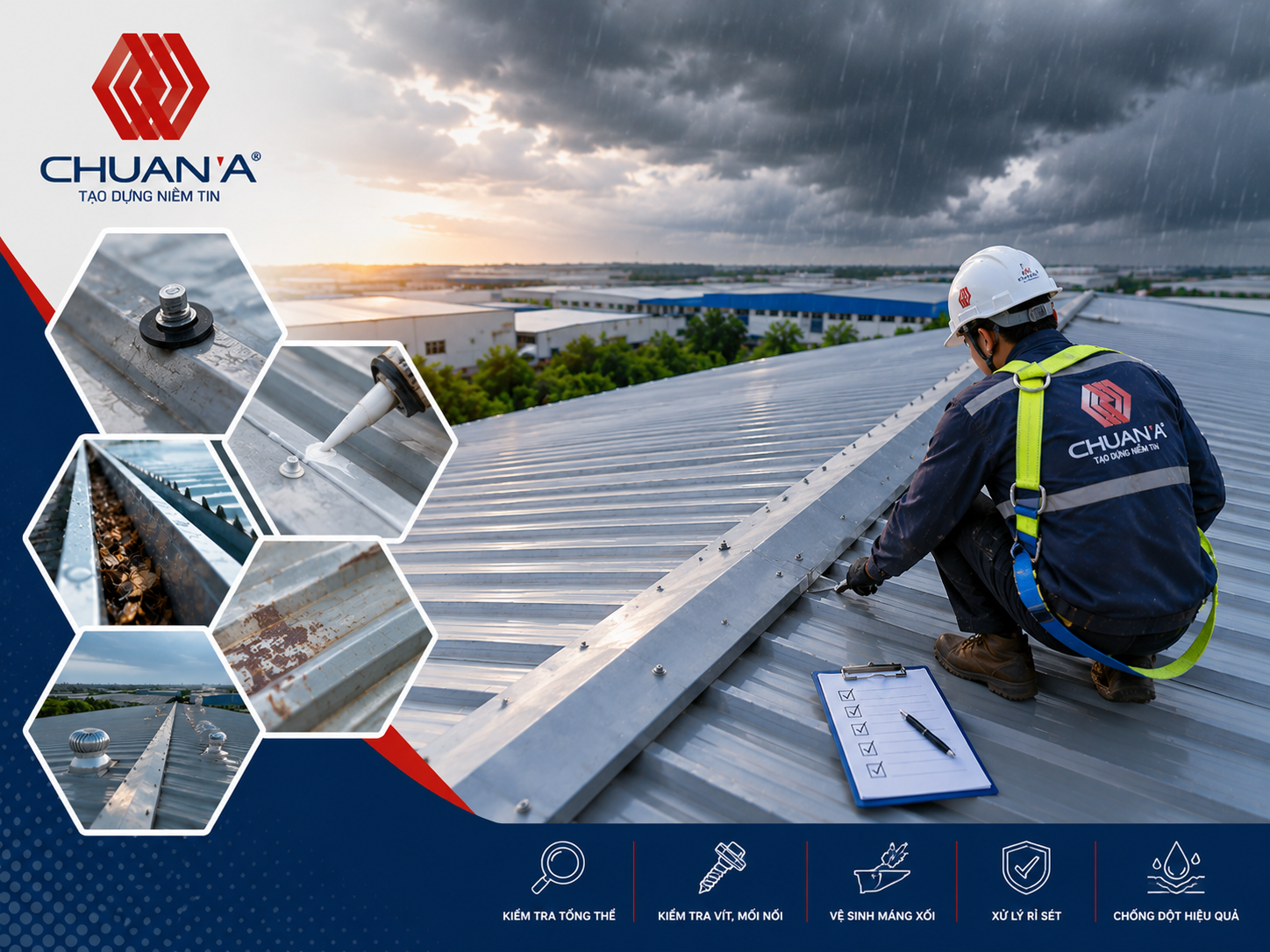
Heavy rainfall can expose weaknesses in factory roofing that remain unnoticed during dry weather. A slightly loose fastener, deteriorated washer, damaged seam or small area of corrosion may not immediately cause visible problems, but prolonged rain can turn these defects into water-entry points.
For this reason, preventive factory metal roof maintenance should ideally be completed before the rainy season begins.
The first step is a systematic visual inspection. Technicians should look for corrosion, dents, deformation, damaged coatings and areas where water may remain after rainfall.
Large roofs can be divided into inspection zones so that defects can be recorded accurately and reviewed after maintenance.
Metal roof fasteners are exposed to movement caused by thermal expansion, vibration and weather conditions.
Technicians should inspect screw heads, washers and the metal surrounding each connection. Damaged or hardened washers can reduce water resistance.
If several fasteners in one area show deterioration, the surrounding section should also be assessed.
Sheet overlaps and roof seams are common locations for water intrusion.
Sealants may deteriorate with age and repeated temperature changes. Inspection should therefore include longitudinal overlaps, transverse joints, roof edges and wall connections.(3).png)
Industrial roofs often contain ventilation equipment, pipes, skylights and other penetrations.
These areas have additional joints and transitions, which can increase leakage risk. Maintenance should examine the flashing, sealing materials and roofing immediately surrounding each penetration.
A roof can be in good condition and still experience water problems if drainage is restricted.
Leaves, industrial dust and debris can reduce gutter capacity. Before heavy rainfall, gutters and outlets should be cleaned and checked for damage.
Small corrosion spots should be documented before they become larger defects.
Where deterioration remains superficial, localized treatment may be appropriate. When metal has become thin or perforated, factory roof sheet replacement may provide a more practical solution.
Areas with a history of leakage deserve special attention.
If the same location has required repeated repairs, maintenance teams should investigate whether the original cause has been properly identified.(3).png)
When replacement is necessary, planning the work before the rainy season gives businesses more control over scheduling.
Suitable factory roofing sheet selection should consider sheet thickness, coatings, corrosion resistance, thermal requirements and the actual factory environment.(3).png)
Rainy-season preparation requires more than simply checking whether a roof currently leaks. A complete inspection should include metal sheets, fasteners, seams, penetrations, gutters and previously repaired locations.
Preventive maintenance gives businesses time to correct minor defects and prepare replacement work before severe weather creates an emergency.
Timely maintenance helps businesses monitor building conditions, reduce leakage risks and extend the service life of metal roofing. When deterioration is identified, an early inspection can help determine an appropriate repair or replacement strategy.
CHUAN A CONSTRUCTION INVESTMENT CORPORATION
Address: Amata Industrial Park Service Center, Long Binh Ward, Dong Nai Province, Vietnam.
Hotline: 0907 494 549
Email: info@chuana.com.vn
Website:https://chuana.com.vn/
Contact Chuan A to discuss factory metal roof inspection, maintenance, repair or replacement requirements in Dong Nai.


