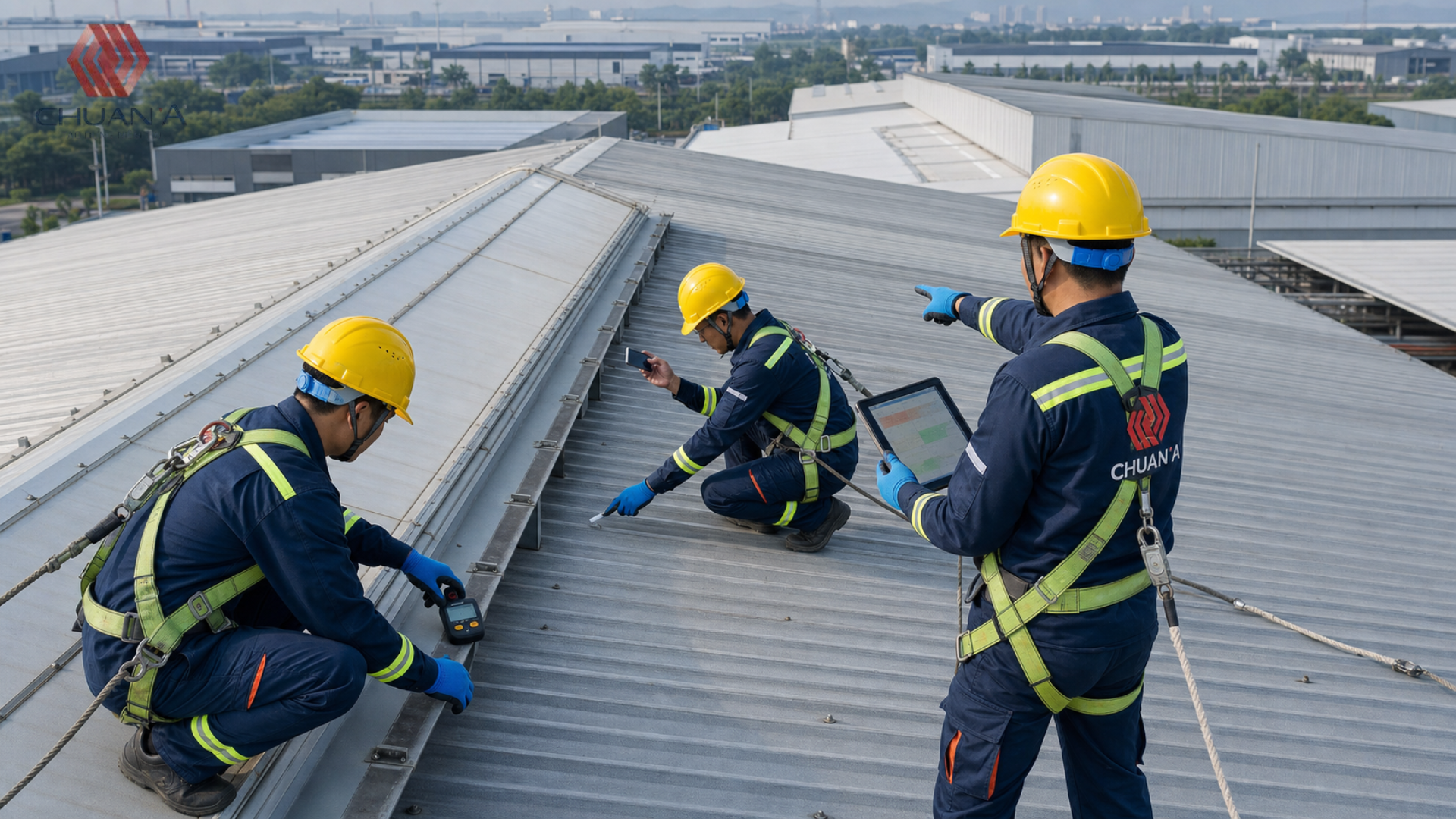
During factory operation, metal roof work generally falls into two categories: periodic maintenance for prevention and repair work to correct existing damage. The two differ in timing, scope and execution method, yet they are often grouped together, making it harder for businesses to plan schedules and budgets.
Factory metal roof maintenance and repair in Dong Nai should therefore be defined from the outset as either preventive inspection or corrective work. This distinction directly affects priority levels, working schedules and how the work is coordinated with production.
Chuan A performs both periodic maintenance and corrective repair for factory roofs in Dong Nai, based on an on-site inspection and the operating conditions of each facility.
.png)
| Aspect | Periodic maintenance | Corrective repair |
|---|---|---|
| Timing | Planned, usually before the rainy season or on an annual cycle. | When damage, leaks or weather-related incidents occur. |
| Objective | Detect deterioration early and extend the service life of the roof. | Restore weather protection and structural safety. |
| Scope | Full roof inspection, cleaning, screw tightening and replacement of aged components. | Focused on the damaged section and related components. |
| Priority | Scheduled around the production timetable. | Usually requires early action to limit further damage. |
| Cost predictability | Easier to estimate as the scope is defined in advance. | Depends on the actual damage found during inspection. |
In practice the two complement each other. Periodic maintenance reduces the number of unplanned repairs, while findings recorded during repair work provide data for adjusting the maintenance plan in following years.
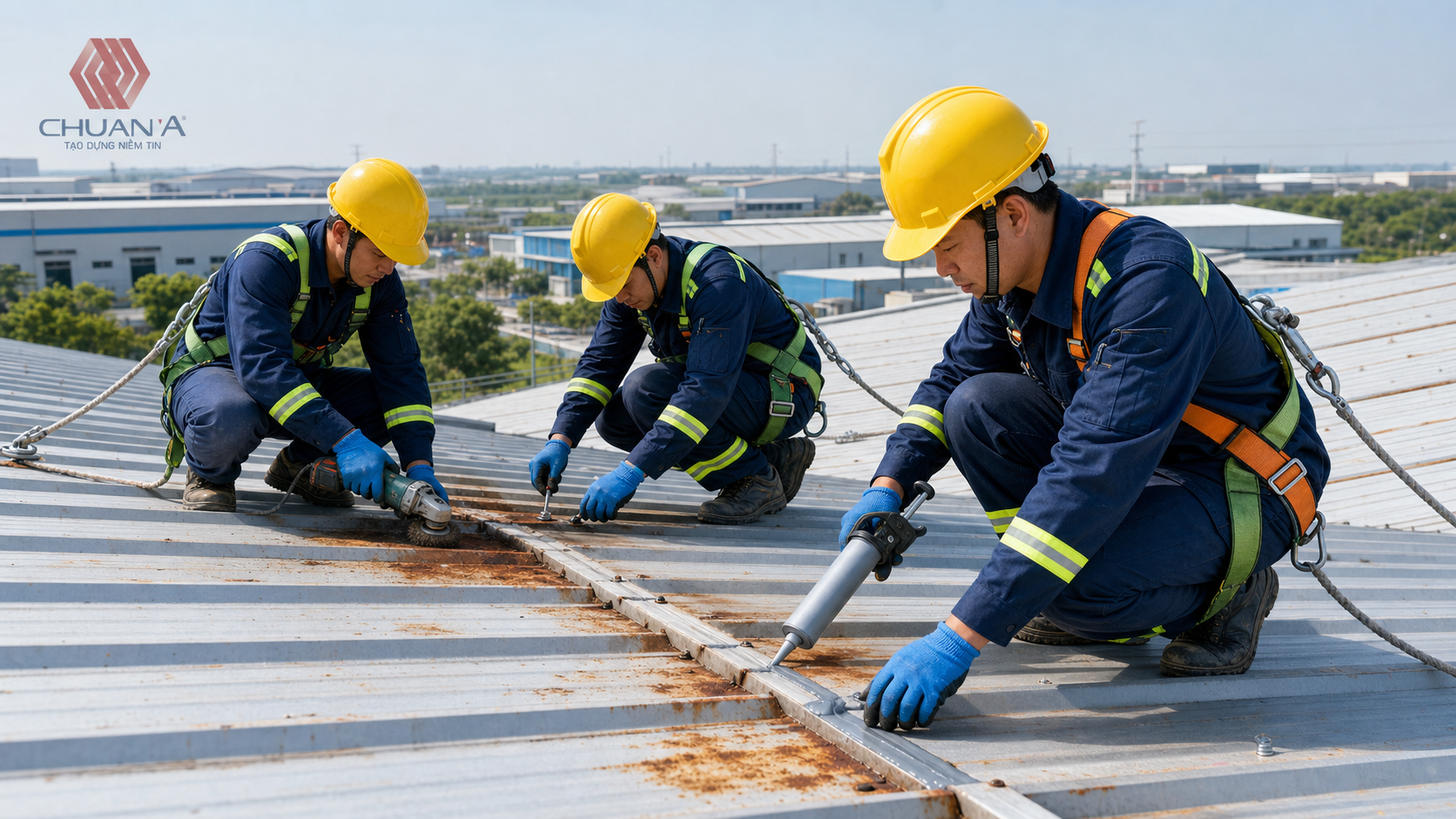
Strong winds may loosen fasteners, lift sheets or displace ridge caps and flashing. These areas need early attention because the exposed section remains under wind pressure and the damage can spread to adjacent panels.
Sheets may shift due to thermal expansion, weakened connections or mechanical impact. When the overlap is no longer sufficient, rainwater can pass through the gap, particularly under wind-driven rain.
Dents commonly occur when walking on the roof away from purlin lines, when objects fall or during equipment installation. Dented areas retain water easily and often become the starting point for corrosion.
Prolonged water penetration, added equipment loads or corrosion can cause purlins to sag and weaken connection plates and bolts. This relates to structural safety and should be assessed carefully before treating the roofing above.
Cracked joints, deformation or blockages cause water to overflow back into the roof. During the rainy season this is a frequent source of water penetration where the roof meets the wall.
Ventilation fans, utility pipes or equipment supports added later will create new water entry points if they are not sealed correctly during installation.
Factories in Dong Nai are exposed to a long rainy season, high temperatures and high humidity. These factors directly affect roof service life:
For facilities inside industrial parks, repair work must also comply with the management board's rules on work registration, permitted hours and occupational safety.
The business describes the roof condition and objectives, which determines whether the work is planned maintenance or corrective repair requiring priority.
The technical team checks the roof and the factory interior, recording damaged locations by roof bay.
Items are grouped by priority: immediate action, planned work and areas to monitor in the next inspection.
Materials, working-at-height equipment and protection for the area below are arranged before work begins.
Work is divided by roof bay to limit disruption to production lines and to keep quality control manageable.
Treated areas are rechecked for sealing performance, connection stability and drainage before handover.
After heavy rain with strong winds, an inspection should be arranged even when no water has been observed inside. Points to review include:
Early treatment after an incident limits the risk of the damage spreading during subsequent rainfall and reduces the chance of water affecting machinery and goods.
For facilities with large roof areas, annual planning gives better control over both cost and working time:
Chuan A Construction Investment Corporation provides industrial construction and facility maintenance solutions in Dong Nai and nearby areas.
Businesses may also review professional factory roof maintenance services for the working process and leaking and corroded factory roof treatment for guidance on assessing corrosion levels.
Chuan A receives factory roof maintenance and repair requests in Dong Nai, Bien Hoa, Long Thanh, Trang Bom, Nhon Trach and nearby areas. Businesses in Binh Duong and Ho Chi Minh City may contact the company to discuss the project location, size and required scope of work.
Maintenance is planned work aimed at inspection and prevention, while repair addresses damage that has already occurred. Maintenance usually covers a wider area with a lighter workload, whereas repair focuses on specific sections and requires priority scheduling.
An inspection should be arranged shortly after the weather stabilises, even if no water has been seen inside, because sheets with loosened fasteners or displacement may not leak immediately but can deteriorate quickly in the next rainfall.
Many items can be completed while the factory operates if covering and zoning are arranged appropriately. Work involving purlins or large-scale sheet replacement usually needs a dedicated time slot.
This should be assessed before working on the roofing above, because the supporting structure directly affects the stability and safety of the entire roof system.
Maintenance responsibility is normally defined in the lease agreement. In practice, the occupying business should still arrange periodic inspections to protect its own machinery and goods, and discuss significant damage with the owner early.
Many industrial parks require prior registration of personnel, working hours and safety measures. This should be confirmed before mobilisation to avoid schedule interruptions.
Whether the work involves a periodic inspection or corrective repair, an early site visit helps define the scope clearly and allows the business to schedule the work around production.
CHUAN A CONSTRUCTION INVESTMENT CORPORATION
Contact Chuan A for factory metal roof maintenance and repair services in Dong Nai.