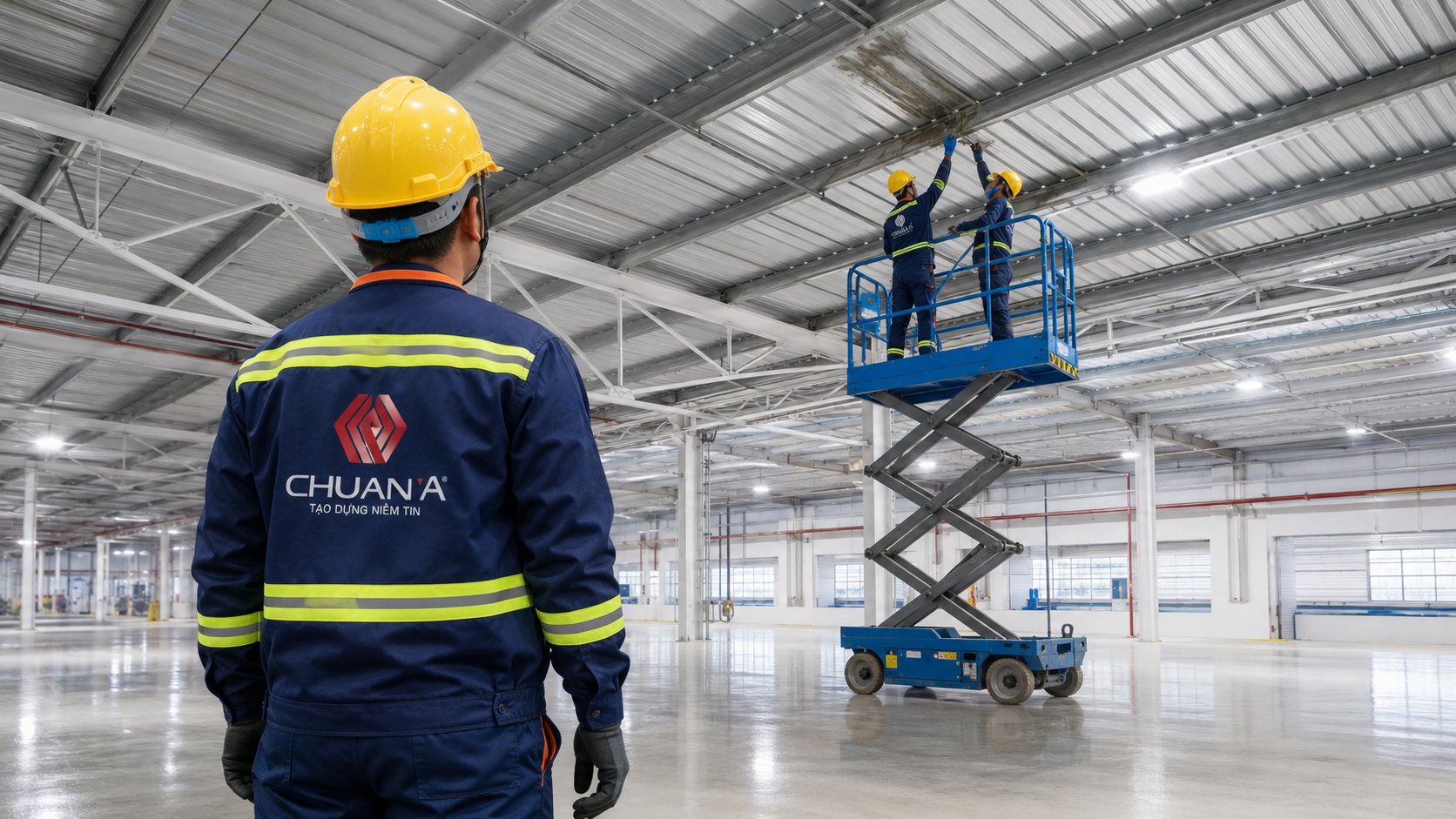
A leaking factory metal roof can affect machinery, raw materials, finished products, electrical systems and working conditions inside an industrial facility. During the rainy season, a minor water entry point may quickly develop into a larger leak when it is not inspected and repaired in time.
Effective factory metal roof maintenance and leak repair in Dong Nai should begin with identifying the actual water entry point, evaluating the extent of deterioration and selecting a repair method suitable for the roof condition. Applying sealant only where water is seen dripping inside the factory is often insufficient because the visible drip point may be far from the original roof defect.
Chuan A provides factory metal roof inspection, maintenance, repair and leak treatment services in Dong Nai. Each proposed solution considers the existing roof condition, damaged area, operational requirements and safety conditions of the facility.
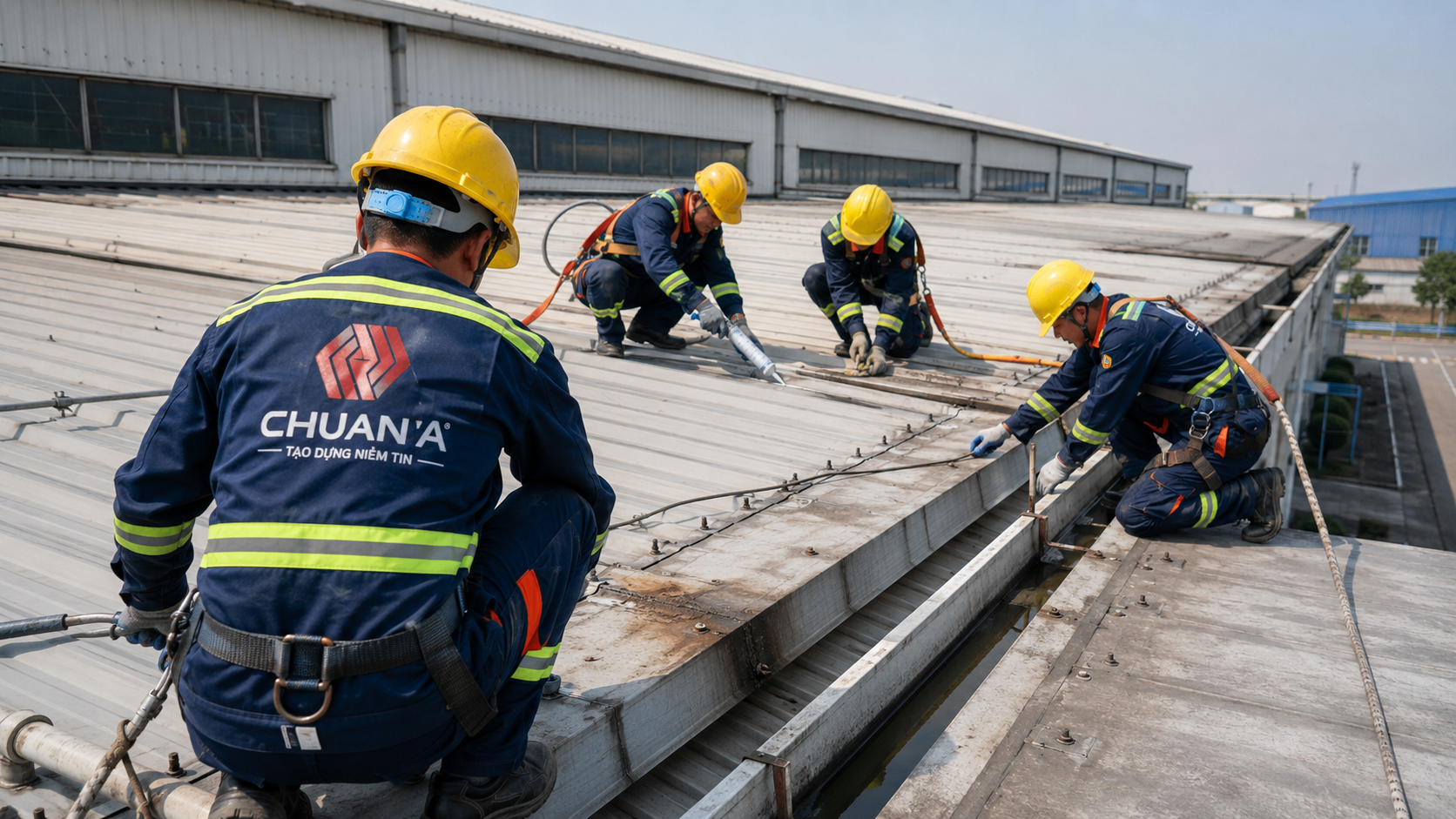
Industrial metal roofs are continuously exposed to heat, heavy rain, strong winds, dust, humidity and material expansion. Over time, fasteners, joints and protective coatings may deteriorate and allow rainwater to enter the building.
Common causes of factory roof leaks include:
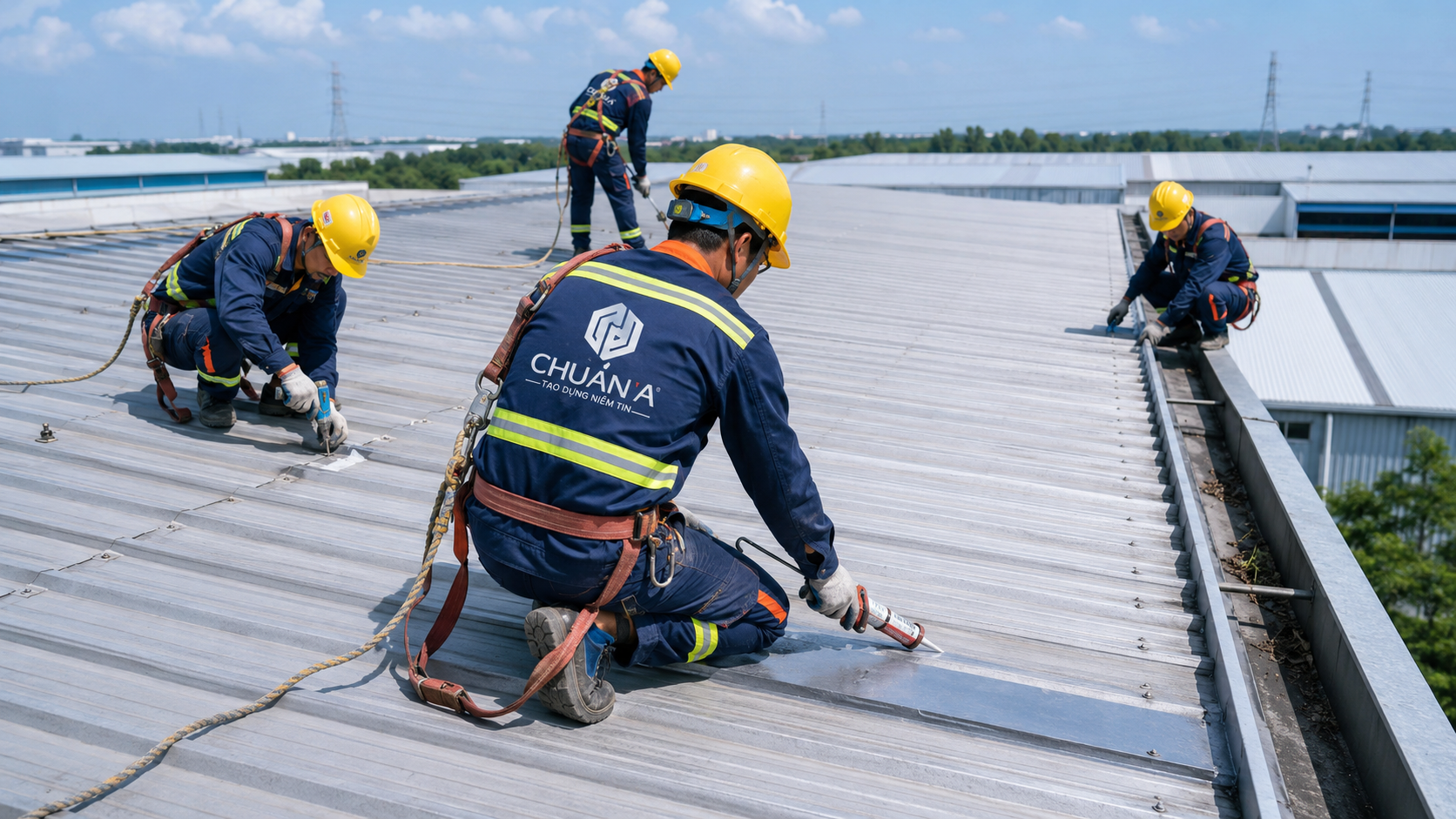
In many cases, rainwater enters through one roof location and travels along the sheet profile, purlins or steel structure before dripping into the factory at another point. The location where water appears below is therefore not always the actual source of the leak.
An effective roof leak repair process should include three main steps:
Treating the actual cause helps reduce repeat leaks and avoids repeated patching in the same area.
A factory roof should be inspected when one or more of the following signs appear:
Businesses should not wait until water flows heavily into the building. A small leak can gradually increase corrosion, damage purlins and create additional defects around the original area.
| Service item | Repair method |
|---|---|
| Roofing screws and washers | Tightening serviceable screws and replacing corroded fasteners or deteriorated rubber washers. |
| Sheet overlaps | Checking overlap dimensions, reinforcing open joints and applying suitable sealing materials. |
| Ridge caps and flashing | Treating open gaps, failed sealant, displaced components and weakened connections. |
| Roof penetrations | Inspecting and repairing seals around pipes, ventilation equipment and utility penetrations. |
| Gutters and downpipes | Cleaning, unclogging, repairing leaks, reinforcing deformed areas and improving drainage performance. |
| Corroded roofing sheets | Cleaning affected areas, evaluating remaining material thickness and applying protection or replacing damaged sheets. |
| Perforated or deformed sheets | Local repair or replacement of sheets that can no longer provide reliable weather protection. |
The business provides basic information such as the factory location, roof area, service period, affected section, severity of water entry and the conditions in which the leak usually occurs.
The technical team checks the interior leak area and the corresponding roof section. The inspection focuses on screws, overlaps, ridge caps, gutters, penetrations, corrosion and visible deformation.
Each leak may involve one or several causes. The technician evaluates the water path, deteriorated roof area and drainage condition before selecting a repair method.
The proposed work may include replacing screws and washers, sealing overlaps, repairing ridge caps, treating corrosion, repairing gutters, reinforcing penetrations or replacing selected roofing sheets.
Roof work requires safety harnesses, appropriate protective equipment, suitable access methods and clearly controlled work areas. The work should also be organised to minimise unnecessary disruption to production below.
After completion, the repaired areas are inspected again. The business receives information about the completed work, the remaining roof condition and areas that should be monitored in the future.
If a screw is loose but the sheet and fixing hole remain serviceable, it may be tightened correctly. When the screw is corroded, the washer has deteriorated or the hole has enlarged, the fastener and sealing components should be replaced. Excessive tightening should be avoided because it can deform the sheet or damage the washer.
Open overlaps may result from thermal expansion, insufficient overlap or weakened fasteners. The area should be cleaned, checked for stability and treated using a suitable reinforcement or sealing method.
Ridge caps and flashing are frequently exposed to wind pressure. Loose fasteners or failed sealant may allow wind-driven rain to enter the roof. Repairs should address both mechanical connections and sealing materials.
Gutters may leak because of corrosion, failed joints, deformation or blockages. When water cannot drain quickly enough, it may overflow back into the roof. Repairs should address both the leaking section and the performance of the entire drainage system.
Surface corrosion may be cleaned and protected when the material remains structurally serviceable. When corrosion has penetrated deeply, produced multiple holes or reduced sheet strength, replacement is usually more practical than repeated local patching.
Local repairs are suitable when the roof remains serviceable, the number of leaks is limited and the defects are concentrated around screws, washers, overlaps or selected roofing sheets.
Sectional roof replacement should be considered when:
The decision to repair or replace should be based on an on-site inspection rather than only on the visible drip location inside the factory.
Inspecting and repairing the roof before the rainy season allows a business to act before water enters the factory. Weak roof areas can be identified under more suitable working conditions, and the business has time to prepare the repair plan and organise production areas.
Main benefits include:
Chuan A Construction Investment Corporation provides industrial construction and facility maintenance solutions in Dong Nai and nearby areas.
Businesses may also review reliable factory metal roof maintenance in Dong Nai for a general overview of maintenance services and the factory roof maintenance process for additional information about periodic inspections.
Chuan A receives factory roof inspection, maintenance and leak repair requests in Dong Nai, Bien Hoa, Long Thanh, Trang Bom, Nhon Trach and nearby areas. Businesses in Binh Duong and Ho Chi Minh City may contact the company to discuss the project location, size and required scope of work.
This depends on the cause and condition of the roof. Local leaks around screws, overlaps or gutters may often be repaired within a defined area. A roof with widespread corrosion may require sectional replacement for a longer-lasting result.
The sealed location may not be the actual water entry point, the material may be unsuitable, the surface may not have been properly prepared or the roofing sheets may continue to expand and deform.
Not always. The technical team should inspect the corrosion extent, remaining sheet condition and number of damaged areas before recommending local repairs or sectional replacement.
Costs depend on roof area, working height, number of leak points, corrosion level, access conditions, material type, safety requirements and whether repair or replacement is required.
A roof should be inspected before the rainy season, after strong winds, when water penetration is detected or when the roof has been in service for a long period without maintenance.
Effective factory roof leak repair begins with identifying the actual cause. When water penetration, corrosion, loose fasteners or poor gutter drainage is detected, an early inspection can help prevent further damage.
CHUAN A CONSTRUCTION INVESTMENT CORPORATION
Contact Chuan A for factory metal roof inspection, maintenance and leak repair services in Dong Nai.