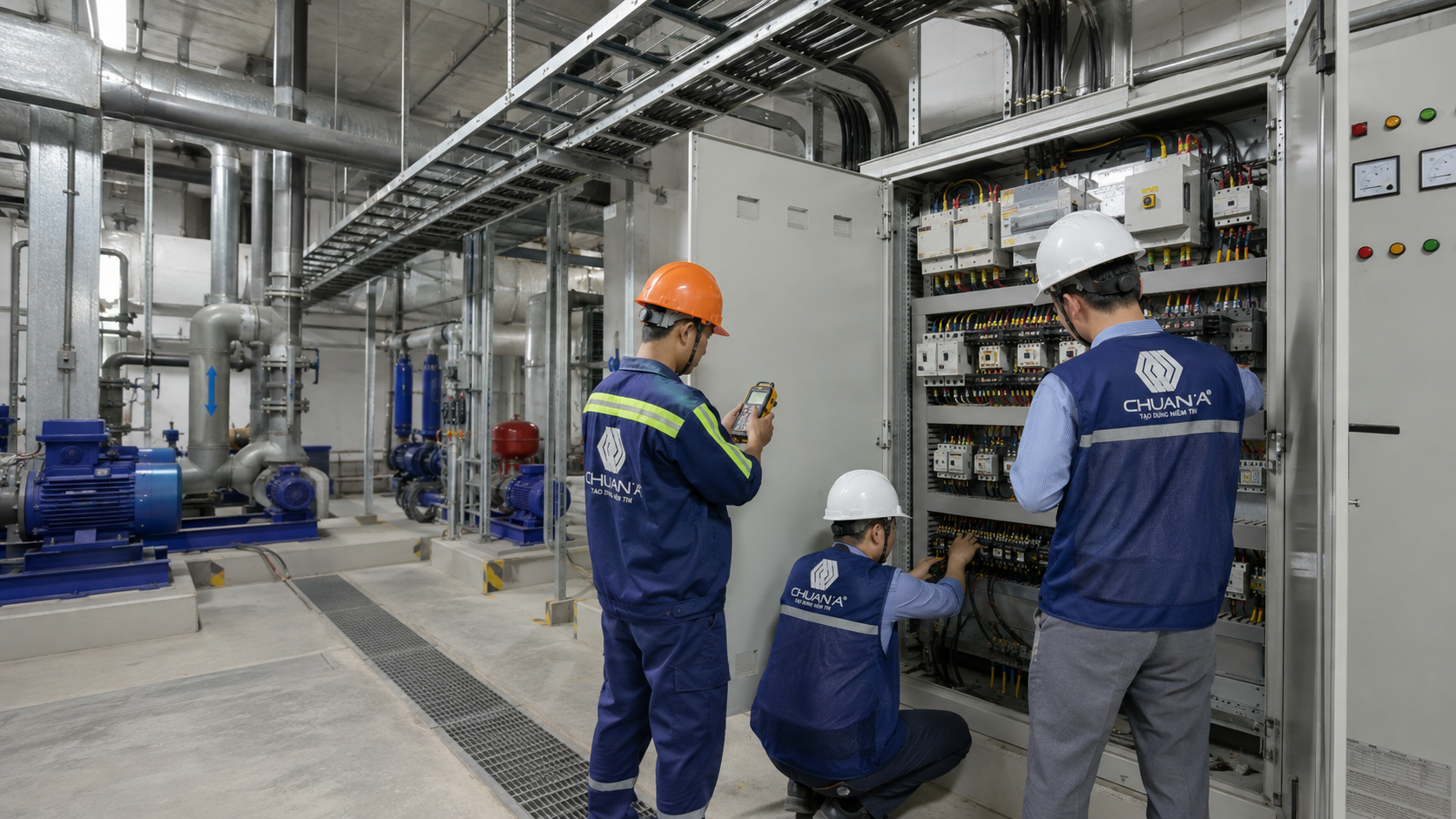
M&E systems are the most commonly overlooked part of factory maintenance, because as long as they keep running, few people ask questions. The difficulty is that most electrical, water and ventilation failures pass through a quiet decline phase before they stop working altogether.
This article focuses on timing: when each system should be inspected, what intervals are typical, and which warning signs indicate that factory M&E maintenance is needed earlier than scheduled.
.png)
M&E stands for mechanical and electrical, covering the electrical and mechanical services that support building operation.
In an industrial facility this typically includes power and lighting, water supply and drainage, ventilation and cooling, compressed air, office air conditioning and the associated control systems.
The same equipment running three shifts deteriorates far faster than equipment running one shift.
Dust, humidity, chemical exposure and high ambient temperature also shorten intervals. Intervals should therefore be set against actual conditions rather than applying a single generic figure.
The first is a fixed calendar schedule. The second is equipment running hours. The third is measured condition. The fourth is unscheduled inspection triggered by abnormal signs.
Most factories combine all four, with the calendar schedule providing the underlying framework.
.png)
Main and distribution panels are usually inspected every six to twelve months, covering re-tightening of terminations, panel cleaning and checks on switching devices.
Thermal imaging should be carried out while the system is under load, since abnormal heat points only appear when current is flowing.
Repeated breaker tripping, a faint burning smell at panels, unusual noise, panel enclosures warmer than normal, or lighting that flickers with load changes should not wait for the next scheduled check.
These conditions usually relate to poor contact at terminations or localised overloading.
Pumps and valves are generally checked every three to six months. Domestic water tanks require cleaning on their own cycle.
Manholes and grease traps serving process wastewater need more frequent cleaning, depending on effluent composition.
Reduced water pressure, pumps running continuously without cutting out, slow drainage at floor gullies, or damp patches along pipe routes all indicate the need for an early check.
Small leaks inside service ducts are often detected only through an unexplained rise in water consumption.
Cleaning fan blades, filters and cooling pads is generally done every three to six months, more frequently in dusty environments.
Motors, belts, bearings and mounting supports should be checked in the same round, together with the waterproofing condition at roof penetration points.
Rising workshop temperature despite equipment running, gradually increasing noise or vibration, and a noticeable drop in airflow are the common indicators.
For roof extractors, damp marks around the base after rainfall indicate that sealing at the roof penetration has deteriorated.
Air filters, oil filters and drain traps normally follow replacement cycles based on running hours specified by the manufacturer.
Leak testing on distribution pipework should be routine, because compressed air leaks raise energy consumption without causing stoppages and are therefore difficult to notice.
Filter cleaning follows a short cycle, while coil cleaning and refrigerant checks are typically annual.
Server rooms and control rooms warrant higher priority, since temperature directly affects the equipment inside.
Building M&E maintenance serves the shared infrastructure of the facility. Production equipment servicing belongs to the process line scope.
These are usually handled by different teams, but their schedules should be coordinated so that shutdown windows can be shared.
Work requiring isolation of main panels or interruption of water supply must be planned in advance and communicated to affected departments.
Many factories group all isolation-dependent tasks into a single shutdown window to reduce the number of disruptions.
The value of M&E maintenance lies in trends rather than in any single measurement.
When termination temperatures, load currents, water pressure and vibration levels are recorded over several rounds, technical teams can identify which equipment is gradually degrading before it fails.
The M&E schedule should sit within the same plan as structural, roofing and infrastructure items to avoid clashes in resource mobilisation.
How to distribute these across the calendar year is discussed in our article on annual factory maintenance planning.
The timing of M&E system maintenance should be based on actual operating conditions, running hours and measured results rather than a fixed interval alone.
When each system follows an appropriate cycle and abnormal signs are addressed early, businesses reduce the risk of unplanned production stoppages. The full list of items to monitor is set out in our article on what factory maintenance includes.
Every factory has different operating loads and environmental conditions. A site survey helps establish appropriate inspection intervals for each system rather than applying one generic schedule.
CHUAN A CONSTRUCTION INVESTMENT CORPORATION
Address: Amata Industrial Park Service Centre, Long Binh Ward, Dong Nai Province, Vietnam.
Hotline: 0907 494 549
Email: info@chuana.com.vn
Website:https://chuana.com.vn/
Contact Chuan A to discuss surveys and M&E maintenance for factories in Dong Nai.


