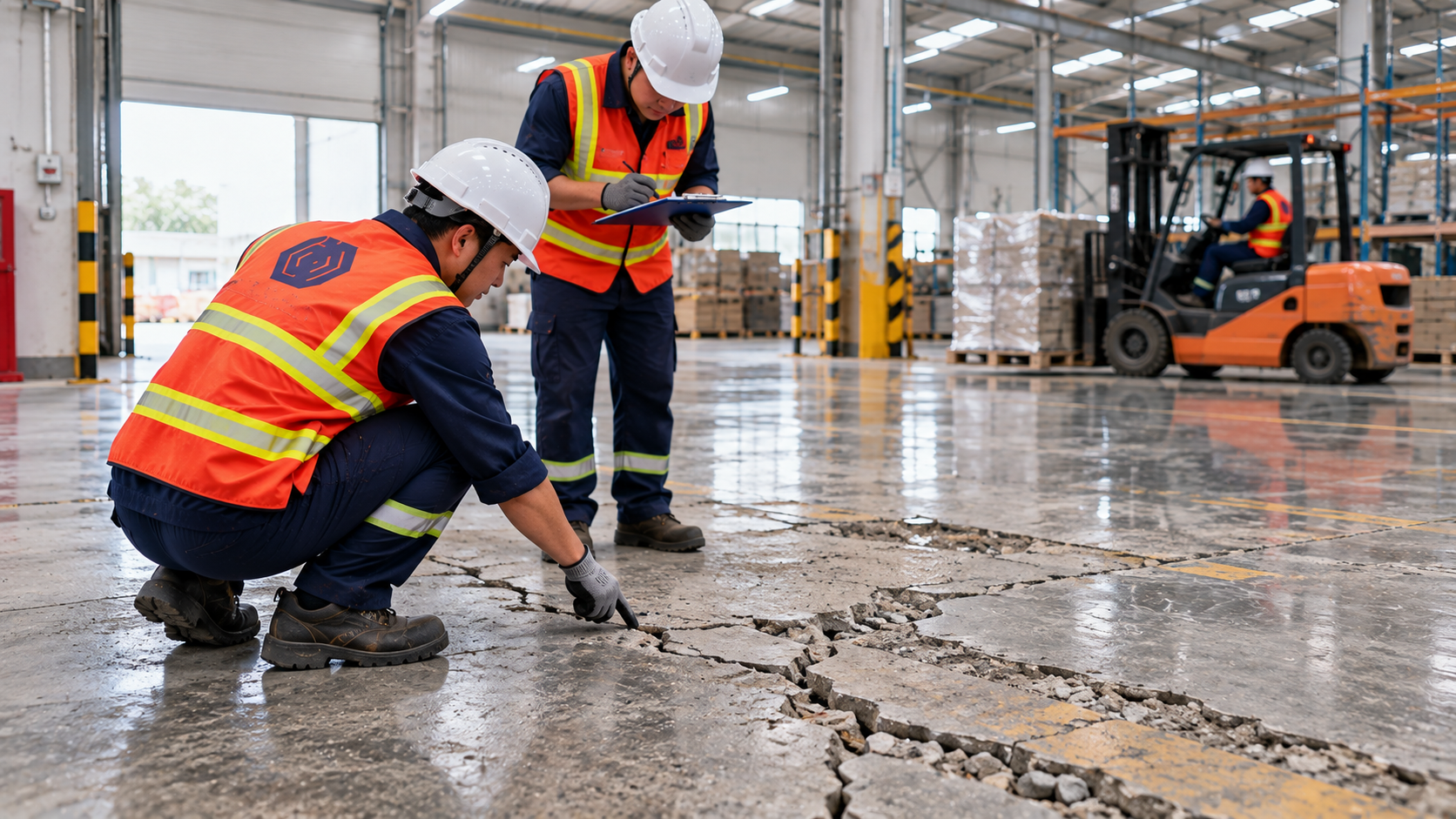
A factory floor often gets attention only after a visible problem appears: concrete starts cracking, water remains on the surface, forklifts no longer move smoothly, or dust keeps building up. Before that point, many businesses continue operating because the early signs do not seem serious enough to justify stopping production.
However, a deteriorating industrial floor can affect more than appearance. As the condition worsens, material handling may become less convenient, cleaning requirements may increase, and certain areas may become harder to use efficiently.
Not every damaged factory floor needs to be completely demolished and rebuilt. Some problems can be handled through localized repairs or surface treatment. Other conditions require a closer assessment of the floor and the underlying structure before a renovation method is selected.
.png)
In a factory or warehouse, the floor is continuously exposed to people, forklifts, carts, pallets, machinery, and stored materials. When the floor becomes uneven or damaged, the impact is usually operational rather than purely cosmetic.
A clean and suitable floor surface helps people and equipment move more predictably. Cracks, settlement, or surface deterioration can force forklifts to slow down, make pallet handling less convenient, or create recurring cleaning work for the facility team.
Chuan A also identifies factory floors as an important part of industrial facility performance, particularly where facilities use heavy machinery, forklifts, high storage racks, or equipment that creates vibration. ([chuana.com.vn](https://chuana.com.vn/xay-dung-cong-nghiep-2026-xu-huong-nha-xuong-hien-dai))
A small crack does not automatically mean the entire floor needs renovation. What matters is its location, length, development over time, surrounding condition, and whether there are changes in floor elevation.
If cracks become more numerous, continue spreading, or appear together with changes in the floor level, the condition should be assessed instead of simply filling the visible cracks. Areas used frequently by forklifts or areas supporting heavy equipment may deserve closer attention because the floor is exposed to repeated loading and movement.
A single crack should also not be used to determine the cause of a floor problem. A practical assessment should consider the surrounding floor, operating conditions, and overall condition of the facility.
Settlement is often noticed when forklifts no longer move smoothly or when palletized goods shake more than usual while passing over a particular section. In some cases, water also collects at the low point after cleaning or other wet operations.
Settlement deserves additional attention when it occurs along major traffic routes, storage areas, or locations carrying concentrated loads. Rather than simply leveling the visible surface, the affected area should be evaluated to determine the appropriate scope of repair.
Bare concrete can wear down over time due to forklifts, wheels, foot traffic, dust, and general industrial activity. When the surface produces dust continuously, the facility may need more frequent cleaning, while dust can also affect stored products, equipment, and nearby work areas.
This condition is often easiest to notice along heavily traveled forklift routes and other high-traffic areas. If the surface is deteriorated while the underlying floor remains suitable, the business may be able to address the surface rather than rebuild the entire floor.
This is one reason industrial floors are often finished with dedicated flooring systems. Chuan A provides Epoxy flooring solutions for factories, including systems intended for dust control, wear resistance, and different operational requirements.
Surface deterioration is one of the most visible signs that a factory floor needs attention. Once the top layer begins to peel or chip, repeated movement from forklifts and workers can continue to loosen the damaged areas.
If only a few spots are affected, localized repairs may be practical. When many areas begin deteriorating at the same time, however, patching one location after another can become a repetitive maintenance cycle. At that point, the overall surface should be reassessed before deciding on a new finishing system.
Water that remains in the same location after cleaning or wet operations should not be ignored. The cause may be related to floor slope, drainage, local settlement, or a change in elevation.
If water repeatedly collects in one location, the area should be assessed rather than simply dried every day. This is especially relevant in facilities that require frequent washing or wet cleaning, where standing water can become an ongoing operational problem.
Not every concrete floor problem requires a large renovation project. Some defects remain limited to the surface and can be treated with a suitable repair method. On the other hand, if cracking, settlement, peeling, and standing water are occurring in several areas at the same time, isolated repairs may not address the broader problem.
A more practical approach is to separate the condition into different categories: surface damage, localized damage, and problems that may involve the underlying floor. Once the scope is understood, the business can consider localized repair, surface preparation, new finishing, or partial floor renovation.
.png)
Not necessarily. A new surface coating cannot solve every underlying floor problem, especially when the base concrete has not been properly assessed or prepared.
Before a new finish is applied, the concrete condition, cracks, surface cleanliness, and other factors affecting adhesion should be considered. Factories dealing with oils, chemicals, or moisture also need to take these conditions into account when selecting a suitable flooring system.
Chuan A's published Epoxy flooring process begins with surface preparation, cleaning, primer application, and treatment of surface defects before subsequent coating layers are installed. ([chuana.com.vn](https://chuana.com.vn/thi-cong-son-san-epoxy-nha-xuong-tai-dong-nai-quy-trinh-chuan-7-buoc-va-giai-phap-chiu-tai-trong-cao-2026))
They matter. A floor used for office access or light pedestrian traffic should not be evaluated in exactly the same way as a floor used continuously by forklifts and loaded pallets.
During a floor assessment, the facility should provide information about the types of vehicles in use, approximate cargo loads, forklift traffic frequency, rack locations, and areas where heavy loads are concentrated. This helps the assessment reflect the way the facility is actually operated.
Chuan A also highlights the relationship between industrial floor quality and operating load, flatness, crack resistance, and surface durability. ([chuana.com.vn](https://chuana.com.vn/xay-dung-cong-nghiep-2026-xu-huong-nha-xuong-hien-dai))
This is often the most difficult part. If the floor is located directly along a forklift route or inside an active production area, the facility may not be able to stop operations for several days without a plan.
For operating factories, renovation can be divided into work zones. One section can be repaired first and returned to service before the team moves to another section. During that period, alternative routes for employees and vehicles may be required.
Working hours, material storage, dust protection, and handover conditions should also be agreed in advance. This helps prevent situations where a partially finished floor needs to be returned to production unexpectedly.
No. The level of intervention depends on the actual floor condition and the intended use after renovation.
Some floors can be addressed through surface preparation, crack repair, or a new finishing layer. Other areas with deeper local damage may require more targeted repair. Only when the affected scope is large or the existing floor no longer meets operational requirements should broader reconstruction be considered.
This is why a site assessment should come before any decision to demolish the existing surface or simply add a new finish.
A business does not need to wait until the floor is severely damaged. If forklifts begin to move less smoothly, dust increases, standing water repeatedly appears, or cracks become more noticeable, these are reasonable points to consider an assessment.
Facilities preparing to change production lines, increase rack density, increase operating loads, or change internal traffic routes should also review the floor before new operations begin. Understanding the existing condition early can prevent the business from installing new equipment on a surface that is not suitable for the new operating requirements.
Chuan A's published industrial construction scope includes factory construction, renovation and expansion, capacity upgrades, and maintenance or upgrades to existing facilities. This provides a basis for discussing individual floor and flooring projects or broader renovation work depending on actual site conditions. ([chuana.com.vn](https://chuana.com.vn/cong-ty-xay-dung-chuan-a))
For surface finishing, Chuan A also provides Epoxy flooring services for factories in Dong Nai, with different systems selected according to operating loads and intended use. ([chuana.com.vn](https://chuana.com.vn/thi-cong-son-san-epoxy-nha-xuong-tai-dong-nai-quy-trinh-chuan-7-buoc-va-giai-phap-chiu-tai-trong-cao-2026))
The final approach should still be based on an actual site assessment. For a deteriorated industrial floor, selecting a coating first is less important than understanding exactly where the floor is failing and how far the problem extends.
For factories, warehouses, and industrial facilities in Dong Nai, Bien Hoa, Binh Duong, and nearby areas, Chuan A can discuss site assessment and repair, renovation, or flooring options based on the facility's actual operating conditions.
CHUAN A CONSTRUCTION INVESTMENT PROJECT JOINT STOCK COMPANY
Address: Amata Industrial Park Service Center, Long Binh Ward, Dong Nai Province, Vietnam.
Hotline: 0907 494 549
Email: info@chuana.com.vn
Website:https://chuana.com.vn/
Contact Chuan A to discuss inspection, repair, renovation, or industrial flooring solutions for factories in Dong Nai.


