Installing a complete fire protection system does not automatically mean that the system will always operate properly. A factory may run for months or years without an actual fire, but during that time a pump may deteriorate, a backup battery may weaken, a detector may become obstructed, a valve may stick, or the control panel may develop a fault that is never investigated.
When an actual emergency occurs, these details can determine whether the system responds as intended. That is why factory fire protection maintenance should not be limited to situations where equipment has already failed. Regular inspections help identify early warning signs and allow the business to address problems before they become major issues.
For an operating factory, maintenance also has to be coordinated with production schedules, access routes, machinery, stored goods, and existing operating requirements. A practical maintenance plan needs to protect the system without unnecessarily disrupting the facility.
.png)
Industrial fire protection systems often contain several groups of equipment, and not all of them operate continuously. Some devices remain on standby until an alarm condition occurs, while pumps, controls, and other equipment must be ready to operate when required.
This standby condition can make it easy for businesses to become less attentive to the system. A detector may still be installed correctly but become covered by dust or an obstruction. A valve may still be physically present but no longer remain in the required condition. A fire alarm panel may appear to operate normally while storing an unresolved fault or warning.
Maintenance is therefore more than cleaning equipment. It involves checking condition, testing operation, documenting abnormal findings, and deciding which items need repair or replacement.
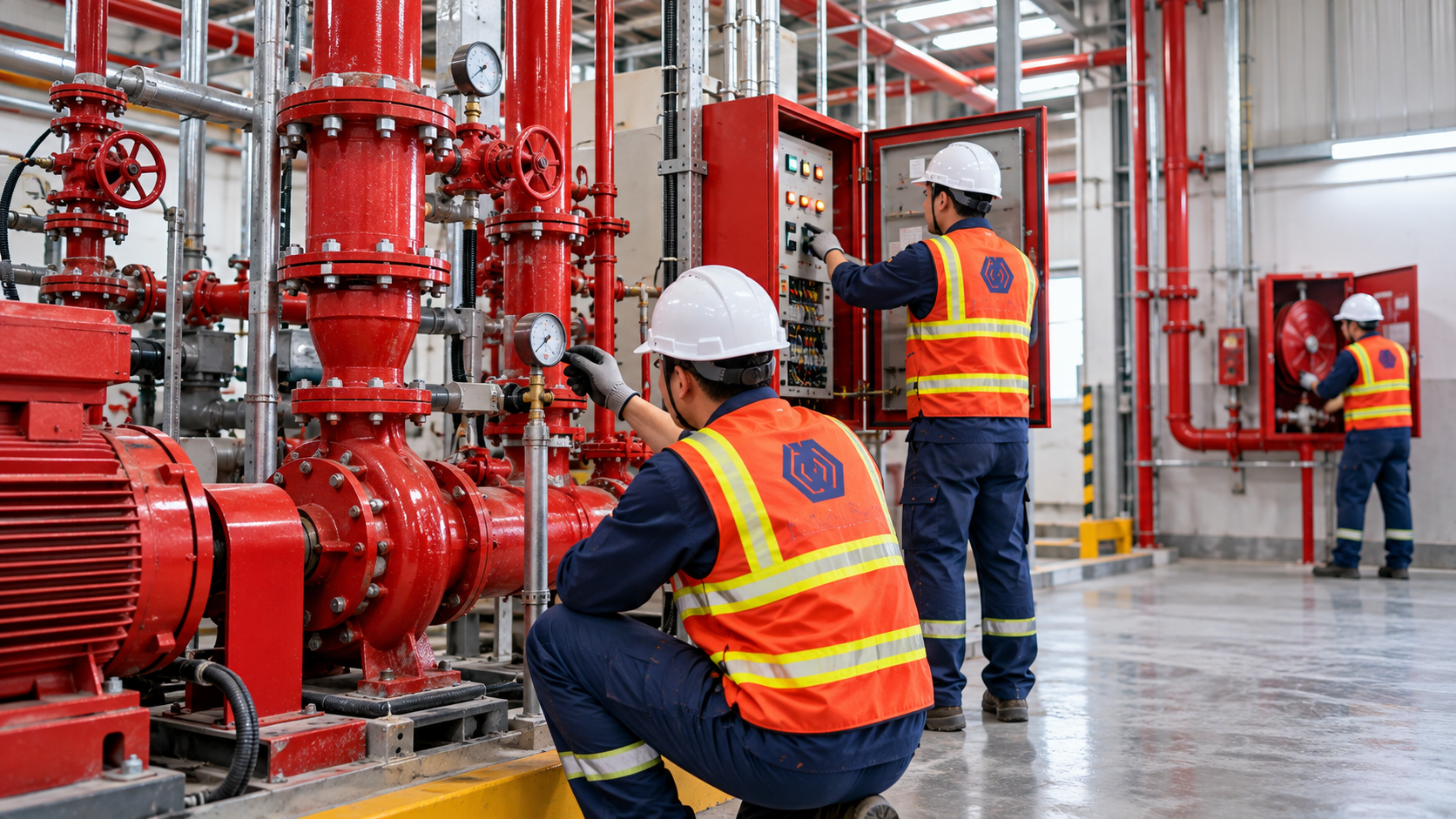
The fire pump area is one of the first areas that should be reviewed during maintenance of a fire suppression system. The overall condition of the pump, controller, connected piping, and any abnormal signs during testing should be checked.
In addition to mechanical condition, the team should look for leakage, unusual indications, and problems around connection points. If the facility uses several pumps with different functions, each one should be identified clearly so that no equipment is missed during the inspection.
The fire alarm control panel receives and processes signals from devices throughout the facility. Maintenance should not stop at checking whether the panel has power. Fault indicators, warnings, backup power, and signals from connected zones should also be reviewed.
Manual call points, smoke detectors, heat detectors, and other detection devices should be checked according to the actual system configuration. If production equipment, storage racks, or partitions have been moved, detector locations should also be reviewed to make sure the new layout has not created obstructions.
Sprinkler heads can become obstructed when factories change storage racks, ventilation systems, piping, or production equipment. This is why maintenance should look not only at the sprinkler head itself but also at the surrounding space.
Piping, valves, and connection points should also be checked for leakage, corrosion, or other abnormal conditions. Chuan A currently promotes fire protection design, installation, testing, and maintenance services, including automatic sprinkler systems for industrial facilities. :contentReference[oaicite:4]{index=4}
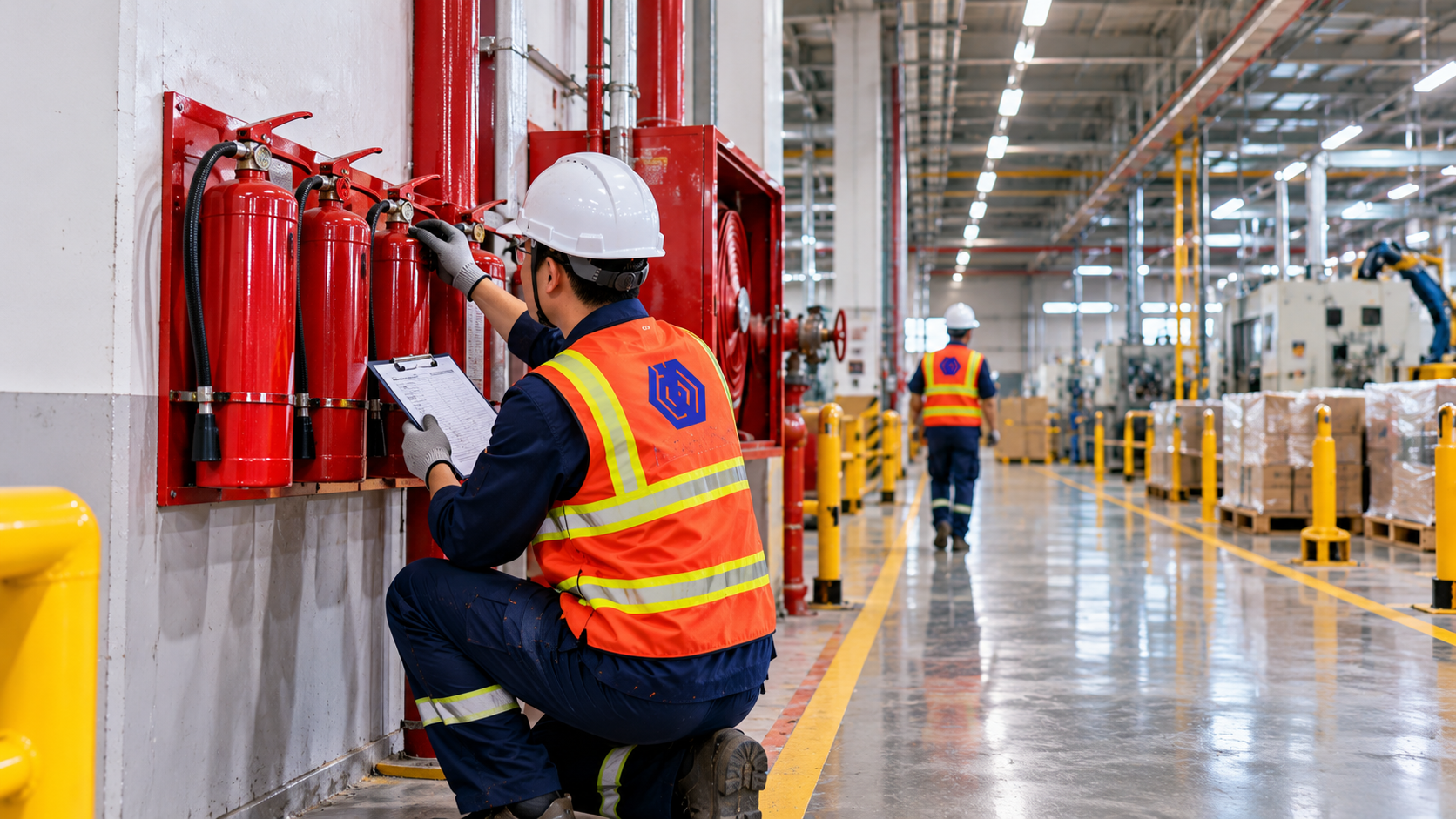
Fire hydrants and hose reels are generally positioned so that personnel can access them during an emergency. Maintenance should include the cabinet, valve, hose, connections, and accessibility of the equipment.
A system component can remain physically intact but still become difficult to use if pallets, materials, or equipment block access. Fire protection maintenance should therefore consider actual operating conditions rather than checking individual components in isolation.
Fire extinguishers are among the most visible fire protection devices in a factory, but they can also be moved easily. During inspection, their locations and visible condition should be checked, along with whether access is being blocked.
In factories with multiple production zones, extinguisher locations should be clearly managed so employees can find them quickly when needed. A unit moved temporarily for another activity can become effectively unavailable if it is not returned to its designated location.
Emergency lighting and exit signs should also be reviewed during maintenance. These devices help occupants identify evacuation routes when normal power is lost or visibility becomes limited.
Factory layout changes, temporary partitions, or equipment relocation can obstruct existing signs. Therefore, maintenance should consider not only whether the equipment works but also whether it remains visible and useful from the actual areas where people move.
A fire protection system can experience problems even when its main equipment remains operational. Valves may be in an incorrect condition, piping may develop leaks, and connection points may become damaged.
That is why maintenance should include the wider piping network within the system scope, especially locations affected by corrosion, physical impact, or changes to the factory structure.
Areas that have recently undergone renovation or new MEP work should receive additional attention because fire protection piping can be affected by construction activities carried out around it.
Equipment that is inspected without proper documentation becomes difficult to track over time. Businesses should maintain records of equipment checked, faults identified, repairs completed, items requiring follow-up, and the date of each maintenance activity.
Clear records allow the responsible team to understand which components were serviced and which areas require further attention. This becomes increasingly important in large factories where equipment is spread across multiple areas.
When a system develops a fault, businesses often respond reactively by fixing the component that has failed. This may solve the immediate problem, but it does not necessarily provide a complete view of the condition of the overall system.
Preventive maintenance works differently. Equipment is reviewed before a major failure occurs, abnormal conditions are documented, and repair or replacement priorities can be planned in advance.
This is particularly useful for continuously operating factories because finding a small problem early can help avoid a larger emergency that requires a production area to be taken offline.
Businesses do not always need to inspect only one isolated piece of equipment. If a factory has recently expanded, changed production lines, reorganized storage, increased rack heights, modified structures, or added new MEP systems, the fire protection system should also be reassessed.
Changes to the building can alter the way the space is used. A system that was appropriate for an earlier layout may not remain fully suitable after production equipment, storage arrangements, or room functions have changed.
For that reason, larger renovation projects should trigger a broader review rather than limiting maintenance to the single fault that happened to be discovered.
Unlike an empty construction site, an operating factory cannot simply stop every activity whenever maintenance is needed. Technicians need to coordinate with the facility team to determine working periods, accessible areas, and which systems may need to be placed in a special condition during testing.
In areas containing machinery, chemicals, stored materials, or active production lines, maintenance activities must also consider the safety of both technicians and factory employees. The objective is not simply to complete a checklist but to perform maintenance without creating additional risk for ongoing operations.
It is not advisable. A fire protection system may report certain faults, but not every potential problem will immediately appear on a control panel.
For example, a sprinkler head may be blocked by a new storage arrangement, a fire hydrant may become inaccessible because goods are stored in front of it, or a mechanical component may deteriorate without generating a clear electronic fault signal.
Regular maintenance allows the business to evaluate the actual operating condition of the system instead of simply reacting when an alarm appears.
Chuan A currently offers fire protection solutions covering surveying, design, installation, testing, commissioning, and maintenance. Its published service scope includes automatic sprinklers, pump and hydrant systems, addressable fire alarms, smoke extraction, and other specialized systems. :contentReference[oaicite:5]{index=5}
For an operating facility, the first step should be a site assessment to identify the system scope, equipment condition, and any changes made to the factory since the original installation. This provides a basis for deciding which components need cleaning, testing, repair, or replacement.
Chuan A also presents a fire protection workflow covering survey, design, installation, testing, commissioning, and ongoing maintenance, allowing businesses to manage the system as a connected process rather than as separate individual tasks. :contentReference[oaicite:6]{index=6}
In addition to planned maintenance, businesses should consider reassessing the fire protection system when there are significant facility changes such as building expansion, production line changes, warehouse reconfiguration, increased rack heights, structural renovation, or new mechanical and electrical systems.
These changes may affect detector locations, sprinkler coverage, piping routes, access to equipment, or evacuation paths. An early assessment can identify areas that need adjustment before they become operating problems.
For factories, manufacturing facilities, and industrial buildings in Dong Nai, Bien Hoa, Binh Duong, and nearby areas, Chuan A can discuss inspection, maintenance, and corrective work based on the actual condition of the facility.
CHUAN A CONSTRUCTION INVESTMENT PROJECT JOINT STOCK COMPANY
Address: Amata Industrial Park Service Center, Long Binh Ward, Dong Nai Province, Vietnam.
Hotline: 0907 494 549
Email: info@chuana.com.vn
Website:https://chuana.com.vn/
Contact Chuan A to discuss fire protection inspection, maintenance, and testing services for factories in Dong Nai.


