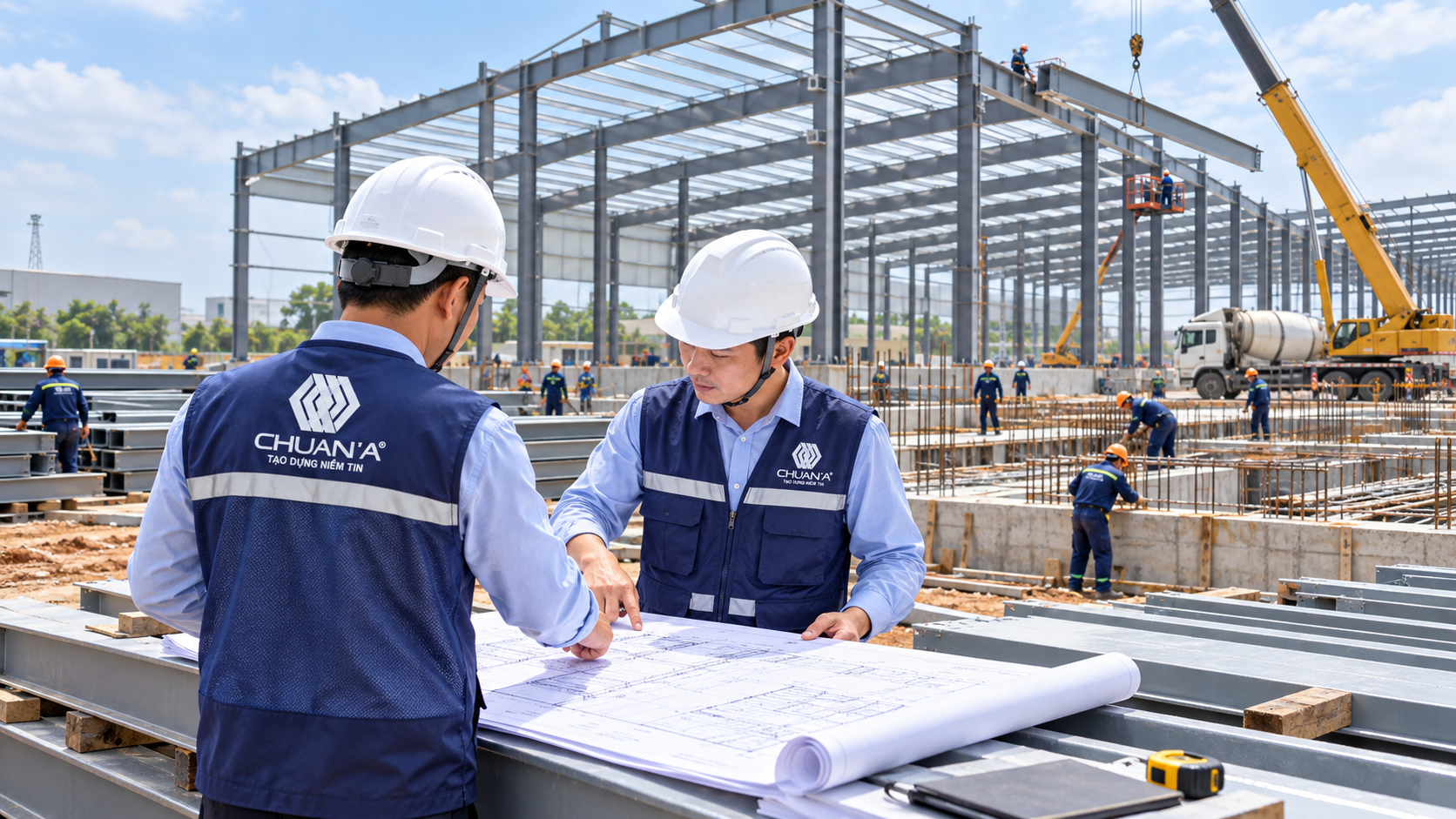
Factory construction costs are a major consideration for businesses planning to develop manufacturing facilities. A well-prepared construction budget helps investors control initial expenses, minimize unexpected costs, and support long-term operational efficiency.
However, construction costs can vary significantly depending on project size, ground conditions, structural design, and technical requirements. Understanding the main cost components is essential before committing to a factory development project.
A reliable factory construction budget should identify individual expense categories rather than relying exclusively on a general price per square meter.
The planning stage may include site surveys, geotechnical investigations, architectural design, structural engineering, and technical system planning.
Accurate design documentation supports material selection, quantity takeoffs, cost estimates, and construction scheduling.
Structural expenses typically include ground preparation, foundation systems, industrial flooring, columns, beams, and steel or reinforced concrete structures.
Soil conditions, machinery loads, and operational requirements directly influence structural decisions. Facilities with heavy equipment or challenging ground conditions may require more complex engineering solutions.
These expenses may include roofing, exterior walls, doors, waterproofing, electrical systems, lighting, water supply, drainage, ventilation, and fire protection.
Specialized factories may also require additional environmental controls, cooling systems, cold storage, or production-related infrastructure.
Internal roads, loading areas, fencing, drainage networks, and utility connections should be included in the investment budget.
A contingency allowance is also important for construction risks, approved design changes, and material price fluctuations.
Total building area has a significant impact on construction expenses. However, the cost per square meter is not identical across projects.
Single-story production facilities, multi-story factories, and buildings with integrated offices may require different structural systems and technical solutions.
Pre-engineered steel structures may offer advantages for facilities requiring large production spaces and flexible construction methods.
Reinforced concrete systems may be suitable for other structural loads or operational conditions.
Material decisions should consider engineering requirements, durability, maintenance, and total life-cycle costs rather than purchase prices alone.
Ground stability, transportation access, material storage areas, and construction logistics influence labor, equipment, and scheduling costs.
Projects on sites with weak soil or limited access may require additional preparation and specialized equipment.
Floor loading, fire protection, environmental controls, ventilation, and electrical capacity should be addressed during the initial design stage.
Late modifications to these systems can increase costs and delay construction..png)
Investors should establish the required production area, manufacturing activities, machinery loads, expansion plans, and expected operational timeline.
These requirements form the foundation for preliminary planning.
Architects and engineers can then propose suitable layouts, foundation solutions, structural systems, and technical infrastructure.
The selected design provides the basis for detailed quantity calculations and construction estimates.
An effective estimate should specify work quantities, measurement units, unit prices, and total values for individual construction activities.
Investors should distinguish construction costs, equipment expenses, consulting fees, project management, applicable taxes, and contingency allowances.
A simplified budgeting formula is:
Estimated Project Budget = Construction Costs + Equipment Costs + Consulting and Management Fees + Other Expenses + Contingency.
Different design options should be evaluated according to initial investment, operational efficiency, durability, and maintenance requirements.
Contract scope, payment schedules, project milestones, and procedures for approving changes must also be clearly established..png)
Cost optimization should focus on engineering efficiency and operational suitability without compromising structural safety or essential technical standards.
Investors can consider standardized structural dimensions, efficient material handling routes, suitable building materials, and early coordination between architectural, structural, and mechanical engineering teams.
Selecting appropriate materials for the manufacturing environment can also reduce unnecessary replacement and maintenance expenses.
Effective project scheduling, construction quantity control, and inspections at key milestones help identify deviations before they create significant additional costs.
A coordinated design and construction process can further reduce rework, improve communication, and support more predictable project delivery.png)
.
CHUAN A CONSTRUCTION CONSULTING JOINT STOCK COMPANY
Address: Amata Industrial Park Service Center, Long Binh Ward, Dong Nai Province, Vietnam.
Hotline: 0907 494 549
Email: info@chuana.com.vn
Website: https://chuana.com.vn/