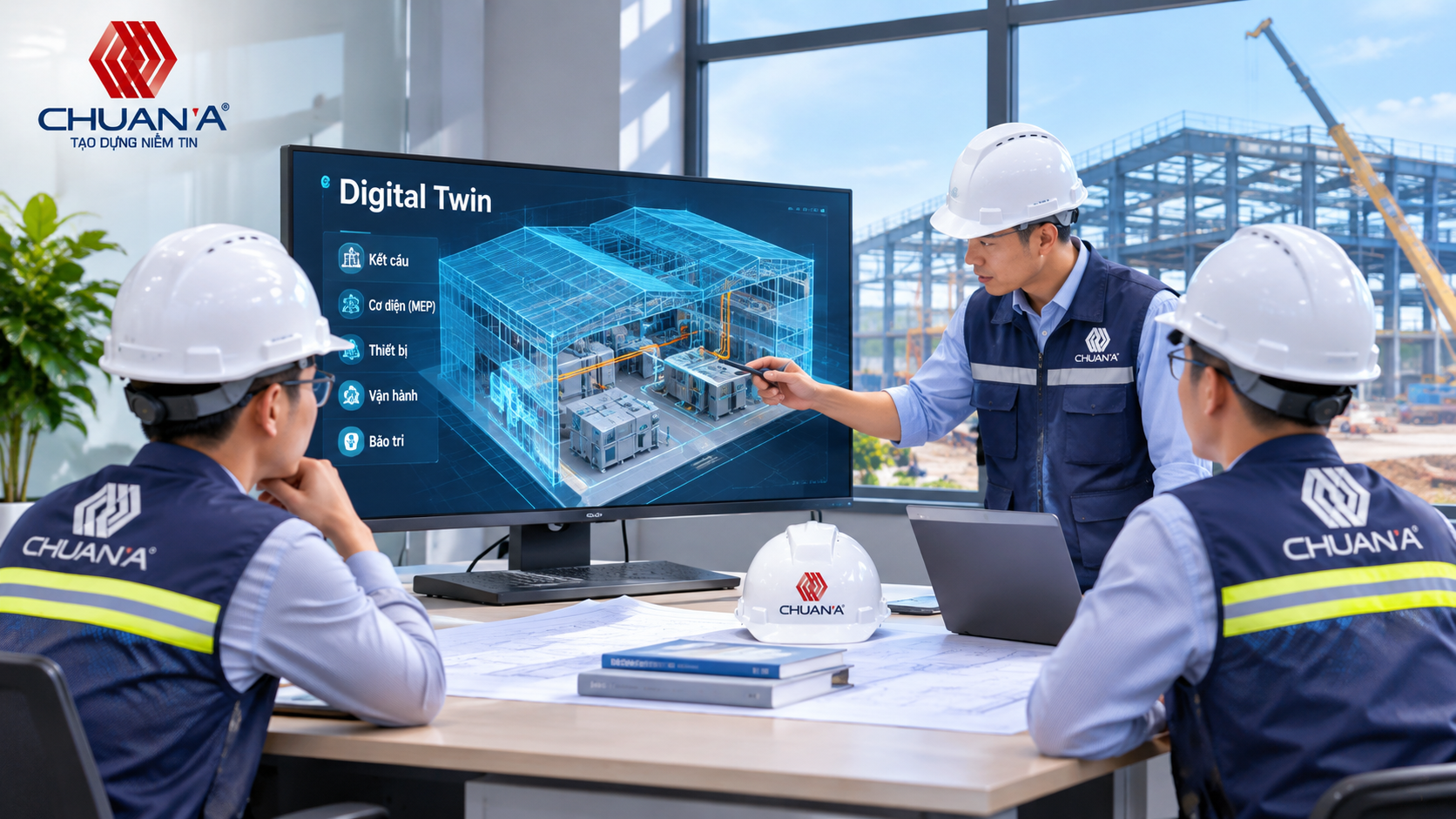
Managing a building does not end when construction is completed. Once a facility becomes operational, owners and facility teams still need to monitor structural conditions, electrical systems, plumbing, HVAC equipment, machinery, and other technical assets. When project information is fragmented or not regularly updated, assessing actual conditions and planning maintenance can become difficult.
A Digital Twin is a digital representation of a physical object, system, or facility. It can combine design information, construction records, sensor readings, and operational data to support monitoring, analysis, and decision-making.
In construction, a Digital Twin can represent and monitor a building, factory, bridge, or infrastructure system. Depending on the project scope, it may cover selected assets or expand to represent multiple aspects of a facility throughout its life cycle.
The key difference between a conventional 3D model and a Digital Twin is its connection to real-world data. A 3D model primarily represents a facility's shape and structure. A Digital Twin can also receive operational data to reflect the condition of the physical asset, according to the system's update frequency and design..png)
A Digital Twin is typically developed by combining a digital model, facility information, sensors, and a data processing platform. These components establish a connection between the physical facility and its digital representation.
For example, a factory may have a digital model containing information about its structure, machinery, electrical systems, and ventilation. When sensors are installed in suitable locations, data such as temperature, humidity, electricity consumption, or equipment operating status can be collected and transmitted to a management platform.
The digital model can then display operational conditions, help identify unusual changes, and provide information for facility managers. A Digital Twin does not automatically guarantee that all data is accurate or updated in real time. Its quality depends on sensor performance, connectivity, data synchronization procedures, and validation processes.
1. Digital Model: A digital representation of a facility or asset. It may be developed using BIM data, technical drawings, site surveys, or other information sources.
2. Sensors and IoT Devices: Collect information from physical equipment and the surrounding environment, such as temperature, vibration, pressure, humidity, flow rates, and operating status.
3. Data Connectivity: Transfers information between physical devices and digital platforms through local networks, the Internet, or suitable communication protocols.
4. Data Storage and Processing Platform: Receives, organizes, stores, and analyzes information. It may use on-premises servers, cloud infrastructure, or a hybrid architecture.
5. Visualization and Analytics Tools: Display facility conditions, charts, alerts, and operational indicators to help managers monitor assets and make informed decisions.
BIM and Digital Twin both use digital models, but their objectives and applications are not exactly the same.
BIM focuses on creating and managing building information, particularly during design, technical coordination, and construction. A BIM model may contain data about components, materials, dimensions, and technical specifications.
In contrast, a Digital Twin aims to connect a digital model with the condition and data of a real-world facility. Operational information can be integrated into the model to monitor performance, assess equipment conditions, and support facility management.
BIM can provide an important information foundation for developing a Digital Twin. However, not every BIM model is a Digital Twin. A useful operational Digital Twin needs real-world data, an update mechanism, and clearly defined objectives.
| Criteria | BIM | Digital Twin |
|---|---|---|
| Main purpose | Model and manage building information | Monitor, analyze, and manage physical assets |
| Data | Design, components, materials, specifications | Design information combined with operational data |
| Real-world connection | Continuous connectivity may not be required | Usually requires data connectivity and updates |
| Project stages | Design, coordination, construction | Can extend into operations and maintenance |
| Main value | Supports design coordination and information management | Supports monitoring and data-driven decisions |
A Digital Twin can combine sensor data to help monitor selected building parameters, such as temperature, humidity, vibration, displacement, and environmental conditions.
For facilities with specific monitoring requirements, sensor readings can help managers identify changes from normal operating conditions. However, structural safety assessments must still follow an appropriate monitoring plan, technical standards, and professional engineering review.
In factories, commercial buildings, and service facilities, Digital Twin technology can help monitor systems such as HVAC equipment, pumps, electrical systems, ventilation, and production machinery.
Facility managers can view equipment locations in a digital model, retrieve technical information, and review data collected by the system. This can support inspections, maintenance assignments, and asset management.
One notable application is combining operational data with analytical methods to identify potential signs of abnormal equipment behavior.
For example, if a machine's temperature or vibration changes significantly compared with its normal operating conditions, the system may generate an alert for technical staff to investigate. With sufficient historical data and suitable analytical models, businesses may develop methods to estimate the risk of equipment failure.
Predictive maintenance does not mean that a system can accurately identify every failure before it occurs. Results depend on data quality, equipment characteristics, analytical methods, and verification by technical personnel.
A Digital Twin can support simulations of selected operating scenarios, such as changing equipment schedules, adjusting temperatures, modifying loads, or evaluating space utilization.
Managers can compare scenarios in a digital environment before considering changes in the physical facility. This provides additional information for evaluating operational decisions instead of relying only on experience or observations at a single point in time.
When connected to electricity meters, sensors, and energy management systems, a Digital Twin can help monitor energy consumption across different areas or equipment groups.
The data may help businesses identify peak consumption periods, compare performance between areas, and evaluate the impact of operational changes. Actual energy savings still depend on equipment, production processes, and the management measures implemented..png)
Improved Facility Visibility: Managers can monitor information and the status of multiple assets through a visual platform instead of manually collecting data from separate sources.
Data-Driven Decision Support: Operational and historical data provide additional evidence for assessing equipment conditions, maintenance schedules, and facility utilization plans.
Better Maintenance Planning: Monitoring asset conditions can help identify unusual behavior and organize inspections more effectively.
Energy Management Support: Consumption and operating data can help identify areas of inefficient energy use and inform potential adjustments.
Improved Coordination Across Teams: When information is organized centrally, engineering, operations, and management teams can work from a shared source of reference data.
Although Digital Twin technology has broad potential, successful implementation requires more than creating a 3D model. Businesses need to prepare the necessary technology, data, and operational processes.
Investment Costs: A system may require sensors, IoT devices, network infrastructure, servers, software, and integration services. Investment levels depend on the monitoring scope and model detail.
Data Quality: Inaccurate, incomplete, or inconsistent data can lead to unreliable analysis. Businesses therefore need procedures for data validation and management.
System Integration: Facilities may use different equipment and software platforms. Connecting these sources requires attention to communication protocols, data formats, and interoperability.
Information Security: When operational devices and systems are connected to networks, businesses should consider access control, data protection, connection monitoring, and cybersecurity incident response.
Workforce Capabilities: Digital Twin projects may require collaboration across construction, MEP engineering, automation, information technology, and facility management. A lack of people who can coordinate these disciplines may reduce implementation effectiveness.
Businesses should begin with a specific management objective and expand the system according to actual requirements.
Step 1: Define the Intended Use. Determine whether the business needs structural monitoring, equipment management, energy tracking, or maintenance support.
Step 2: Assess the Facility and Existing Systems. Collect drawings, available BIM data, equipment lists, technical information, and current operational records.
Step 3: Develop the Digital Model. Define the model scope, level of detail, and the information that needs to be connected to the physical facility.
Step 4: Select Sensors and Connectivity Solutions. Determine installation locations, data types, update frequency, and communication methods.
Step 5: Integrate and Validate Data. Connect the model to storage, processing, and visualization platforms. Check data accuracy and system stability.
Step 6: Operate and Improve. Monitor system performance, refine alerts, update the model, and expand the scope when necessary..png)
Chuẩn A Construction Investment Joint Stock Company operates in civil construction, industrial construction, and infrastructure development. According to the company's introduction, Chuẩn A has more than 15 years of experience and is based at Amata Industrial Park in Dong Nai, Vietnam. Its services include construction, renovation, and building finishing.
As the construction industry continues its digital transformation, Digital Twin technology offers the potential to connect design information with real-world operational data. However, implementation requires coordination across multiple disciplines and must match the requirements of each project.
For businesses planning to build factories, renovate facilities, or upgrade infrastructure, preparing technical documentation, organizing building information, and defining operational requirements at an early stage can create better conditions for adopting modern management technologies in the future.
Chuẩn A is available to discuss construction, renovation, and building finishing requirements with investors, review the project scope, and explore an implementation direction suited to actual site conditions.
CONTACT INFORMATION
CHUẨN A CONSTRUCTION INVESTMENT JOINT STOCK COMPANY
Address: Amata Industrial Park Service Center, Long Binh Ward, Dong Nai Province, Vietnam
Hotline: 0907 494 549
Email: info@chuana.com.vn
Website: https://chuana.com.vn/