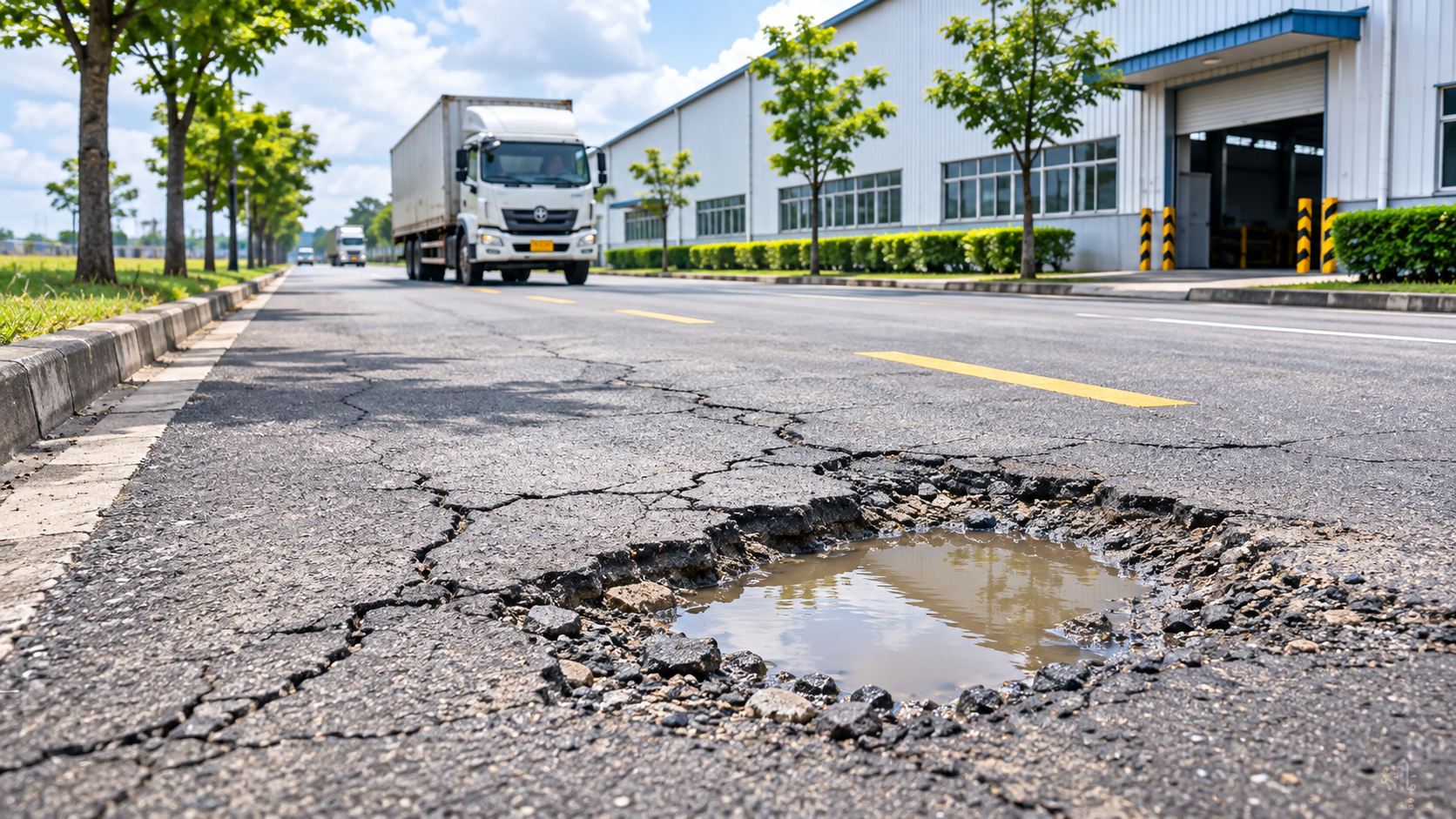
Internal roads in industrial parks support trucks, container vehicles, forklifts, employees, and daily deliveries. Over time, pavement may develop potholes, cracking, ruts, or persistent standing water. These conditions can slow logistics and create safety risks. Before deciding when to repair an internal road, facility managers should examine both visible surface damage and the condition of the pavement structure and drainage beneath it.
.png)
Not every crack means that a road must be rebuilt. However, rapidly developing damage or defects along heavy-vehicle routes should be assessed before they spread.
Potholes make vehicle movements uneven and may damage wheels or cargo, particularly near loading bays and turning points. Raveling or loose aggregate on asphalt surfaces can indicate deterioration or water infiltration. Record the location, affected area, and traffic frequency.
Isolated cracking may reflect temperature changes, shrinkage, or movement. A network of cracks concentrated in wheel paths can indicate repeated loading or weakening support layers. On concrete roads, pay particular attention to slab cracks, broken edges, and damaged joints.
Depressions beneath wheel paths, uneven levels around manholes, and water remaining long after rainfall are warning signs. If settlement continues or earlier patches fail quickly, placing another surface layer may not address the underlying problem.
Production expansion may increase truck movements beyond the operating assumptions used in the original design. Braking, acceleration, turning, and repeated loading at warehouse entrances can concentrate stress. Inspectors should compare actual vehicle types and usage patterns with the road's intended function.
Water entering through cracks, pavement edges, or damaged drainage can weaken the base and supporting soil. Potholes, settlement, and cracking may reappear if moisture sources remain. Road assessment should therefore include drains, inspection chambers, and surface elevations.
Trenches dug for cables or pipes can settle if reinstatement is inadequate. Material selection, compaction, construction methods, and curing conditions also influence service life. Reviewing construction records and earlier repairs helps distinguish surface damage from deeper defects.
Urgent inspection and traffic protection are appropriate when potholes, broken concrete slabs, or uneven levels could destabilize vehicles, create trip hazards, damage cargo, or become hidden by floodwater. Entrances, bends, emergency vehicle access routes, and forklift crossings deserve special attention.
No single pothole diameter or crack width applies to every industrial road. Priority depends on the pavement type, traffic, location, defect progression, and site-specific safety requirements.
Prepare a route map and mark damaged locations before requesting quotations. Take photographs with an object for scale, record how long the defects have existed, note changes after heavy rain, and identify where large vehicles brake or turn. Asphalt and concrete pavements require different inspection approaches.
Where deep instability is suspected, specialists may need to investigate the base, subgrade, or other pavement layers. Surface cracking alone does not prove that the asphalt layer is the sole cause.
When damage is limited and the supporting layers remain sound, localized removal, preparation, suitable patching materials, or crack treatment may be appropriate. Repair details must match the pavement and traffic conditions. Simply pouring material into a pothole without preparing the base can result in early failure.
Interconnected cracks accompanied by rutting, pumping of water and fine material, or repeatedly failing patches may indicate weakness below the surface. Work could involve removing damaged layers, stabilizing support material, and rebuilding the affected pavement to an engineered design. An overlay alone cannot reliably correct a failed base.
Concrete roads may require edge repairs, joint restoration, partial-depth patching, or replacement of severely damaged slabs. The appropriate intervention depends on crack location, differential movement, and load transfer between slabs. Asphalt patching is not a universal solution for concrete pavement defects.
Where roadside water accumulates or pavement edges erode, the drainage slope, channels, inspection chambers, and discharge points should also be reviewed. Coordinating pavement and drainage work can reduce the risk of reopening a recently repaired road to fix buried pipes.

Where possible, divide the work into stages to preserve access for deliveries and employees. Agree on work zones, temporary truck routes, pedestrian barriers, warning signs, material deliveries, and protection of underground utilities. Emergency access and evacuation routes must not be obstructed without an approved alternative arrangement.
Opening times must follow the selected materials, installation procedures, curing requirements, and technical acceptance criteria. There is no universal reopening time for all pavement repairs. Before handover, check surface levels, smoothness, drainage, and the agreed inspection records.
Facility managers should inspect pavements around the rainy season, after major changes in loading, and following utility excavation. Photographs taken from consistent positions can reveal whether cracks, rutting, or water accumulation are progressing.
For related project information, see Chuan A's industrial park infrastructure construction solutions and its internal road works described in a parking facility project.
Chuan A lists industrial park infrastructure construction, including internal roads, site preparation, and drainage systems, among its service areas. Businesses can share road drawings, damage locations, vehicle operating conditions, and access requirements when discussing a survey, repair, or upgrade. The actual scope, materials, and schedule should be confirmed following an on-site assessment.
Learn more about Chuan A's construction service areas.
CÔNG TY CP ĐẦU TƯ XÂY DỰNG CÔNG TRÌNH CHUẨN A
Address: Trung tâm dịch vụ KCN Amata, phường Long Bình, tỉnh Đồng Nai, Việt Nam.
Hotline: 0907 494 549
Email: info@chuana.com.vn
Website:https://chuana.com.vn/
Contact Chuan A to discuss the inspection, repair, maintenance, or upgrading of internal factory and industrial park roads in Dong Nai, Vietnam.