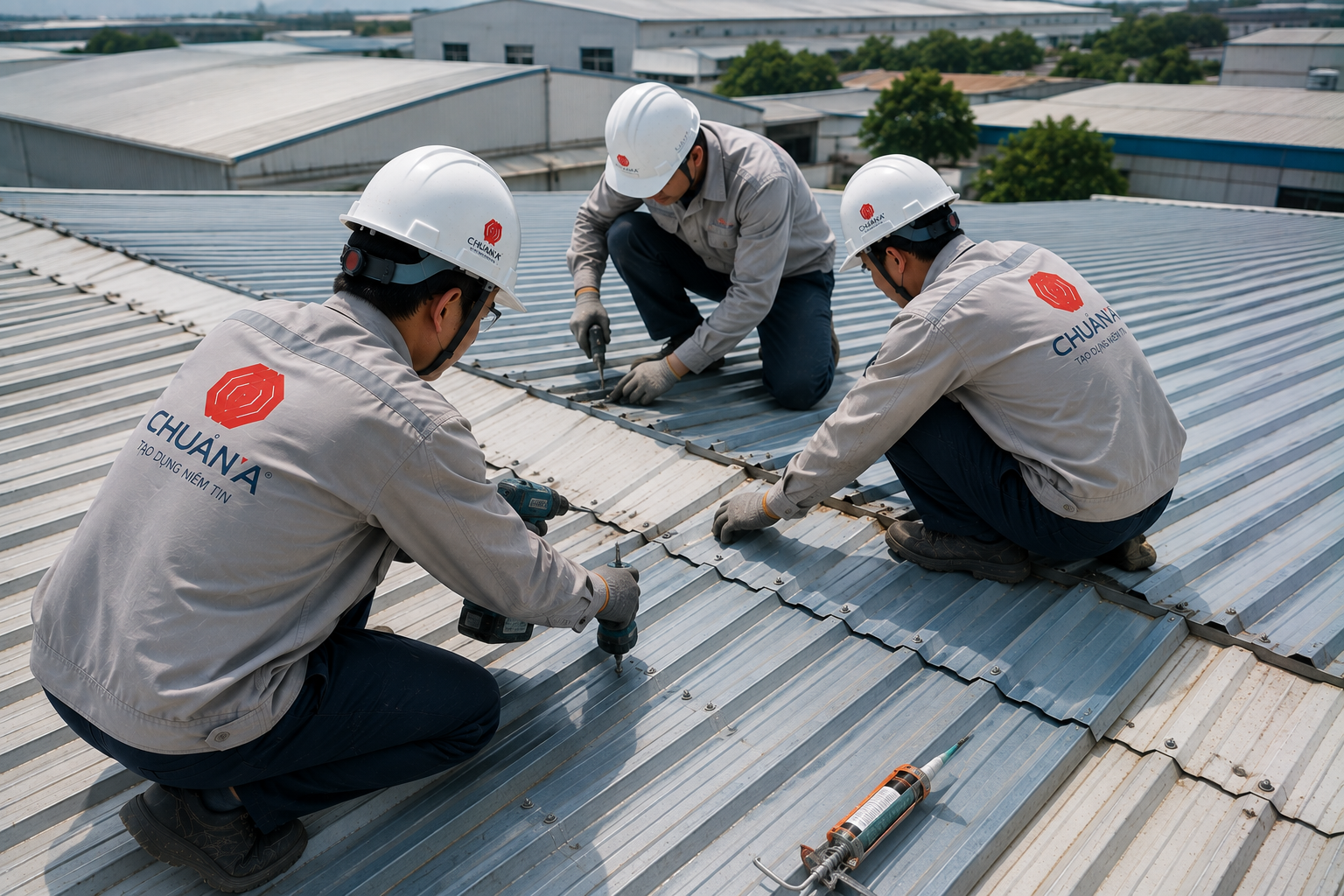
Factory metal roofing is exposed to changing weather, industrial dust, moisture, thermal movement and long-term mechanical stress. Without a structured maintenance process, minor defects may remain unnoticed until they become leaks or widespread corrosion.
A systematic factory metal roof maintenance program helps businesses identify roof conditions, prioritize corrective work and maintain useful records for future inspections.
The process should begin with a visual inspection of the entire roofing system.
Technicians should examine sheets, fasteners, seams, gutters, penetrations, ventilation equipment and previously repaired locations.
Large roofs should be divided into zones so that defects can be mapped accurately.
Not every defect requires the same response.
Roof areas can be classified as serviceable, monitor, repair soon, urgent repair or replacement candidate.
This classification makes maintenance planning more efficient and helps prioritize resources.
Leaves, industrial debris and accumulated dirt can hold moisture and restrict drainage.
Cleaning improves visibility during inspection and reduces the chance of standing water.
Gutters and drainage outlets should be cleared as part of normal metal roof servicing.(13).png)
Roof fasteners should be checked for looseness, corrosion and damaged washers.
The metal surrounding fastener holes also needs inspection because replacing a screw may not solve the problem if the sheet has deteriorated.
Roof overlaps, wall connections and sealed penetrations are common maintenance areas.
Sealants can become brittle, crack or separate after prolonged exposure to heat and ultraviolet radiation.
Maintenance should identify the reason for deterioration before new sealing material is applied.(13).png)
Corrosion should be documented by location and severity.
Surface oxidation may be manageable through localized treatment, while extensive thinning or perforation may require replacement.
Tracking corrosion over multiple inspections helps maintenance teams identify areas deteriorating faster than expected.
Typical leak-prone locations include fasteners, seams, roof penetrations, skylights, wall interfaces and gutters.
If leakage has already appeared inside the factory, the source should be traced rather than assuming the visible drip directly identifies the defect.
Metal roof repair is appropriate for limited defects.
Examples include damaged fasteners, local sealant failure, isolated corrosion or small sheet damage.
Each repair should be documented for future follow-up.(11).png)
Some sections may be too deteriorated for economical repair.
Severely corroded, perforated or heavily deformed sheets should be assessed for replacement.
Suitable factory roofing sheet selection should consider thickness, coatings, corrosion resistance and operating environment.
Maintenance should end with a final inspection.
Completed work should be photographed and recorded, and a recommended date for the next inspection should be established.
This creates continuity between maintenance cycles.
A complete factory metal roof maintenance process should move from inspection and classification to cleaning, fastener checks, corrosion assessment, leak prevention, repair, replacement and final documentation.
Following a structured process helps businesses maintain better visibility into roof condition and reduces reliance on emergency repairs.
Timely maintenance helps businesses monitor building conditions, reduce leakage risks and extend the service life of metal roofing.
CHUAN A CONSTRUCTION INVESTMENT CORPORATION
Address: Amata Industrial Park Service Center, Long Binh Ward, Dong Nai Province, Vietnam.
Hotline: 0907 494 549
Email: info@chuana.com.vn
Website:https://chuana.com.vn/
Contact Chuan A to discuss factory metal roof inspection, maintenance, repair or replacement requirements in Dong Nai.


