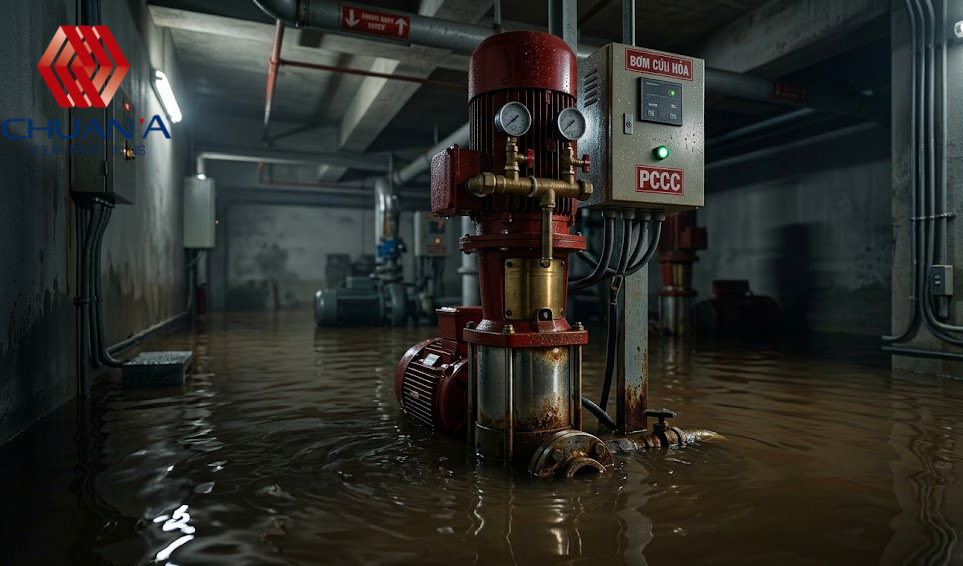
Flooded fire pump or damp control panel? Check out this expert 6-step emergency response guide to salvage equipment, prevent short circuits, and maintain your fire protection system properly.
In the infrastructure of any building, factory, or industrial park, the fire pump system is regarded as the "heart" of the safety network. However, because they are typically installed in basements, underground technical rooms, or low-lying positions to optimize suction pressure, fire pumps and their control panels are often the first victims of urban flooding, high tides, or internal pipe bursts.
When water infiltrates an electric motor or causes mold in an electronic control panel, the damage goes far beyond destroying equipment worth tens of thousands of dollars. More dangerously, it completely paralyzes the emergency response capability during a fire incident, turning the entire facility into a fire trap with no functional active suppression. This article provides building managers and operating engineers with a comprehensive, professional manual to handle this crisis effectively.
Before diving into solutions, we must clearly identify the root causes to establish robust preventive measures:
Natural Disasters and Urban Flooding: Heavy rainfall exceeding the city's drainage capacity leads to water cascading into building basements.
Technical Pipeline Failures: Leaks or bursts in domestic water supply lines or the fire protection pipelines themselves within the pump room.
Sump Pump Failures: Pump rooms are equipped with sumps and submersible pumps, but power outages or pump failures cause the room to fill rapidly.
High Ambient Humidity: Severe humidity spells (common in tropical regions) cause moisture to condense on the surface of electrical components, leading to mold growth and rusted contact points.
When discovering a flooded pump room, panic can lead to fatal electrical accidents. Strictly adhere to the following 6-step protocol:
Never step into the flooded area unless you are absolutely certain that the power supply to the pump room has been completely cut off at the Main Switchboard (MSB) outside. Water is an excellent conductor; a minor leak from the control panel can cause fatal electrocution.
Deploy backup submersible pumps (powered by generators or independent power sources) or call in vacuum trucks to clear the water. Once drained, remove mud, debris, and silt clinging to the pump body and motor.
For Diesel Engine Fire Pumps: Check whether water has entered the air filter, oil tank, or starter motor. Never attempt to crank the engine at this point, as it could cause hydrostatic lock (hydrolock), cracking the engine block.
For Electric Motor Pumps: Remove the cooling fan shroud and open the terminal box to inspect whether water has penetrated the stator windings.
Do not rely solely on standard hair dryers, as they cannot provide deep, sustained heat. Professional engineers utilize these methods:
Radiant Heat/Halogen Lamps: Position high-output heat lamps around the windings (ensuring proper shielding to prevent fire hazards).
Industrial Oven Baking: If the rotor and stator can be disassembled, transport them to an electromechanical workshop to bake in a temperature-controlled oven at $80^\circ\text{C}$ to $100^\circ\text{C}$ for 12 to 24 hours.
Low Voltage Heating: Apply a low-voltage AC current directly into the windings so that the internal resistance generates heat, drying the motor from the inside out.
This is a mandatory compliance step before re-energizing the system. Use a Megohmmeter:
Measure between phases and between each phase to the ground (frame).
Standard: The insulation resistance must be at least $1\text{ M}\Omega$ per kV of rated voltage (e.g., for a 380V motor, resistance must be $> 0.38\text{ M}\Omega$, though achieving over $5\text{ M}\Omega$ at room temperature is highly recommended for ultimate safety).
Flooding destroys the grease within the bearings, causing corrosion and seizing upon restarting. Disassemble the bearings, wash them with gasoline or kerosene, dry thoroughly, and pack them with new water-resistant grease, or replace them entirely if pitting is visible.
The control panel serves as the "brain," housing PLC modules, time relays, contactors, and sensitive circuit boards. Moisture causes nuisance circuit breaker tripping or, worse, completely stops the pump from activating during a pipe pressure drop.
Chemical Contact Cleaning: Use a dedicated electronic cleaner spray (such as CRC 2-26 or equivalent contact cleaners) to eliminate mold and oxidation from component pins. Never use water or standard rubbing alcohol with high water content.
Controlled Circuit Board Drying: Use a heat gun or dryer adjusted strictly below $60^\circ\text{C}$ to evenly dry the PCB. Excessive heat can damage semiconductors or melt solder joints.
Terminal Retightening: Moisture increases contact resistance at terminal blocks, generating extreme heat when current flows. Tighten all terminal screws firmly.
Component Replacement: Contactors exposed to water usually suffer from compromised suction coils. If continuity tests reveal a short or open circuit in the coil, replace the unit immediately.
To prevent your business from incurring major financial losses in the future, implement these enterprise-grade design and operational frameworks:
Install Anti-Condensation Heaters: Always integrate a small space heater inside both the electrical enclosure and the motor housing. These heaters run continuously when the pump is idle, keeping the internal temperature $3^\circ\text{C}$ to $5^\circ\text{C}$ above ambient temperature to completely stop condensation.
Elevated Pump Inertia Bases: When designing the pump room, ensure the concrete plinths for the pumps are elevated at least 20cm to 30cm above the finished floor level to provide a safety buffer against minor flooding.
Deploy High IP-Rated Enclosures: Fire control panels should carry at least an IP54 rating (dust and splash-proof) or IP65 if placed in high-risk zones.
Establish a Rigid Periodic Maintenance Protocol: Test-run the fire pumps weekly (15 minutes for electric pumps, 30 minutes for diesel pumps). Regular operation is the most natural and effective way to self-dry the motor through internal heat generation.
CHUAN'A CONSTRUCTION INVESTMENT JOINT STOCK COMPANY