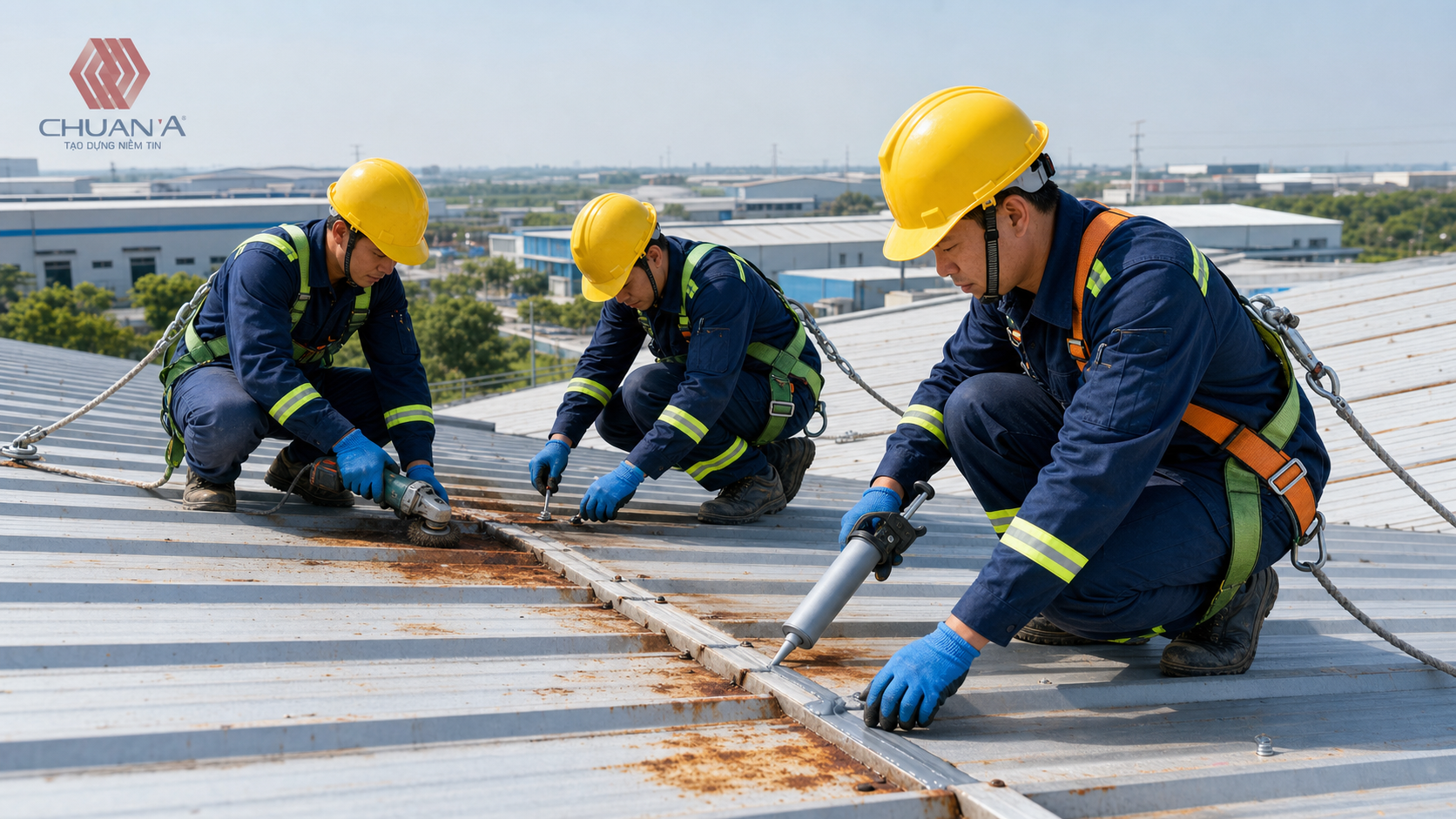
Leaks and corrosion often appear together on factory metal roofs that have been in service for many years. When the zinc coating and paint layer deteriorate, the sheet begins to corrode at the surface, the corrosion then progresses through the material and small perforations form. Rainwater entering through these points accelerates the process further.
Maintenance for leaking and corroded factory roofs in Dong Nai therefore involves more than sealing the visible water entry point. The situation should be assessed according to the corrosion level, the remaining sheet thickness and the load-bearing condition of the roof, which determines whether rust treatment, local repair or sectional replacement is appropriate.
Chuan A inspects the corrosion condition, evaluates the extent of damage and proposes a suitable solution for factory roofs in Dong Nai and nearby areas.
.png)
Industrial roofing sheets normally have a zinc or aluminium-zinc alloy coating together with an outer paint layer. These layers protect the steel base from water and air. Once the protection is broken, the exposed steel begins to corrode.
Common reasons for coating deterioration include:
Corrosion does not always begin on the upper surface. In many cases sheets corrode from below because of condensation or rising chemical vapour, so the damage is only discovered once the roof has already been perforated.
.png)
Corrosion gradually reduces the thickness and strength of the sheet. Once it penetrates the steel base, small holes appear and rainwater begins to enter. In many cases the water does not drip directly beneath the hole but travels along the sheet profile or purlins before falling inside the factory.
The process usually accelerates over time:
Treating the roof at the surface-rust stage is therefore considerably simpler and less costly than dealing with widespread perforation.
| Level | Indicators | Treatment direction |
|---|---|---|
| Surface rust | Faded and chalking paint with small rust spots, sheet thickness still intact. | Surface cleaning, spot treatment and restoration of the protective coating. |
| Spreading corrosion | Rust across patches, rough surface and paint peeling in several areas. | Mechanical cleaning, thickness assessment, anti-rust primer and finish coating. |
| Deep corrosion | Noticeably thinner sheets, weak response when tapped, scattered small holes. | Local patching where the sheet remains serviceable and replacement of badly damaged panels. |
| Perforation and loss of rigidity | Multiple holes, degraded or deformed sheets that cannot support foot traffic. | Sectional replacement, with parallel inspection of purlins and connection details. |
Before selecting a method, the extent and depth of corrosion must be determined. The inspection normally covers:
Inspecting the supporting structure should not be skipped. Prolonged water penetration can corrode purlins and connection plates, and this area is not easily observed from the roof surface.
Damaged sections are mapped by roof bay together with an assessment of corrosion level and repair priority.
Rust, loose paint, dust and contaminants are removed so the new coating can adhere properly. The surface must be dry before protective layers are applied.
Small holes are patched using a method suitable for the roofing material. Sheets that no longer retain sufficient strength are replaced rather than patched again.
Primer and finish coats are applied following the required number of layers and drying intervals for the prevailing weather conditions.
Corroded screws and aged washers in the area are replaced, and drainage performance is checked to prevent water from collecting again.
The treated area is rechecked for sealing performance and drainage. The business receives information on completed items and the locations to monitor.
Rust treatment and coating restoration are suitable when:
Sectional replacement is usually more appropriate when:
In many projects the practical solution is a combination: replacing sheets in severely damaged sections while applying corrosion protection to the remaining roof to extend its overall service life.
Chuan A Construction Investment Corporation provides industrial construction and facility maintenance solutions in Dong Nai and nearby areas.
Businesses may also review factory metal roof leak repair for other leak causes and professional factory roof maintenance services for the working process and contractor assessment criteria.
Chuan A handles leaking and corroded factory roof requests in Dong Nai, Bien Hoa, Long Thanh, Trang Bom, Nhon Trach and nearby areas. Businesses in Binh Duong and Ho Chi Minh City may contact the company to discuss the project location, size and required scope of work.
Not necessarily. If the sheets retain sufficient thickness and rigidity, cleaning and coating restoration remains a viable option. Replacement is generally considered when corrosion has penetrated deeply or spread widely.
Protective coatings shield the surface but cannot replace lost material. Perforated locations should be patched or the sheets replaced before coatings are applied.
This is usually caused by condensation from temperature differences, chemical vapour generated during production or inadequate ventilation, all of which allow moisture to accumulate beneath the sheets.
Many tasks can be carried out during operation if covering, zoning and dust control are arranged appropriately. Large-scale sheet replacement is normally scheduled around the production timetable.
An inspection before each rainy season and after unusual weather is advisable. Facilities near the coast or exposed to chemical vapour require more frequent checks.
Prolonged water penetration can affect purlins, connection plates and fixings below. Supporting steelwork in leak-affected areas should therefore be inspected during roof repair work.
When a roof shows corrosion together with signs of water penetration, an early inspection helps determine the corrosion level and select a suitable solution before the damage spreads.
CHUAN A CONSTRUCTION INVESTMENT CORPORATION
Contact Chuan A for inspection and treatment of leaking and corroded factory metal roofs in Dong Nai.