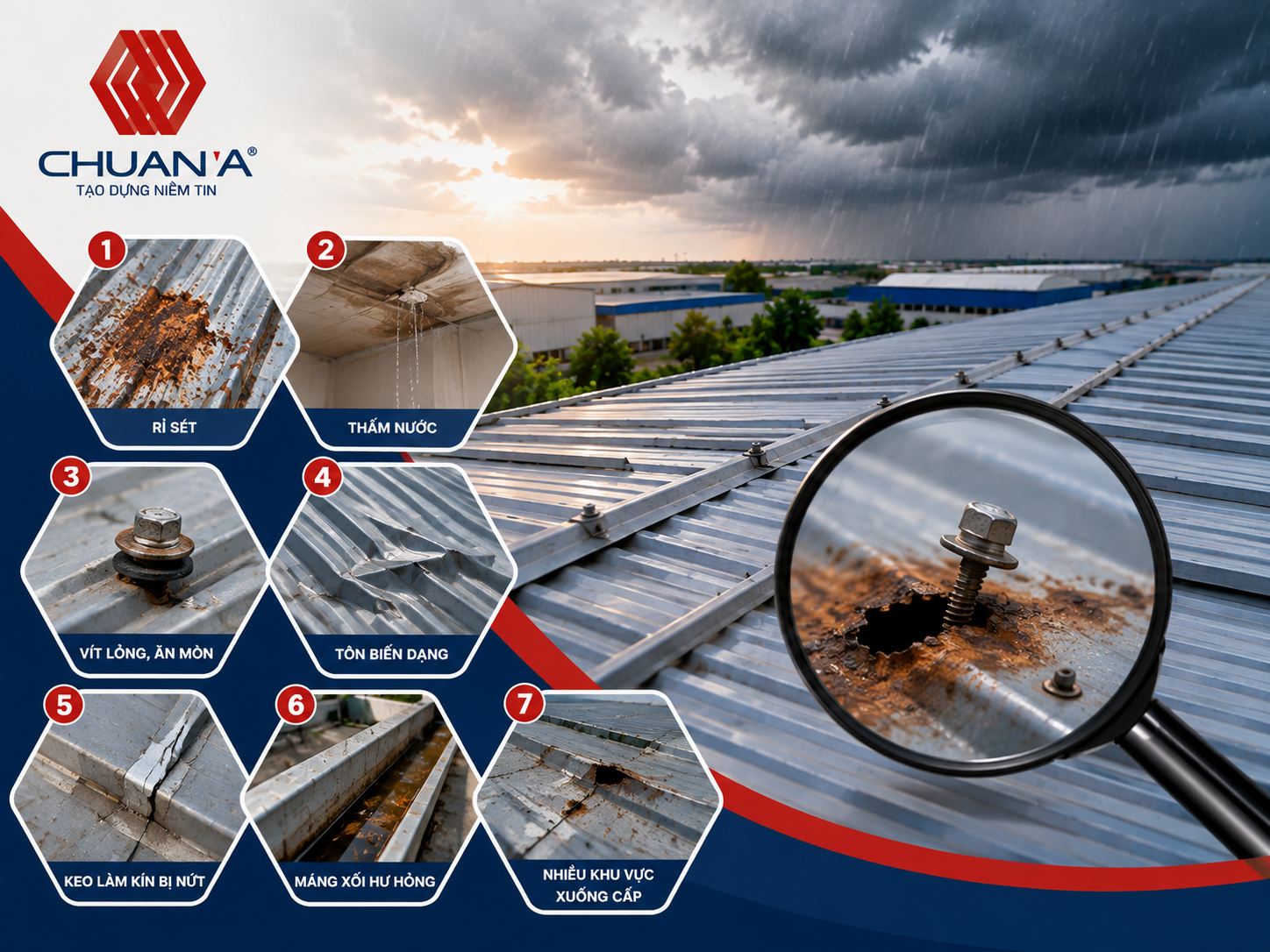
Factory roofing can deteriorate gradually without creating an immediate visible problem inside the building. By the time water reaches production areas, the original roof defect may have existed for months.
Recognizing early warning signs allows facility managers to schedule factory metal roof maintenance before deterioration becomes more extensive.
Corrosion commonly develops near sheet edges, fasteners, scratches and locations exposed to standing water.
Early corrosion may appear minor, but continued exposure to moisture can expand the affected area.
Maintenance teams should evaluate both the visible corrosion and the remaining condition of the metal.
Water marks on walls, ceilings or structural members should be investigated.
The visible water location inside the factory may not correspond directly with the point of entry because water can travel along roofing or structural components.
Effective metal roof leak prevention therefore requires tracing the actual source.
Fasteners maintain the connection between roof sheets and the supporting structure.
Loose screws, damaged washers or corrosion around fastener holes can increase leakage risk.
The surrounding metal should also be checked because replacing a screw alone may not solve a problem if the sheet itself has deteriorated.(5).png)
Mechanical impact, equipment installation, strong winds and maintenance traffic can damage roofing sheets.
Depressions can retain water, while damaged coatings may expose metal to corrosion.
Localized deformation may be repairable, but severely damaged sheets should be evaluated for replacement.
Sealants around seams and penetrations are exposed to temperature changes and ultraviolet radiation.
As they age, they may become brittle or separate from the surface.
Routine inspection should therefore include sealing materials rather than focusing only on metal sheets.(6).png)
Drainage systems are part of the roof's overall performance.
Debris can restrict water flow, while continuous moisture exposure can contribute to gutter corrosion.
A complete maintenance program should inspect gutters, outlets and drainage connections.
A single loose fastener is usually a localized maintenance issue. Multiple leaks, widespread corrosion and numerous damaged sheets may indicate broader roof deterioration.
At this point, businesses should consider a complete condition assessment and determine whether phased factory roof replacement is more appropriate than repeated local repairs.(5).png)
The answer depends on the extent and severity of deterioration.
Localized defects can often be corrected through metal roof repair. Widespread thinning, perforation or repeated leakage may justify replacing affected sections.
When new roofing is required, material selection should consider coatings, thickness, corrosion resistance and the industrial environment.
Corrosion, water stains, loose fasteners, damaged sheets, cracked sealants, drainage problems and widespread defects are all useful warning signs.
Identifying them early gives businesses more time to plan maintenance and reduce the risk of emergency work.
Timely maintenance helps businesses monitor building conditions, reduce leakage risks and extend the service life of metal roofing. When signs of deterioration are identified, an early inspection can help determine an appropriate repair or replacement strategy.
CHUAN A CONSTRUCTION INVESTMENT CORPORATION
Address: Amata Industrial Park Service Center, Long Binh Ward, Dong Nai Province, Vietnam.
Hotline: 0907 494 549
Email: info@chuana.com.vn
Website:https://chuana.com.vn/
Contact Chuan A to discuss factory metal roof inspection, maintenance, repair or replacement requirements in Dong Nai.


